To remind you where I am as I am writing this, here is a picture of one of the most famous of London’s structures – the Tower Bridge. My hotel is immediately adjacent to this bridge.

I last spent time in London about 30 years ago, when I came several times to negotiate for Reinsurance with Lloyds of London for a malpractice insurance company that I helped nonprofit community clinics in California set up. At that time, Lloyds’ building was new, and thought to be very controversial, and because all of its plumbing, heating, and air conditioning pipes were on the outside of the building, it was known as “Lloyds Loo”.

I got to London a day before most of the other people traveling on this trip to England, Scotland, and Wales, and desperately needed to stay awake until the normal going-to-bed time (after a 10 hour flight from SFO that landed at Heathrow at about 6AM on which I got about 4 hours of sleep). So I took my camera and started out to explore the area between the Thames (and the Tower Bridge and the Tower of London) on the south and Lloyds on the north. An area of 2800 sq. Meters, which I think is about 1 square mile (although I’m not sure that this calculation is correct).
I was looking for new buildings and how they fit into the landscape. I was astounded at what I saw! London has obviously undergone a serious building boom. My hotel was in the neighborhood of the Tower of London, whose White Tower, was, for a long time, the tallest building in London. Here’s a picture of the Tower with the current tallest building, known as the “Shard” behind it.

To understand truly why it’s called the “Shard” look at the detail photo below.

Yes, the building IS finished! The Architect, Renzo Piano, designed it that way. (He is also known for designing, amongst other things, the Centre Pompidou in Paris.)
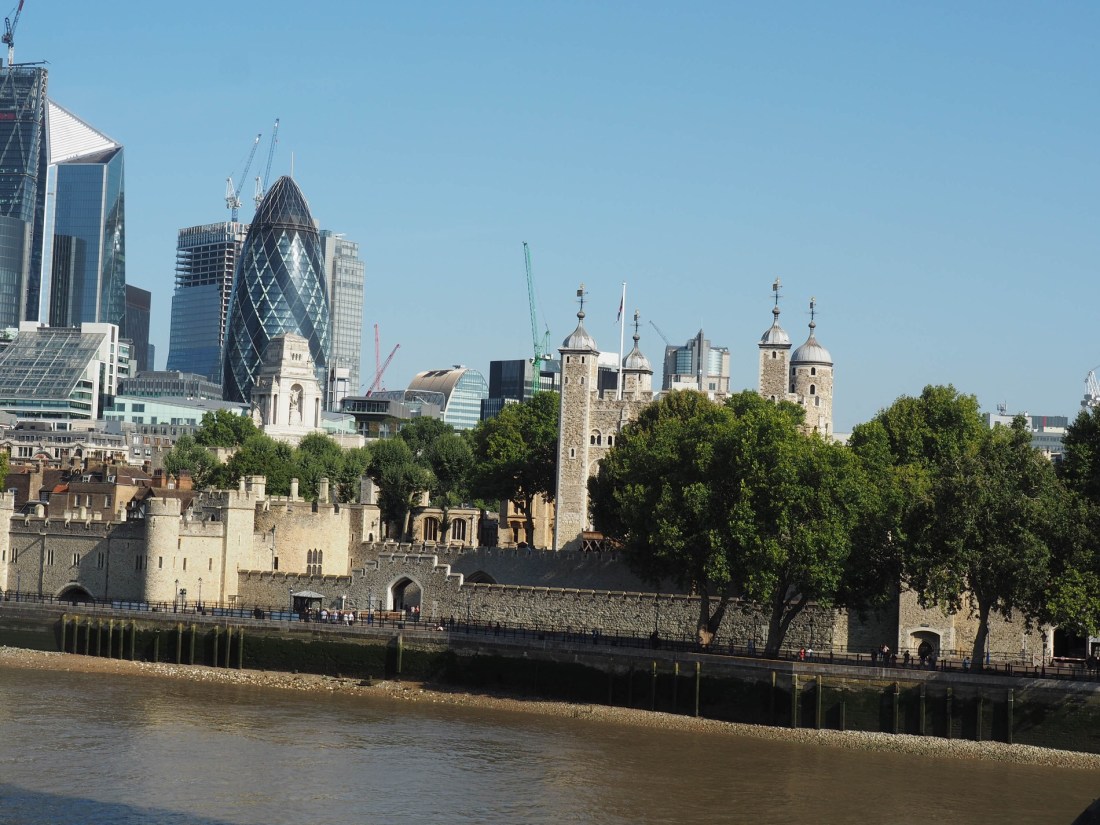
I walked across Tower Bridge to take a picture back looking towards the Tower (with my back to the Shard, as it were). This immediately told me that the face of the City of London had changed radically. (The City of London is the name of the area that was originally settled in London, and it is now the home of most of the banking and insurance businesses). That’s the White Tower of the Tower of London just behind the trees, the “Gherkin” to its left, and the “Scalpel” further back to the left.
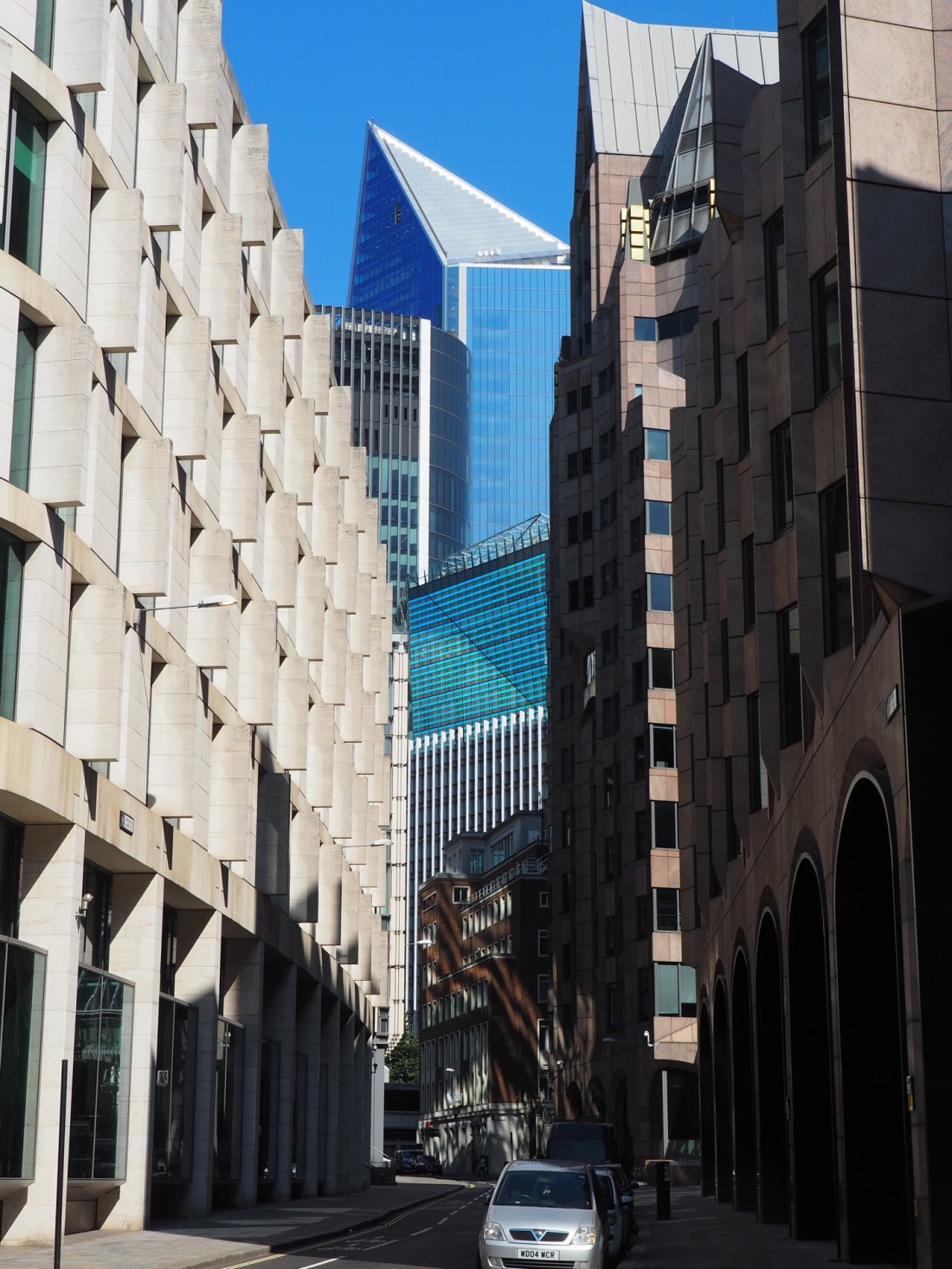
What interested me the most was the juxtaposition of the new buildings with the old, for example, the reflection on the lower brown building in the background from the glass of an unseen building around the corner.
And in the juxtaposition of the new buildings with other ‘new’ buildings. That’s a part of “Lloyd’s Loo” on the left, with the Willis building (not nicknamed – that’s the name of the primary tenant) immediately opposite it, the “Gherkin” in the middle, and the not yet completed “Scalpel” to the right.
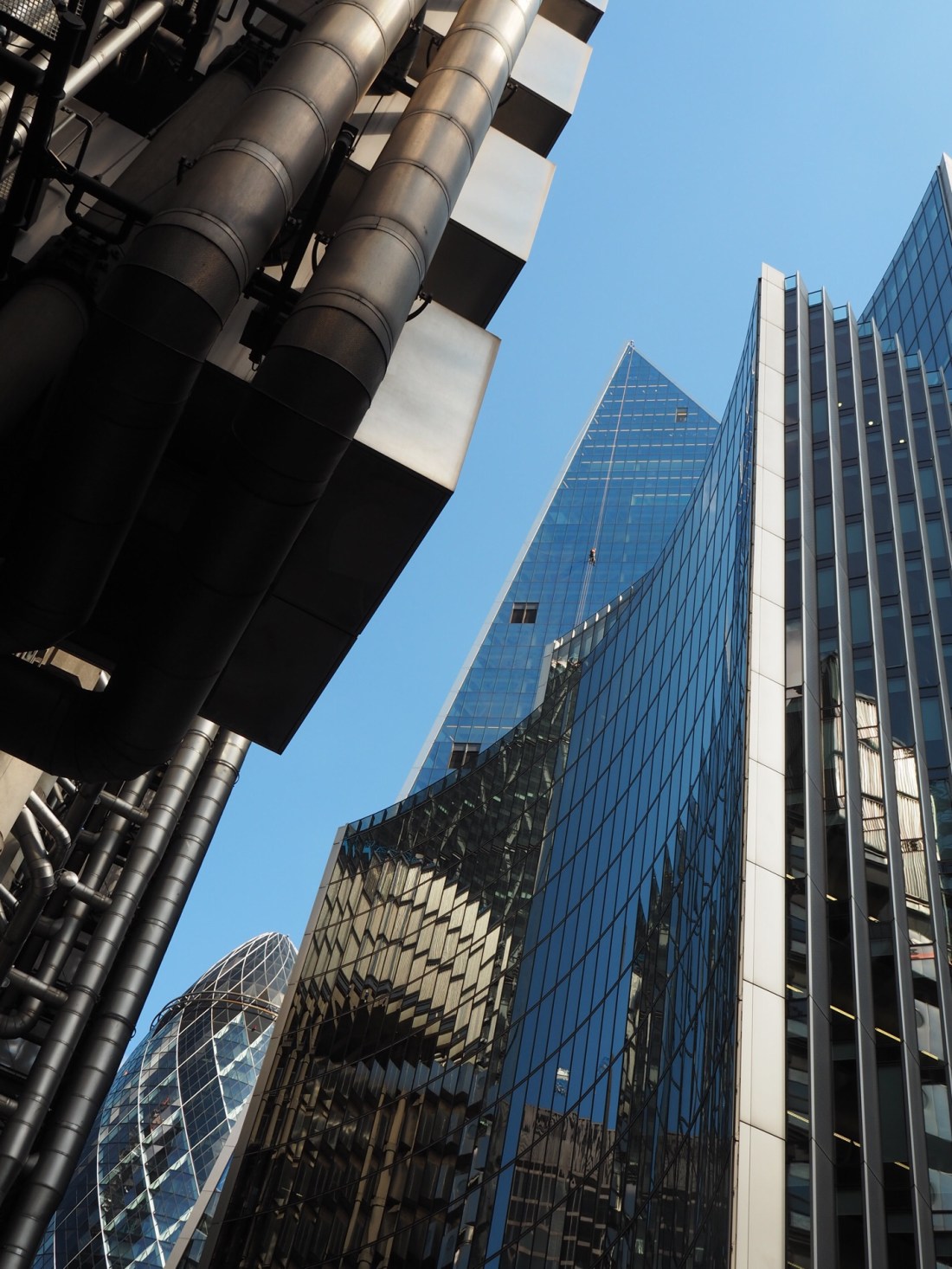
And did your notice the man rappelling down the side of the “Scalpel” in the photo above?

He casually dropped down to just above street level, seemed to talk briefly to co-workers who were on a scissor lift installing panels under the fascia, dropped his ropes, and then disappeared behind the wall surrounding the construction site….

I wonder if the architect of the “Gherkin” was inspired by the shape of the spires on the church next door?

And whether the architects of the various buildings have ever come to look at the overall effect that their buildings make when viewed together?

Mary
Written in London,
Uploaded from Caernarfon, Wales 9/7/18

 Mary's Travel Blog