A “henge” is defined as a circular ditch, normally with a bank on the inside of it. Stonehenge as we know it now was originally just a circular ditch, although the bank is on the OUTSIDE of it. The original ditch was cut into the chalk at about 3000 BCE, but it is thought that erecting the famous stones did not begin until about 2500 BCE. The whole area on the Salisbury plane must have been important to the Neolithic people, because it is dotted with burial mounds, but what is more amazing is that Mesolithic postholes have been found around the outside of the existing stones, showing that large timber posts about 30” in diameter had been placed there between 8500 and 7000 BCE.
The original circular ditch when it was cut (using picks made out of antler, some of which were found in the ditch) must have been dazzling, because it was cut into the white chalk. And although the current site is covered with carefully mown grass, the effect of the monument is still pretty dazzling. You can walk across the plane, approaching as the early humans would, or travel by shuttle bus from the visitor center, and then travel on foot to the monument itself – being greeted not by the priests who may have greeted ancient visitors, but by sheep who apparently do their bit to mow the grass.

And over the heads of the sheep, Stonehenge makes itself known:

Because the site is actually very fragile – and prone to vandalism (many early visitors carved off chunks to take with them, or left their initials) the ordinary visitor is not allowed inside the circle, except in small groups in the early morning or late afternoon – or at the summer solstice. But actually, this may be to the good, because there is a knee high fence that keeps visitors away from the monument and actually has the added benefit of making it possible to take pictures WITHOUT anyone blocking your way. You can pretend that you are a Neolithic visitor come to celebrate the solstice as you circle the structure.

You come very close to the “heel” stone so you can actually see its surface and how it relates to the circle.

As you walk, you get different views of the stones and their arrangement seems to shift like a kaleidoscope, with stones appearing and disappearing from view, and seeming to change places with each other.
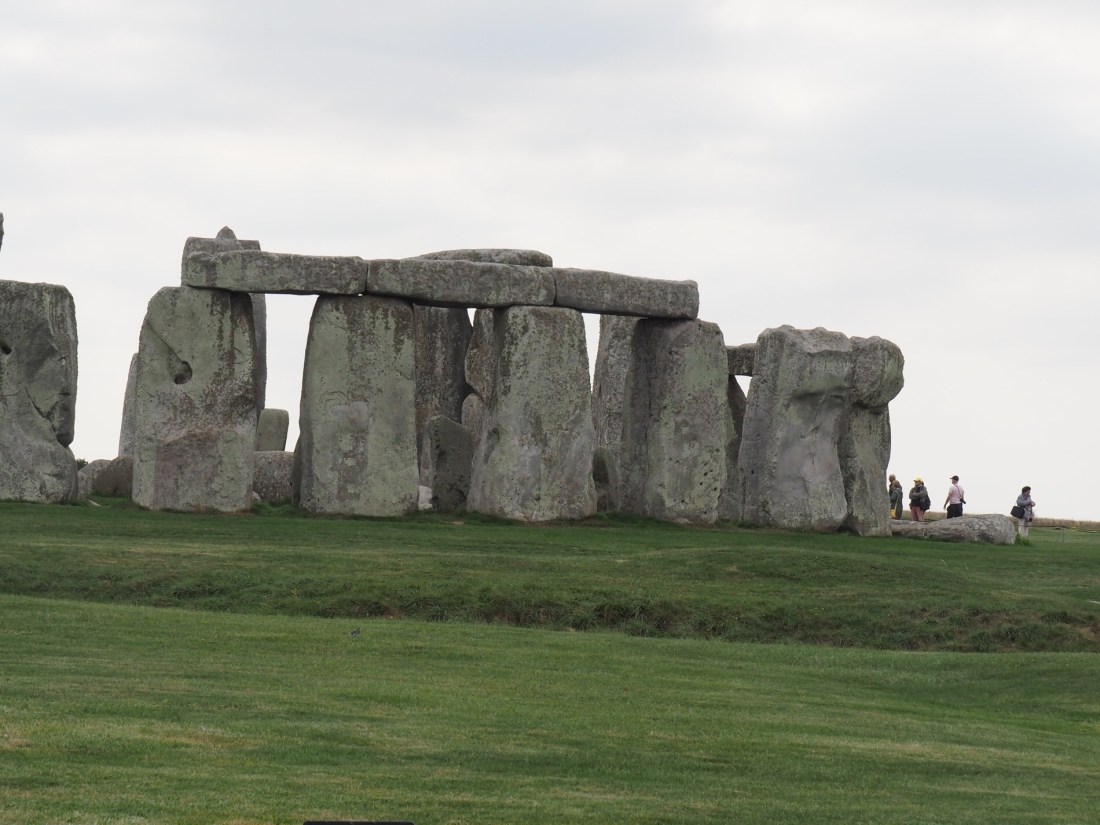
Having a long lens allows you to look more closely at the stones, and you see that some seem to have ‘faces’ – although whether they were worked into the stone or just a natural phenomenon is unclear.

What is clear, however, is that many of the larger stones, made of sarsens (an extremely hard sandstone) have been worked to shape them. These stones must have come from the Marlborough Downs about 19 miles north of Stonehenge.
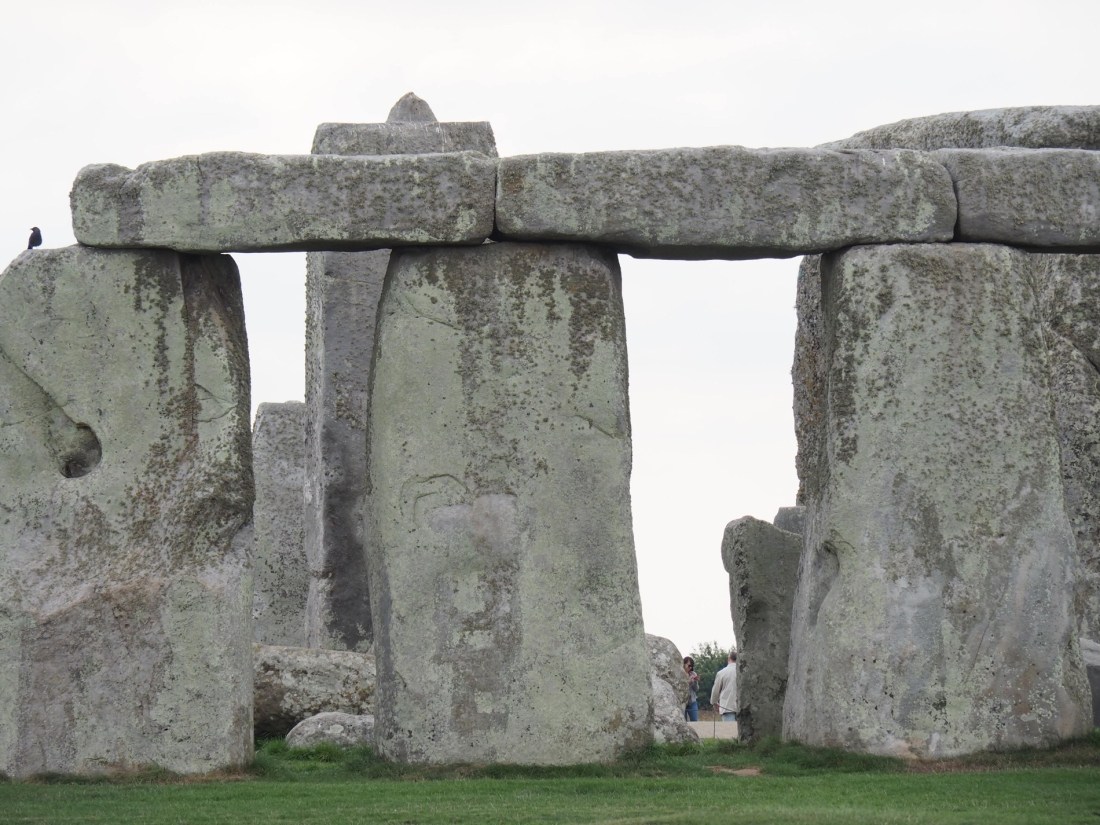
Here, the stones are aligned in such a way that they seem to be touching each other, although in this shot there are actually stones behind each other – an optical illusion makes you think that they are a solid row of rock.
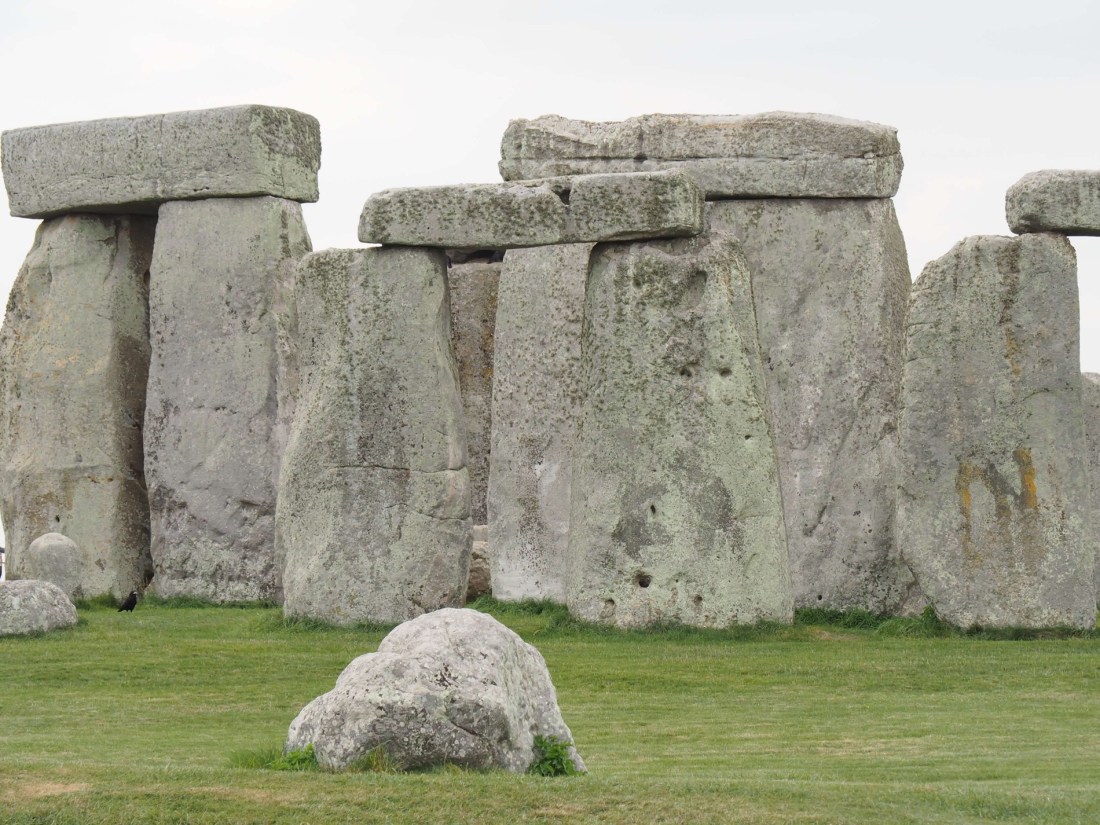
There are also smaller bluestones inside the circle, made up of a variety of different types of rock, but all of them came from the Preseli Hills of Wales, over 150 miles west of Stonehenge. Two of these are the smaller erect stones in the picture below. Note the ‘peg’ on top of the large stone to its right – a hole in the lentil stone would have fit over this peg to lock the stones together.

Experts theorize that the larger stones were brought on wooden sledges (a sample provided at the visitor center), and that the blue stones must have come by water from Wales and then via sledge to the site. (Note the human figure behind and to the left for an idea of the scale of this stone).

Of course we all know that Stonehenge is perfectly aligned with the winter and summer solstice, and that its building was an engineering marvel. It is theorized that hundreds of people would have worked to create the monument – and they had to be fed and housed on a somewhat barren plane. In addition to figuring out the astronomical equation so as to perfectly align the monument to the summer and winter solstice, an engineer would have had to work out the problems not only of how to move the stones but how to erect and then cap them, and create the first flow chart for the arrival of the stones and the materials needed.
And at this time, remember, there were no GPS devices, no metal tools, no cranes – it’s uncertain as to whether there was even any written language.
Interestingly enough, the Great Pyramid at Giza was erected at about the same time, but the first bronze metalworking in Britain took place 300 years after Stonehenge was erected. And, surprisingly, some of the stones, especially the bluestones, were re-arranged several times. So it appears that Stonehenge was merely a work in progress….
Mary
Written over the course of several days
Posted from York, England 9/11/18

 Mary's Travel Blog