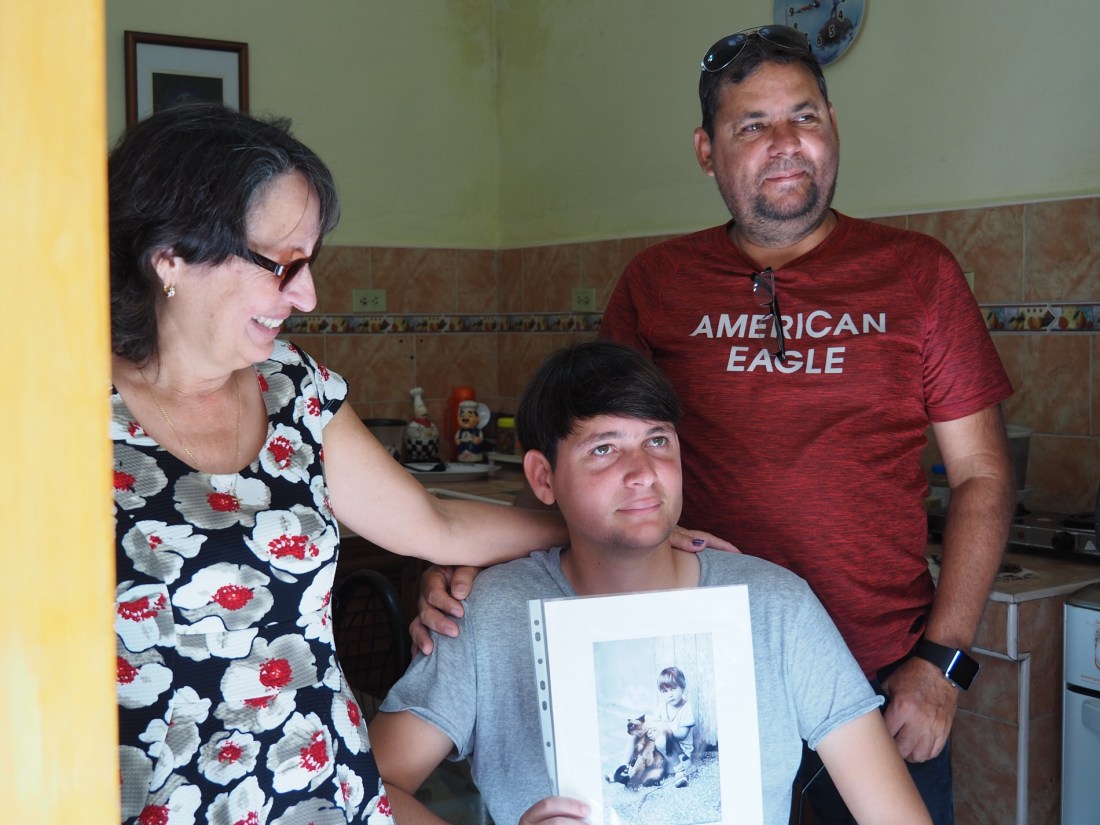
He is 84, she is 78. When she was 14 or 15, Rafael “kidnapped” Maria and took her home with him. In the morning, he took her back to her father and said that he had accepted responsibility for her and that was that – they have been married ever since. (Yes I asked – Maria had her eye on him from the very beginning, and she went with him willingly.). They have 8 children (4 boys, 4 girls) 18 grandchildren, and 10 great grandchildren (with one, Maria tells us) on the way.
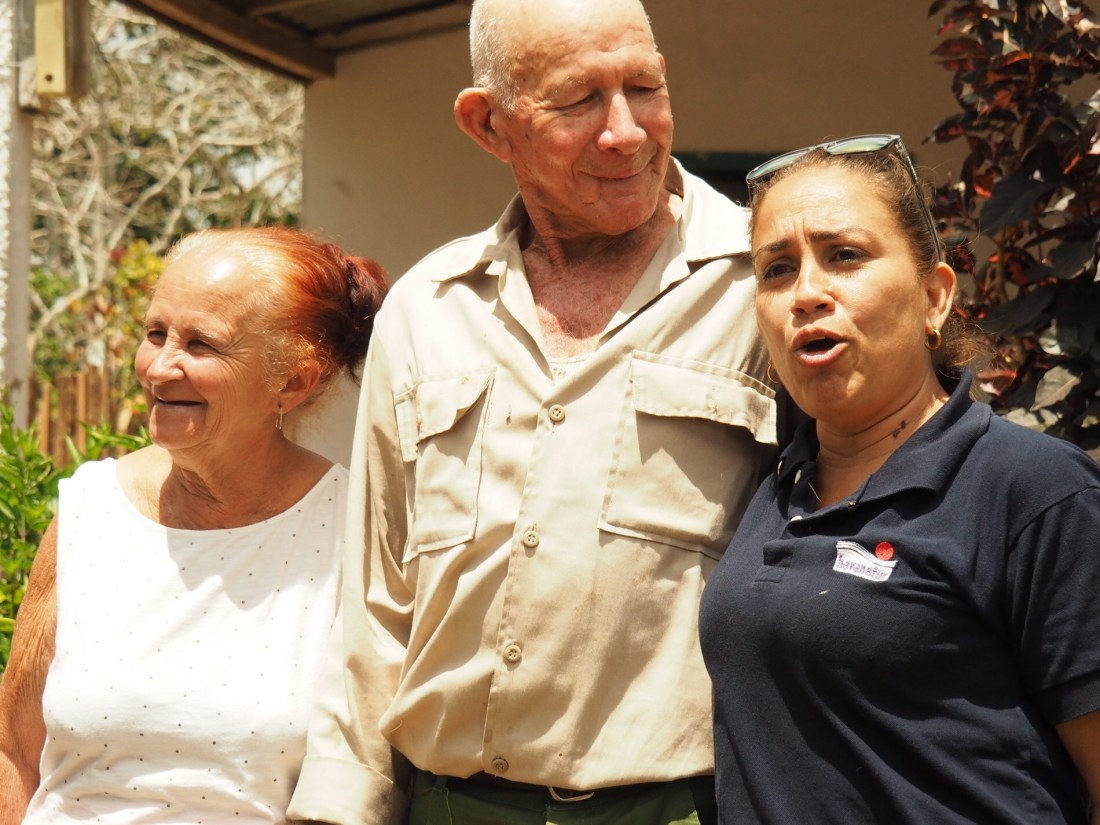
(Maria is on the left, Rafael in the middle, and Milagros, our Tour Leader, on the right)
Maria’s gardens are impressive. At home, coleus are house plants – here they live outside. I grow amaryllis inside and coddle them carefully to get them to bloom. Maria’s amaryllis live OUTSIDE and are blooming with abandon.

The house that Rafael inherited from his father is small, but spotlessly clean. Pictures of heroes of the revolution hang on the wall in places that you would normally expect to be occupied by religious saints:

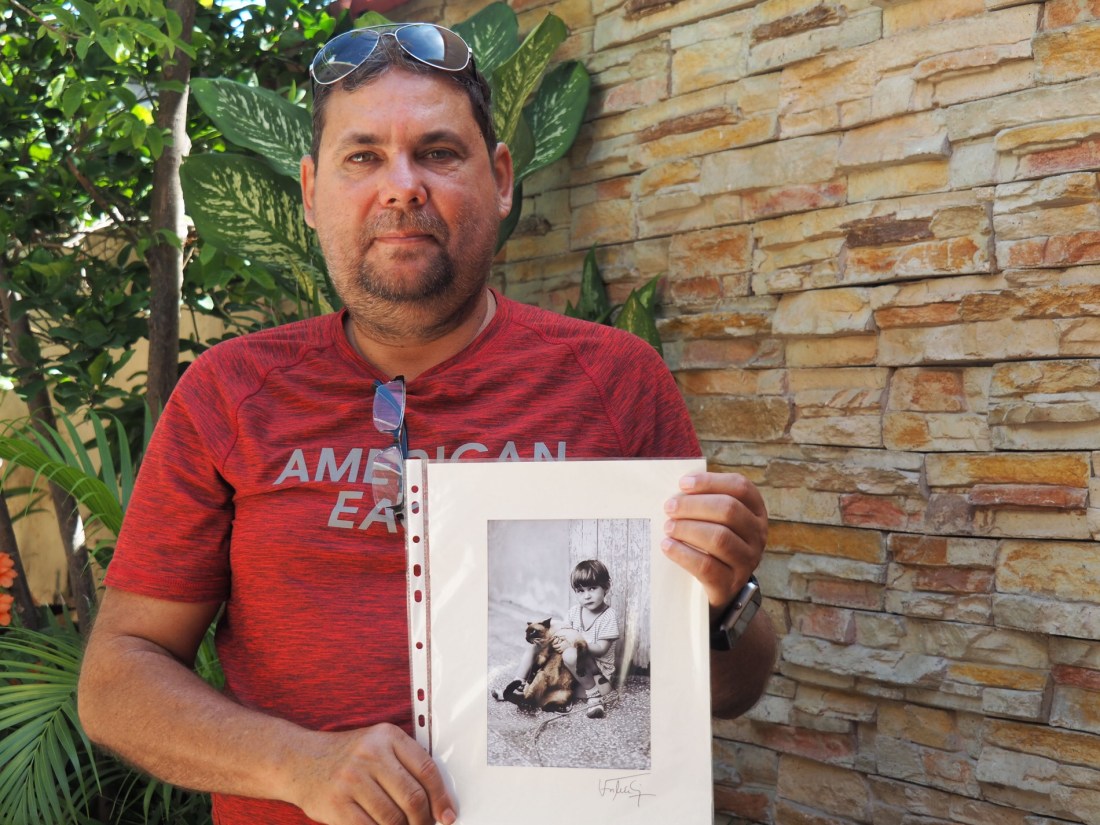
The elder son, Umberto, and his wife, Marta, live next door. Umberto tell us that the house in which they now live is the third house he has built there – in the first he ‘made’ his first child a boy, and in the second he ‘made’ his second child. Apparently, there are to be no more children – he is 58 and Martha is 52. Here is a picture of Umberto with our tour leader, MIlagros, and driver, David, with one of the baskets that are used for picking.

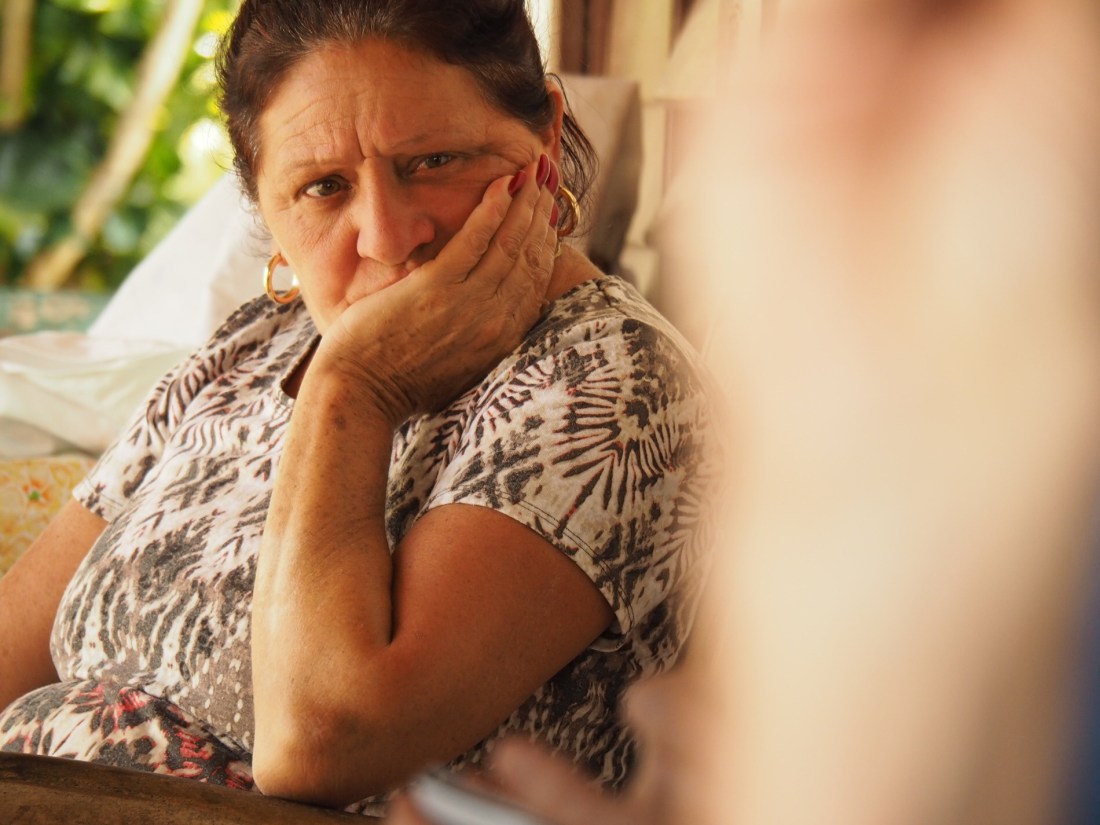
And his wife, Martha
Umberto gave us some frightening statistics about the effects of global warming on the plantation.
First of all, of course, is the increasing frequency and severity of hurricanes. Irma destroyed 8,000 of his coffee plant out of the 20,000 he had in one of his ‘gardens.’. This is a huge loss, because remember that a coffee plant doesn’t start producing until it has been in the ground for 3 years and produces only for a total of 10 years. So, if he loses 5 year old plants, he has to wait a long time before he gets another crop!
But of more concern is the change in the life cycle of the coffee plants. 5 years ago, the coffee trees were continuing their normal cycle of blooming 3 times a year (and, of course, providing 3 crops of coffee berries). NOW the plants only bloom ONCE a year, so there is only one crop.
The government is the primary purchaser of Umberto’s coffee berries. They are picked when they are ripe (red) by campesinos who come for the harvest season and make more in a week than they could in a month at their regular jobs. Umberto prefers to sell the berries the same day they are picked rather than drying them himself and selling them later. He gets a little less per kilo, but he also doesn’t run as much risk – what if it rains while the berries are spread out on the concrete drying platform and they spoil? Or the winds come up and blow them away?
On the other hand, the price he gets for his berries are based upon the grade that the government assigns to his berries. This seems to be based upon the ripeness of the berries and the percentage that are ripe versus those that are green in the batch. Even though the berries are picked by hand, it is impossible to ensure that all of them are really ripe – a percentage is likely to be green So, if the government assigns a lower grade and isn’t offering enough, Umberto can tell the government buyer to take a hike, dry the beans himself and sell them later. He is obligated to sell 90% of his crop to the government, but there is a certain amount of ‘slippage’ in the remaining 10%, and he
can sell that percentage privately – say to a local paladar (private restaurant). Another benefit to waiting is that, once the berries are dried, it is impossible to tell the ‘grade’.
Umberto seems to be primary farmer of the plantation now – although his father says he works every day. I am worried that the tradition of family farming of coffee may not continue, however, because the eldest grandson told us that he has taken a course to be a lifeguard, and, of course, he makes a lot more money as a lifeguard than he could as a coffee farmer AND he doesn’t have to work as hard, AND he has the opportunity to meet many more girls….But, he says, he does help his father on the plantation when he’s not at the pool…
Typed in Trinidad, Cuba
Published from Atlanta, GA on the way home




























 Mary's Travel Blog