Kelpies

Kelpies

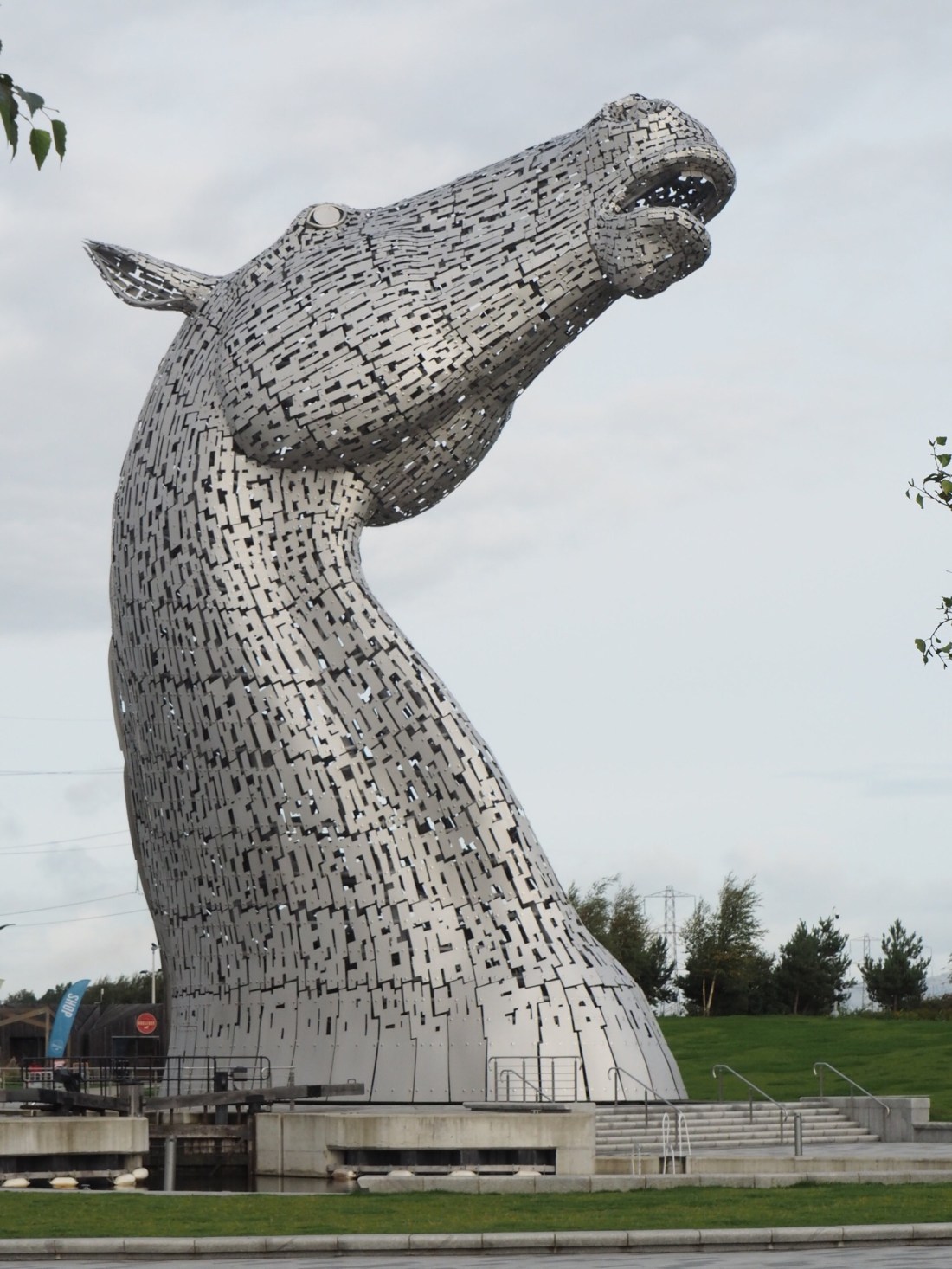
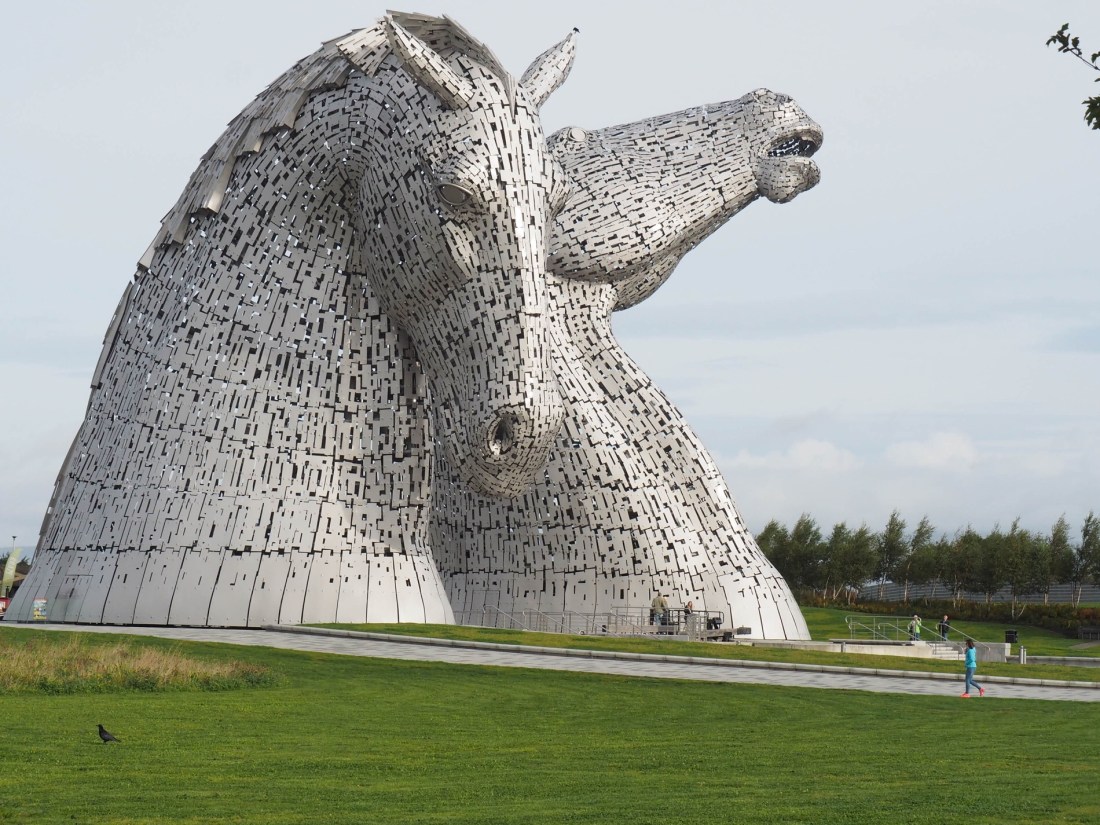
Kelpies were thought to be shape shifting water spirits. They could take several shapes, but in their equine form, they were believed to have the strength of 10 horses. This belief seems appropriate, since Clydesdale Horses powered the area between Edinburgh and Glasgow for a long time. They pulled barges on the canals, which were one of the major means of carrying goods from one place to another, helped with farming, and the like.

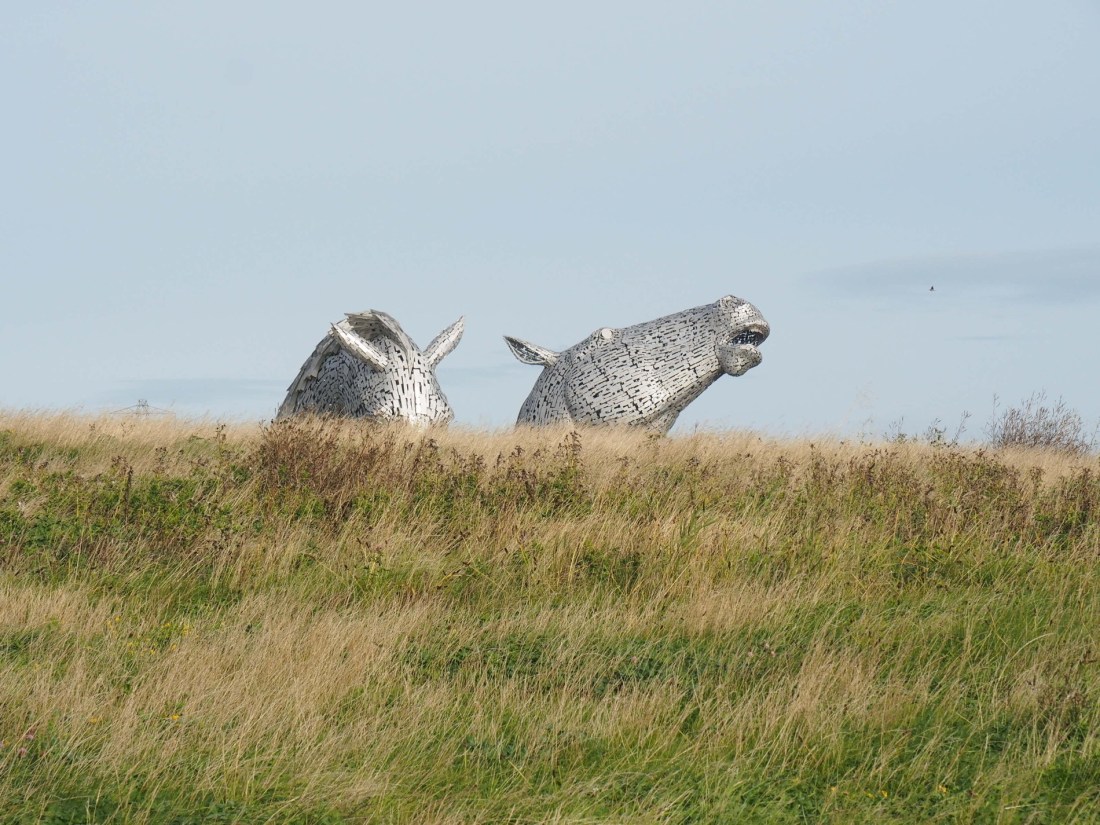
This area has suffered from a stagnant economy, and many schemes have been hatched to rejuvenate the area and attract tourists. One of these is to build a new extension to the Forth and Clyde Canal, which reconnects the canal with the River Forth, and to build sculptures of the Kelpies in Falkirk. They are about 90ft tall, and each weighs over 300 tons. When you first arrive at the site you can believe that they are actually rising up out of the ground.

Clydesdale horses still live here and were the models for the sculptures. The real horses who were the models are Baron, at 18.1 hands or 1.84 meters in height, but in the sculpture, he stands 30 meters high, or about 98 feet.

And Duke stands 17.3 hands or 1.8m in height, but in the sculpture, he stands 26.5 meters, or about 87 feet.

Both worked for Glasgow City Council, providing rides around Pollock Country Park and transporting goods needed for the park. Baron retired in 2014, Duke in 2015, and the artist, Andy Scott, called them both his models and his muses.

He said “working with the horses really captures the spirit of the project, because I wanted to honor old working horses from the past.”

I told you how high each sculpture stands. To give you a better idea of the structural engineering, just the jaw (not the entire head) of Baron weighs 17 tons.

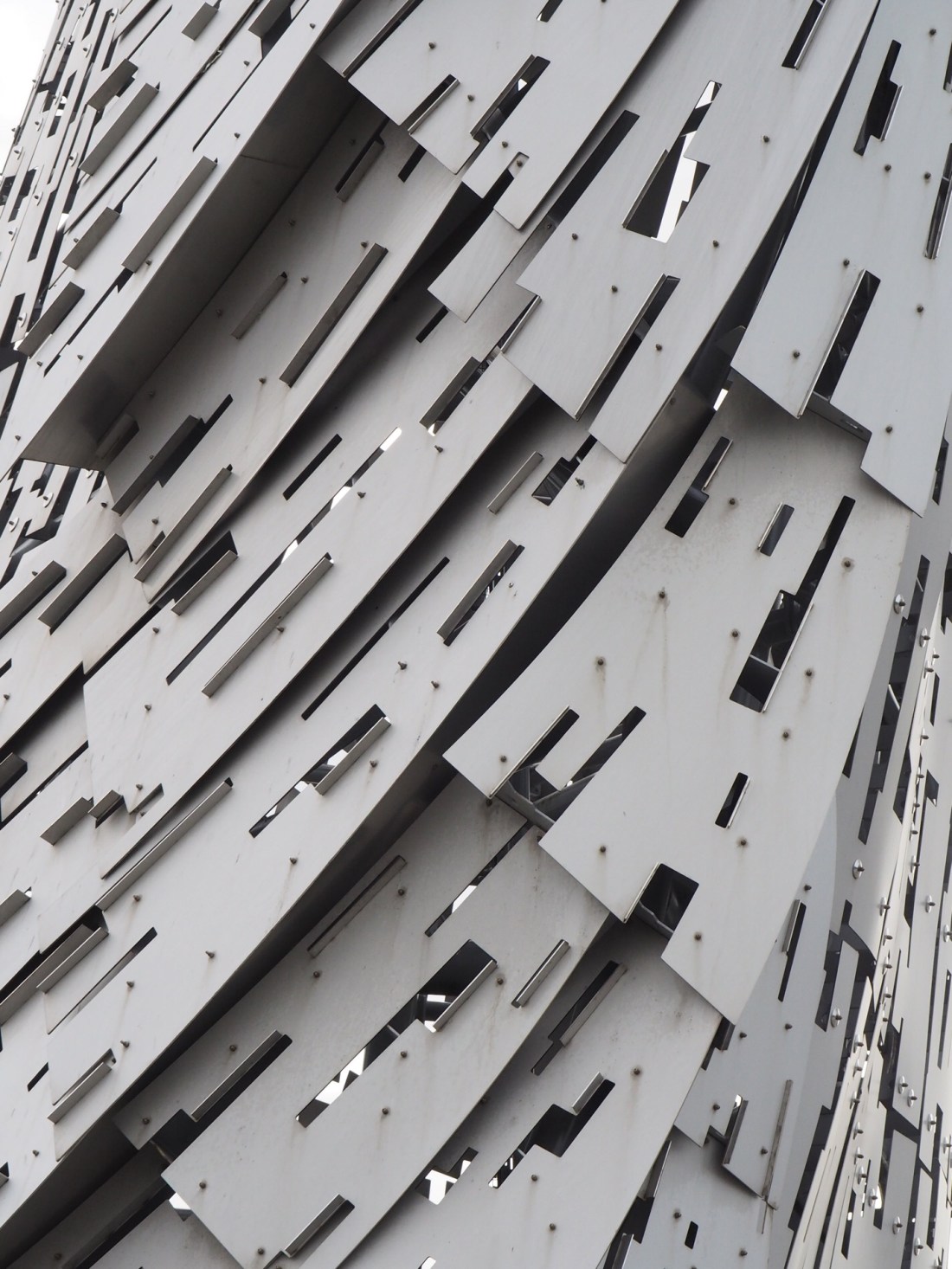
12,000 tons of steel are in the reinforced concrete pad. The skeleton that holds up the structures is tubular structural steel, and the plates that form the skin are stainless steel. There are 928 of them, and each was individually sized and numbered so that they could be bolted onto the structure in the correct order. It took 90 days to assemble the sculptures.

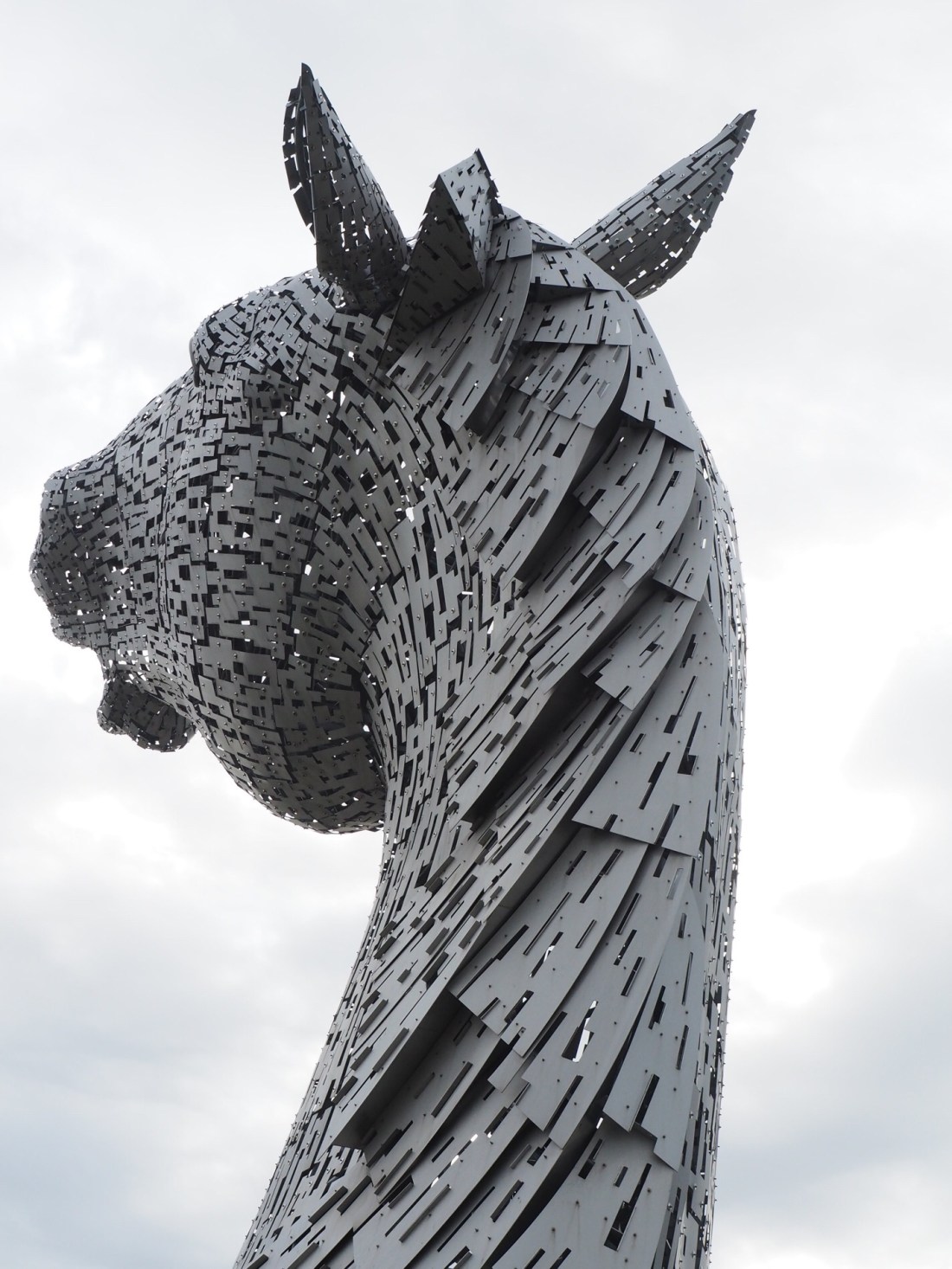
Here are details of Duke’s mane and ears

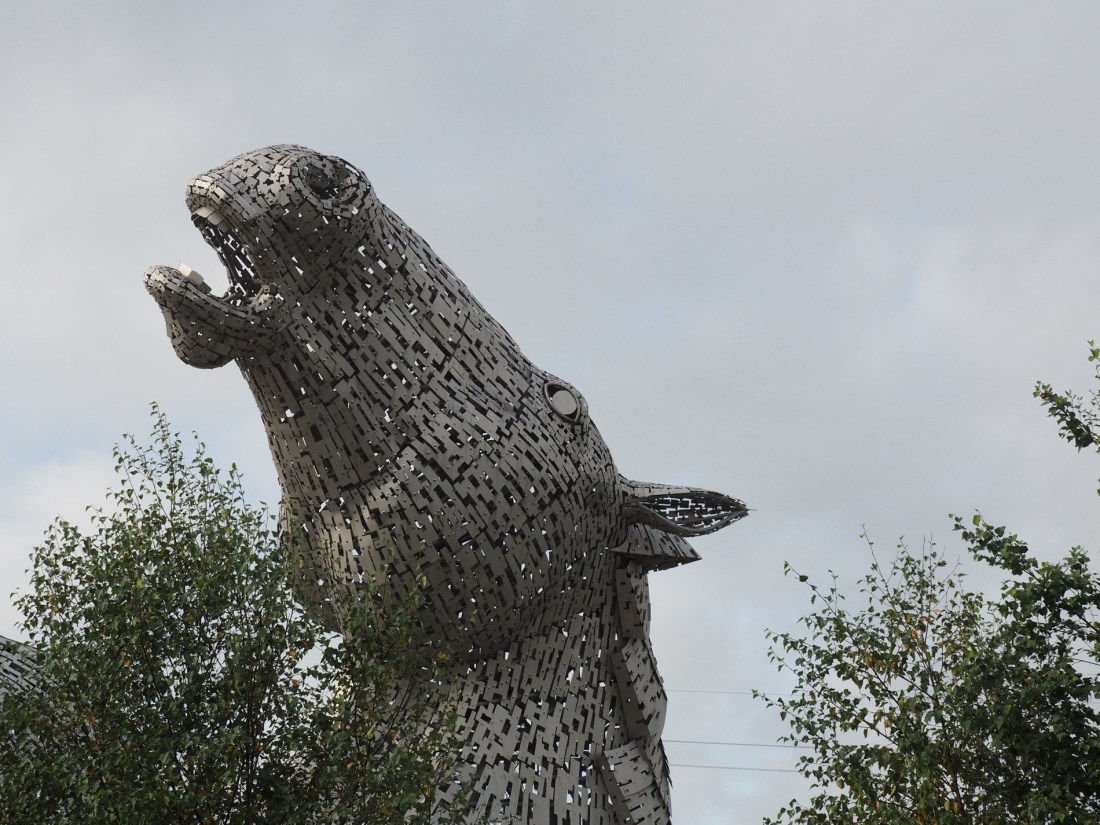
And Baron even has teeth:

The scheme to attract visitors to the area has obviously worked: during the fist year following the opening, nearly one million people visited the sculptures.

When Queen Elizabeth came to officially open the sculptures and re-name the canal, two of the honored guests who greeted her were the real Duke and Baron, as seems fitting.

Mary

Written and posted from Inverness, Scotland 9/15/18

Wales

Legend has it that Merlin was from Wales, and that his Welsh name was Merrdin Emerys. I have read and re-read Mary Stewart’s trilogy about Merlin and Arthur (The Crystal Cave, The Hollow Hills, and The Last Enchantment) set primarily in Wales, and thus was excited to come to Wales and see it for myself.

There are scenes in the book set in Segontium, a Roman fort that, in the book, Ambrosius’ engineers re-built during the campaign to re-take Britain from the Saxons. And just a short walk from our hotel in Caernarfon is the ruins of Segontium. One thing to mark off my “must see” list – even though it was only from the coach (aka bus).

O.K., legend as recounted by Mary Stewart says that Ambrosius and his brother Uther were actually heirs to the British throne, but fled the country as children after their elder brother was assassinated by the Saxons. They were taken in by a king in Brittany and there grew up and built their forces. They were successful in returning to England and driving out the Saxons, but soon afterwards, Ambrosius died, and Uther became king. Uther was the father of Arthur. Merlin was given the infant Arthur to care for and had a great deal to do with his education and eventual coming to the throne after the death of Uther.

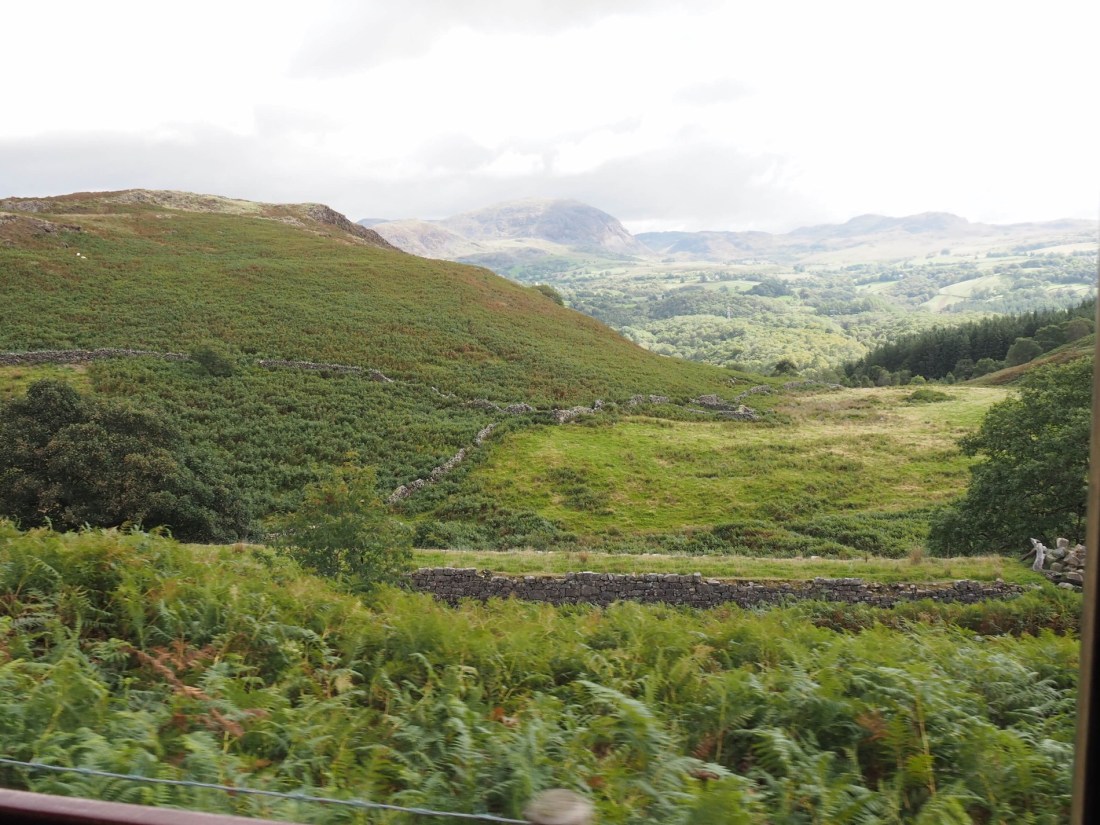
In the book, Merlin is born and lives in Wales and makes several journeys on horseback across it and to London. The landscape cannot be much changed since his time (other than the roads and fences, of course).

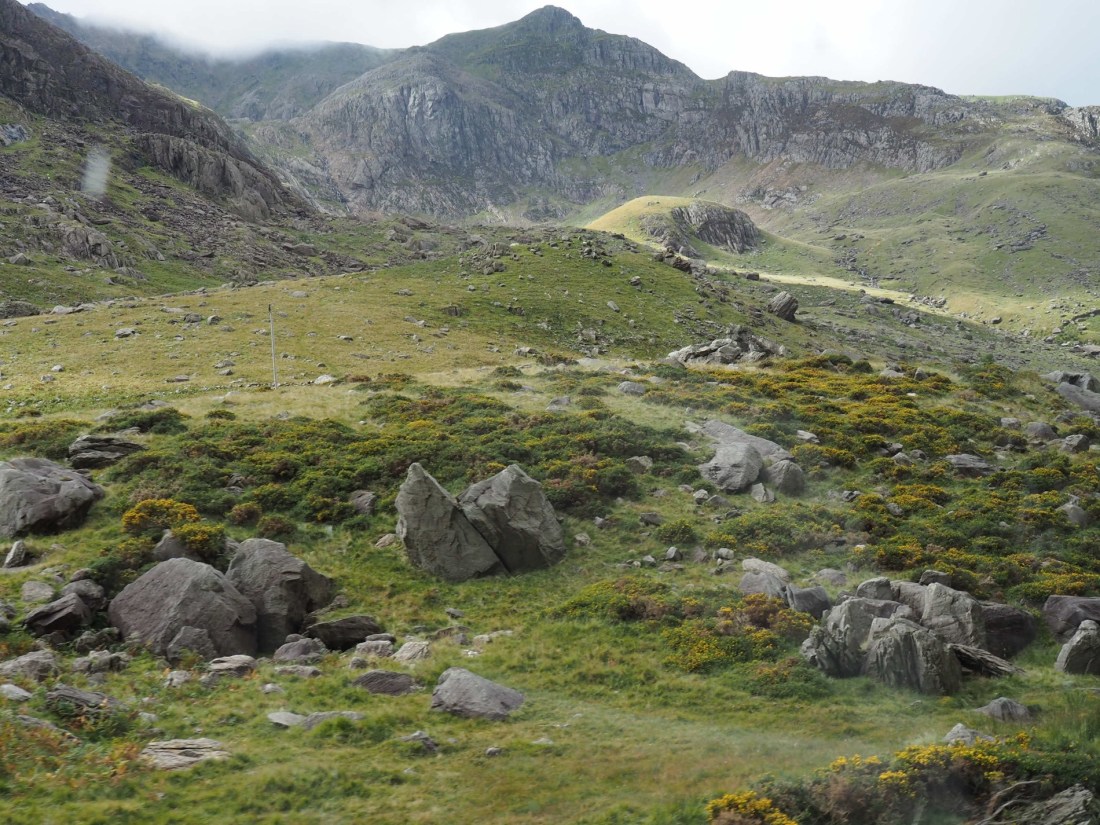
We drove through the Welsh countryside, skirting around Snowdonia, the highest mountain in Wales, and I quickly fell under the enchantment of the place.

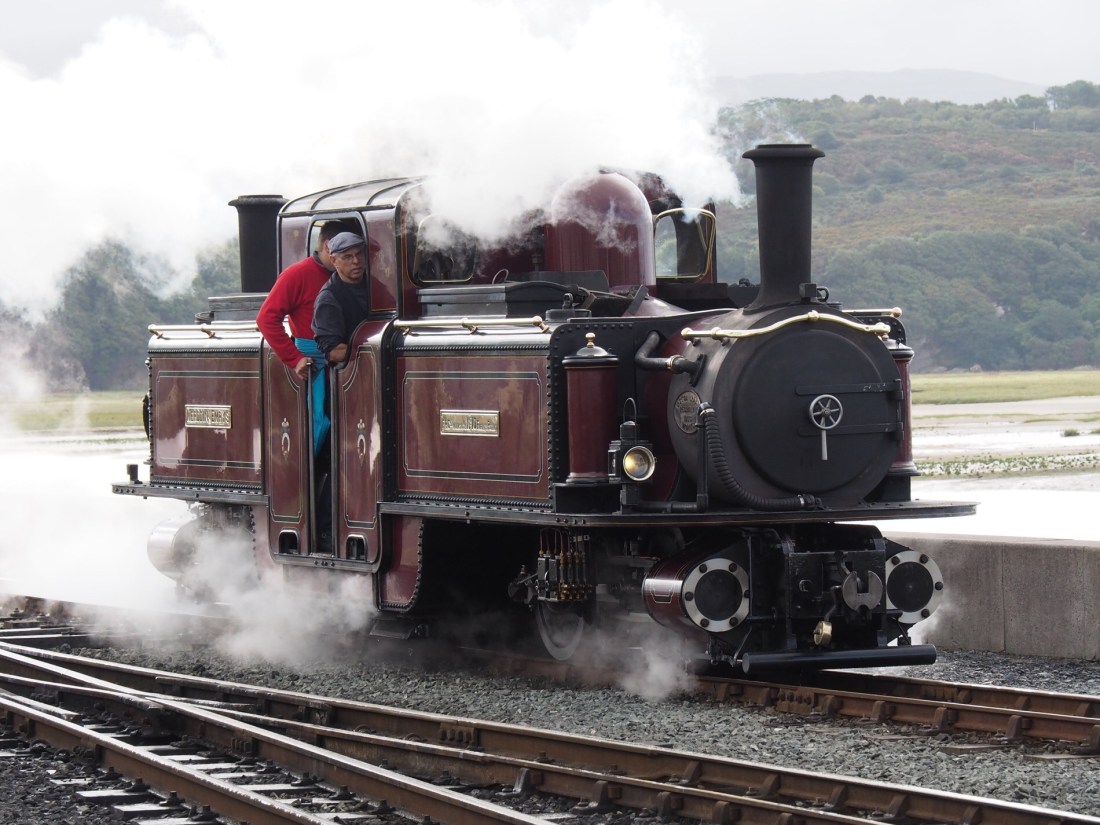
We went one day to Blaenau Ffestiniog to ride a famous narrow gauge railway built originally to carry slate from the quarries down to the river to be shipped all over the world. Now it carries tourists (and also some of the locals whose homes are only reached by train).

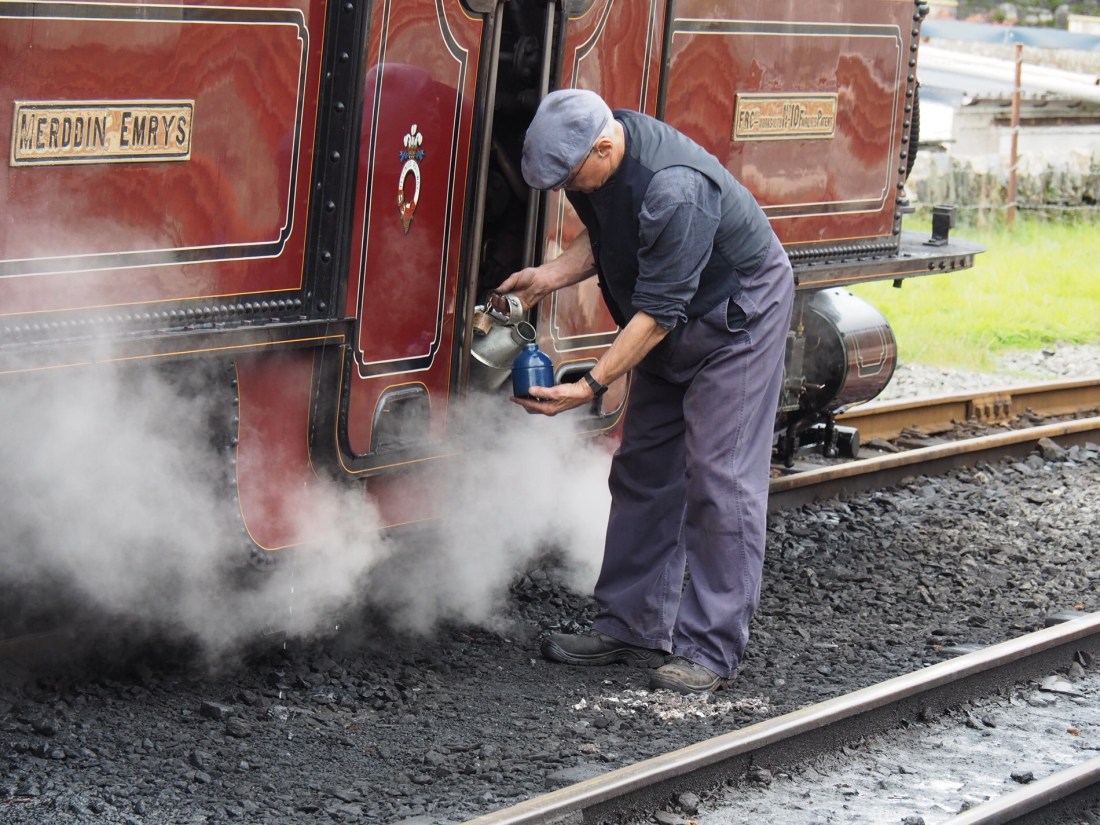
The engine pulling the train that day was a “Double Fairlie”, which has two sets of driving wheels, one in front and one behind, that swivel independently of each other so that the engine can navigate the sharp twists and turns of the railroad (0-4-4-0-T). It was built in 1879, re-built in 1988 by Boston Lodge Motors

and lovingly maintained by a large team of volunteers. Here an engineer is filling an oil can, preparing to oil the undercarriage.

And, since it is a Welsh engine, I wasn’t too surprised to read its name plate:

Mary

Written in Wales, Posted from Edinburgh Friday, 9/14/18

Whitby Abbey

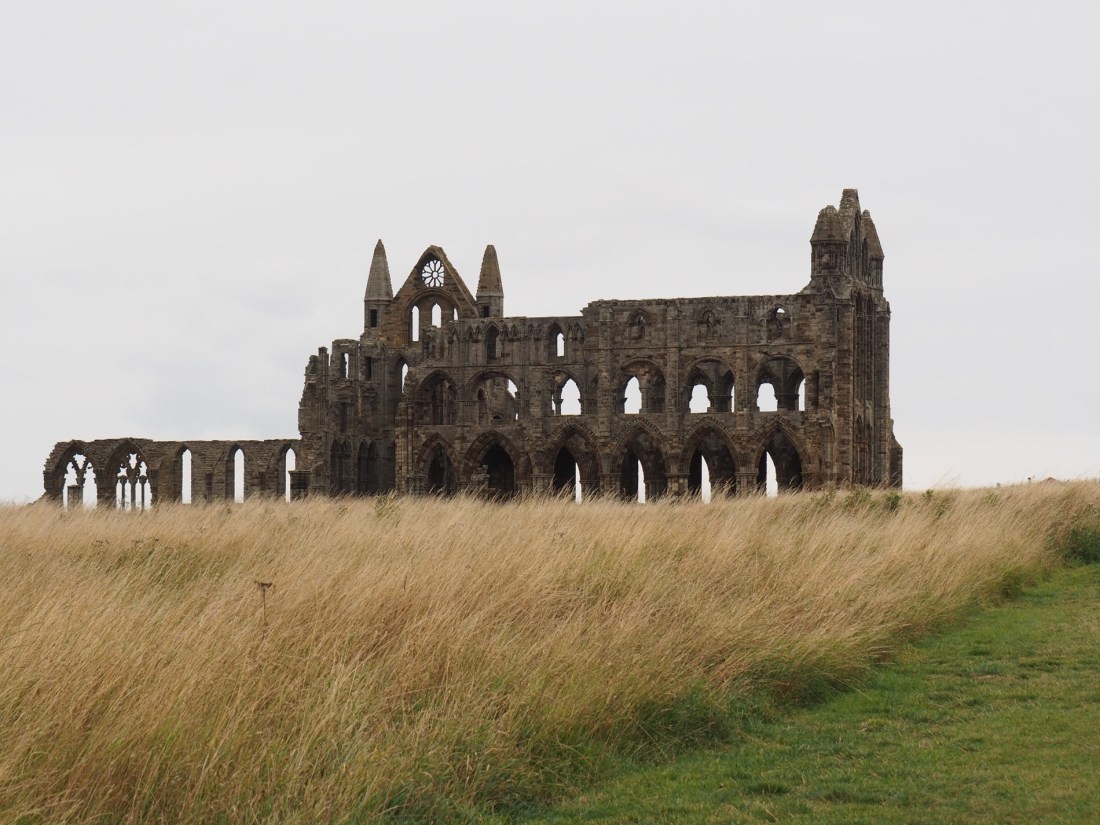
Whitby Abbey stands on the east coast of England, looking out over the North Sea on a high, windswept plateau. Here is the abbey as seen from the north side of the estuary near which it is situated through the jaw bones of a whale (the whaling industry was very important here).

The abbey was founded in the 7th century by King Oswiu of Northumbria. As head of the abbey he appointed a woman, who came to be known as St. Hild. She was the daughter of a king. The only two occupations for a woman at that time were marriage or to take Holy Orders (enter a convent). She was apparently pretty headstrong, and therefore wasn’t up for marriage, so she became a nun.

This was obviously the correct choice, because as head of this abbey with her administrative skills (and, no doubt, her royal connections) the abbey thrived and became famous. Interestingly enough, the abbey housed both men and women (living and worshiping separately).

By 664 the Abbey was so well respected that the Synod of Whitby was held there. There were two ‘arms’ of Christianity in England at the time, the Celtic and the Roman, and they celebrated Easter at different times. Clerics from both factions met here, and after much debate, the Roman date for Easter was chosen, and has been followed ever since.

Because of its location, at the mouth of a navigable river, the fishing village just down below the cliff, the Abbey and its community were frequently the object of Viking attacks, and it was abandoned in the 9th century. In the 11th century, the abbey was re-established as a Benedictine abbey. The original abbey building had disappeared, so the monks built again, and it was enlarged several times. The ruins that we visited were actually built in the 13th century in the Gothic style.

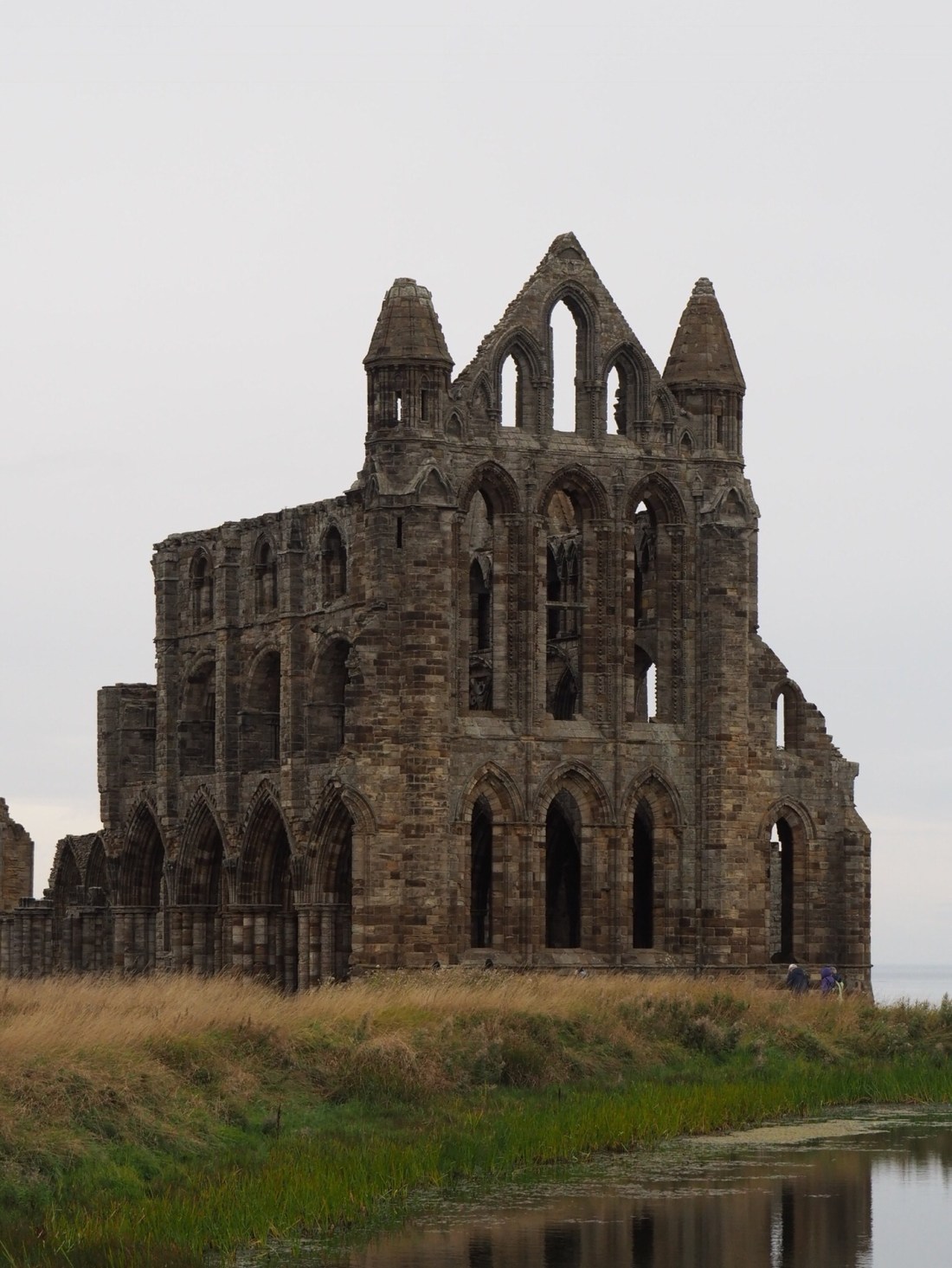
Interestingly enough, Bram Stoker spent some time in the town of Whitby, and the abbey ruins provided the inspiration for one of his most famous books, “Dracula.” And the day that we visited, because the skies were overcast, the abbey was particularly atmospheric, as you can see from the pictures below:

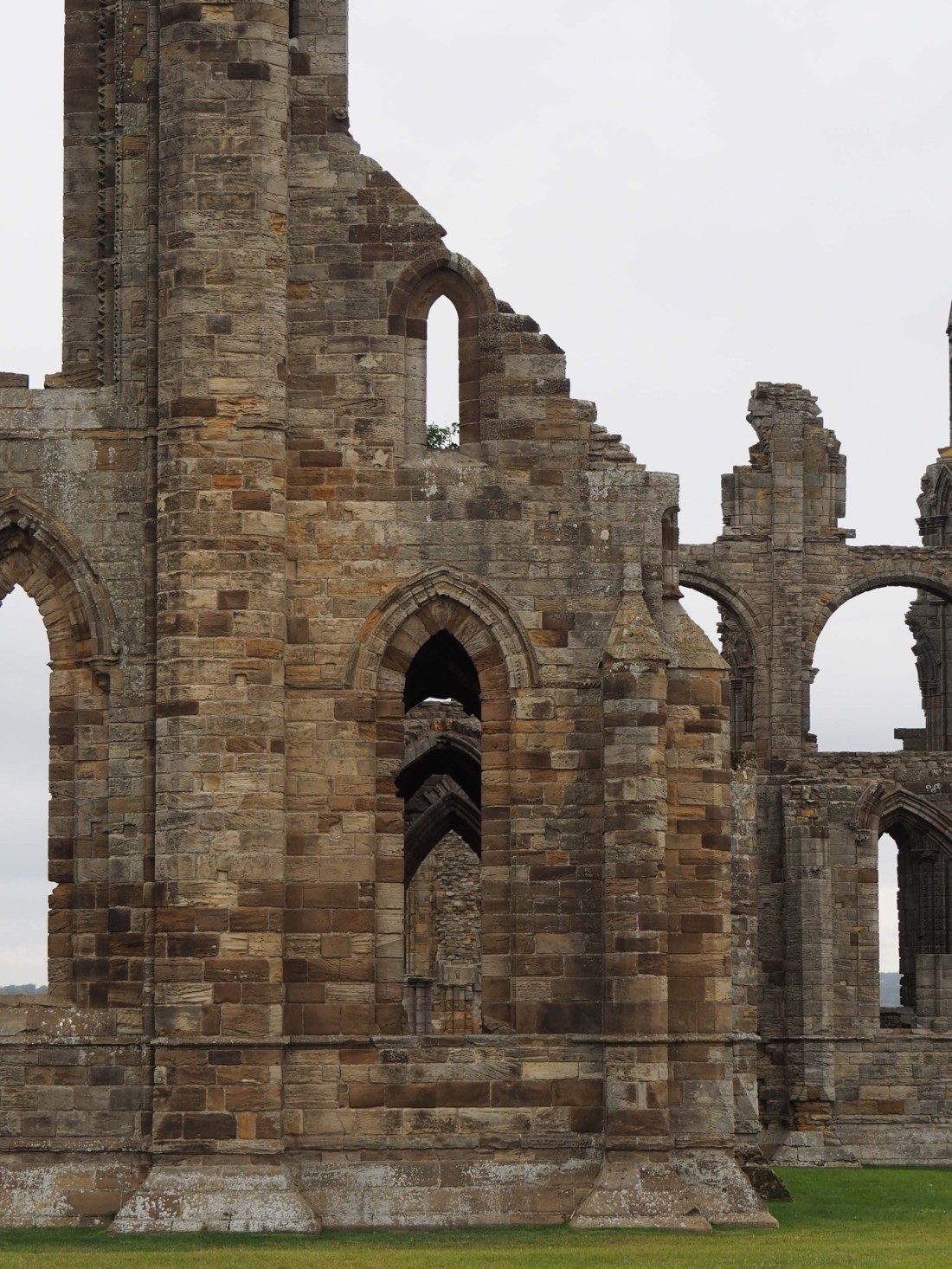
You can actually wander inside the ruins to see how finely the gothic arches were made

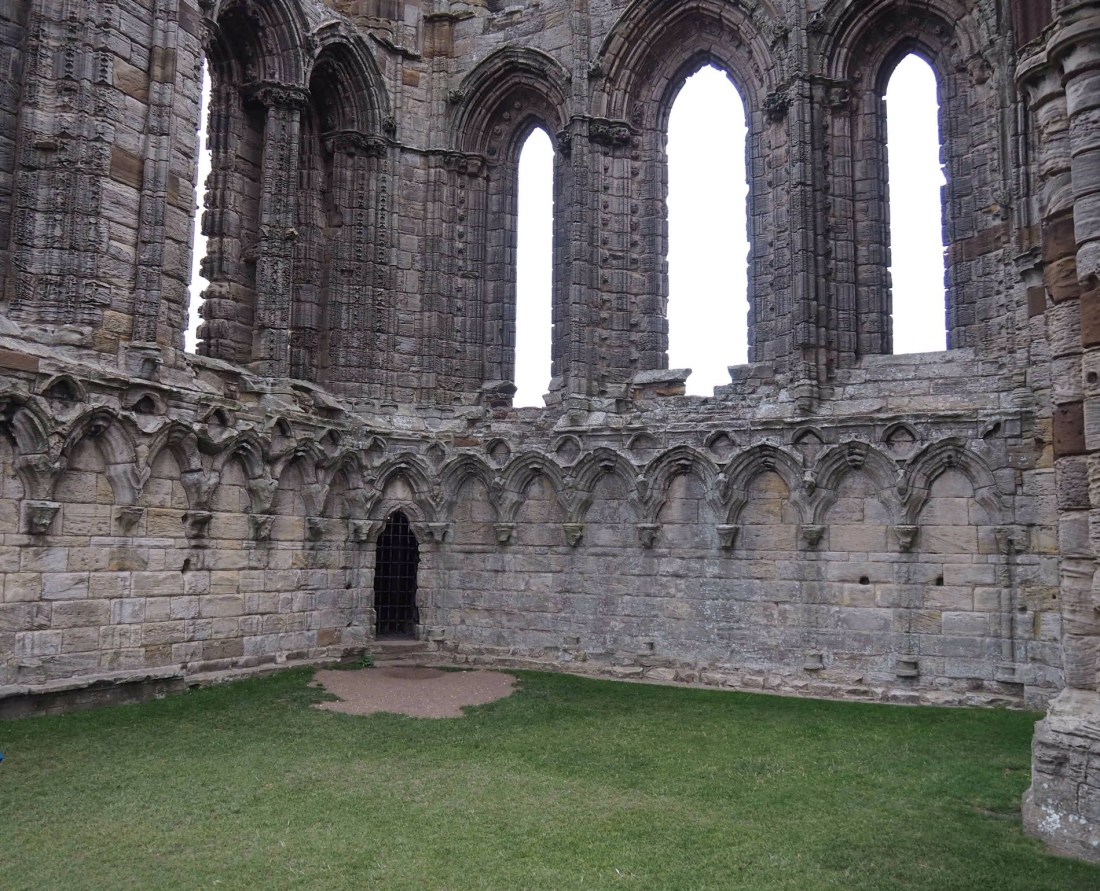
And the area where the monks must have sat in the quire

The abbey was constructed using stones set into bands of color

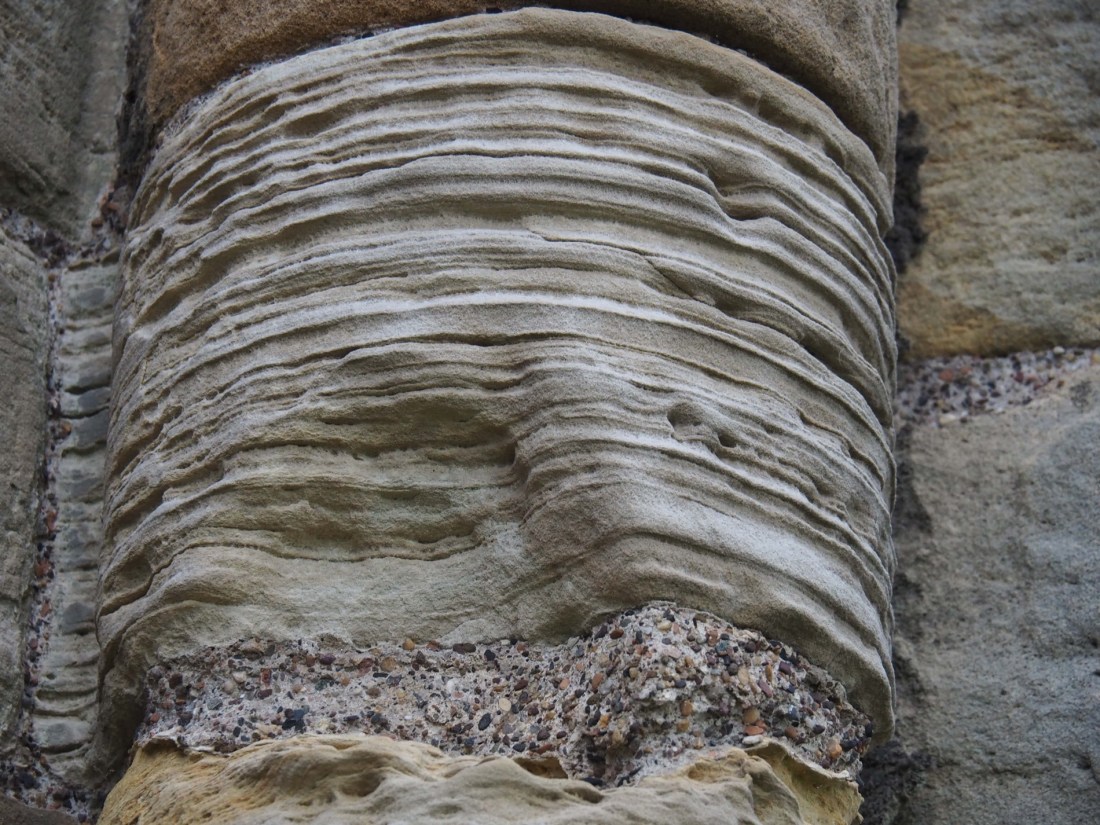
Some of the stone must be softer than the rest

And what must once have been glorious stained glass has long since succumbed to time, storms, and winds.

The abbey has survived bombardment (by a German ship in the First World War), quarrying (by the Cholmley family which bought the abbey and its estates when Henry. VIII dissolved the monasteries and used its stone to extend what would have originally been the Abbot’s house), storms and time and still has a haunting presence on the moor.

Mary

Posted 9/12/18 from Grasmere in the Lake District of England

Stonehenge

A “henge” is defined as a circular ditch, normally with a bank on the inside of it. Stonehenge as we know it now was originally just a circular ditch, although the bank is on the OUTSIDE of it. The original ditch was cut into the chalk at about 3000 BCE, but it is thought that erecting the famous stones did not begin until about 2500 BCE. The whole area on the Salisbury plane must have been important to the Neolithic people, because it is dotted with burial mounds, but what is more amazing is that Mesolithic postholes have been found around the outside of the existing stones, showing that large timber posts about 30” in diameter had been placed there between 8500 and 7000 BCE.

The original circular ditch when it was cut (using picks made out of antler, some of which were found in the ditch) must have been dazzling, because it was cut into the white chalk. And although the current site is covered with carefully mown grass, the effect of the monument is still pretty dazzling. You can walk across the plane, approaching as the early humans would, or travel by shuttle bus from the visitor center, and then travel on foot to the monument itself – being greeted not by the priests who may have greeted ancient visitors, but by sheep who apparently do their bit to mow the grass.

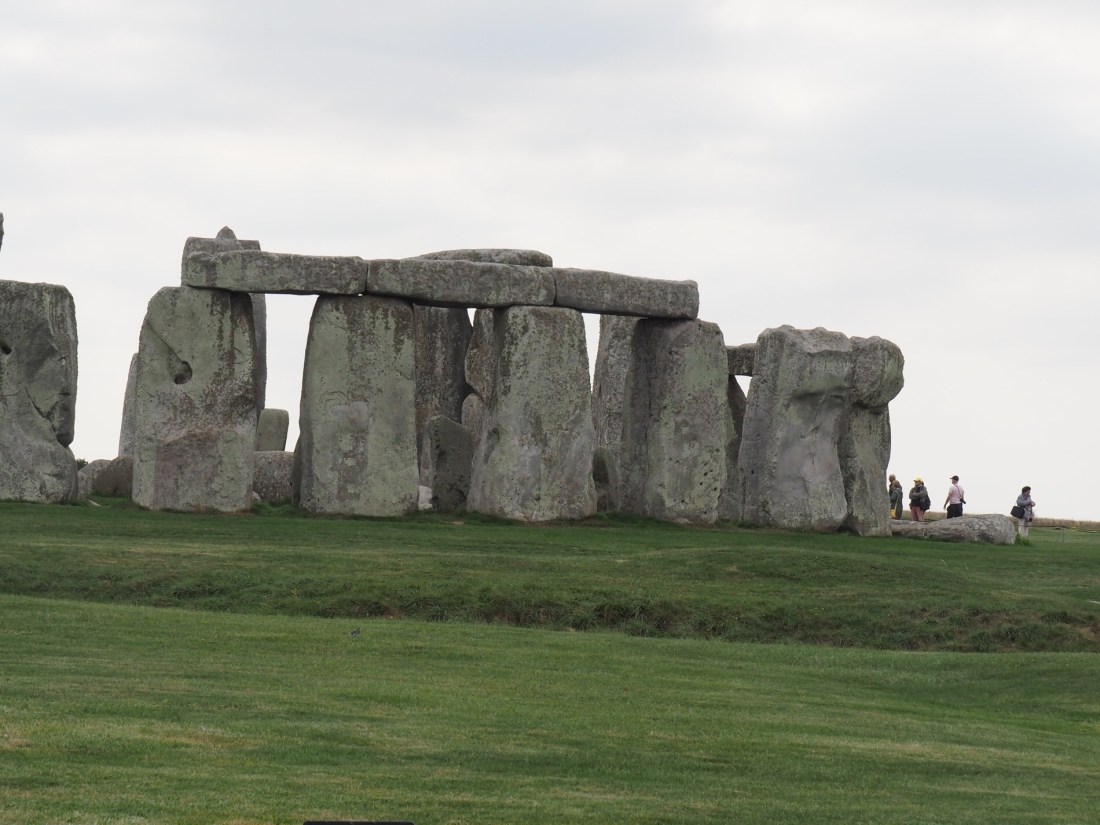
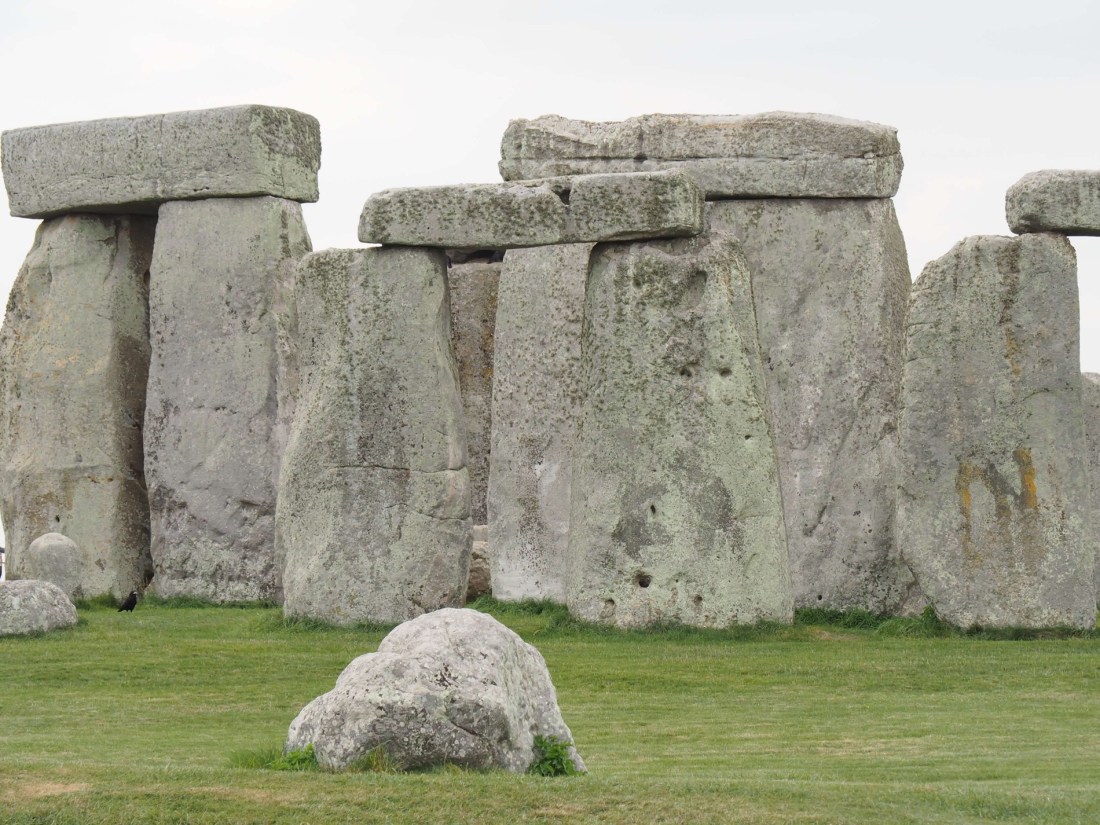
And over the heads of the sheep, Stonehenge makes itself known:

Because the site is actually very fragile – and prone to vandalism (many early visitors carved off chunks to take with them, or left their initials) the ordinary visitor is not allowed inside the circle, except in small groups in the early morning or late afternoon – or at the summer solstice. But actually, this may be to the good, because there is a knee high fence that keeps visitors away from the monument and actually has the added benefit of making it possible to take pictures WITHOUT anyone blocking your way. You can pretend that you are a Neolithic visitor come to celebrate the solstice as you circle the structure.

You come very close to the “heel” stone so you can actually see its surface and how it relates to the circle.

As you walk, you get different views of the stones and their arrangement seems to shift like a kaleidoscope, with stones appearing and disappearing from view, and seeming to change places with each other.

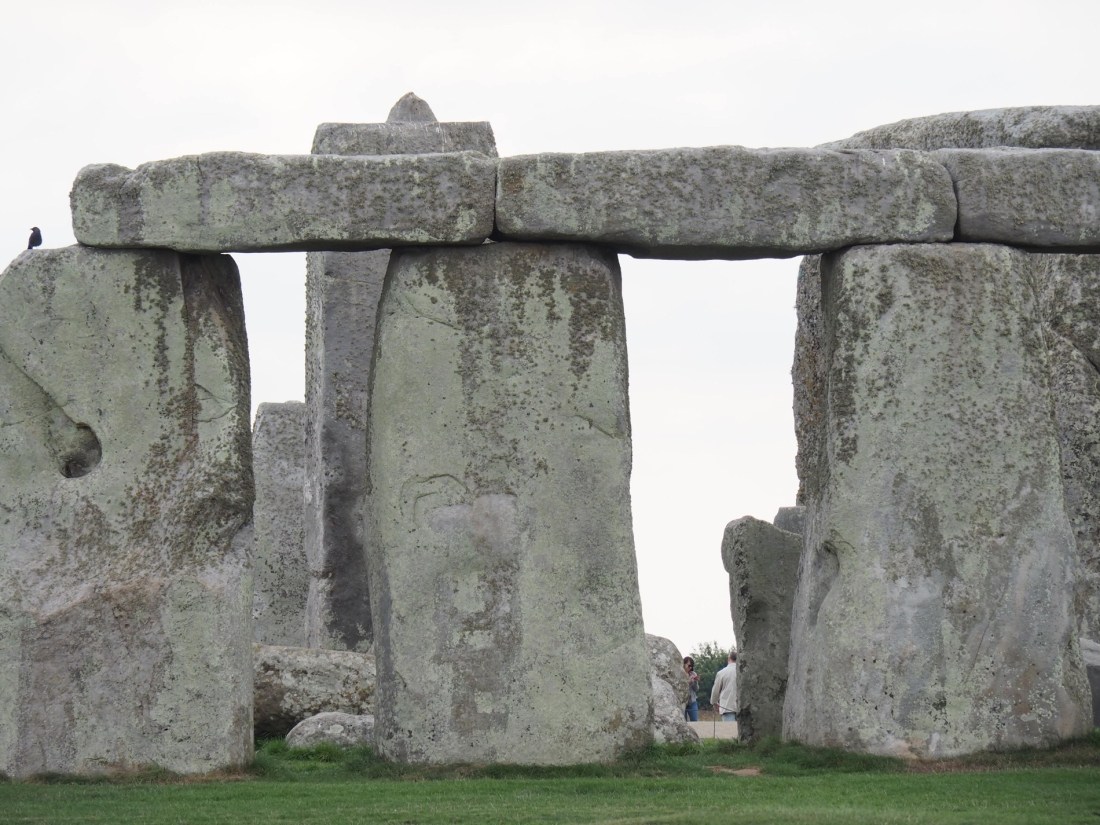
Having a long lens allows you to look more closely at the stones, and you see that some seem to have ‘faces’ – although whether they were worked into the stone or just a natural phenomenon is unclear.

What is clear, however, is that many of the larger stones, made of sarsens (an extremely hard sandstone) have been worked to shape them. These stones must have come from the Marlborough Downs about 19 miles north of Stonehenge.

Here, the stones are aligned in such a way that they seem to be touching each other, although in this shot there are actually stones behind each other – an optical illusion makes you think that they are a solid row of rock.

There are also smaller bluestones inside the circle, made up of a variety of different types of rock, but all of them came from the Preseli Hills of Wales, over 150 miles west of Stonehenge. Two of these are the smaller erect stones in the picture below. Note the ‘peg’ on top of the large stone to its right – a hole in the lentil stone would have fit over this peg to lock the stones together.

Experts theorize that the larger stones were brought on wooden sledges (a sample provided at the visitor center), and that the blue stones must have come by water from Wales and then via sledge to the site. (Note the human figure behind and to the left for an idea of the scale of this stone).

Of course we all know that Stonehenge is perfectly aligned with the winter and summer solstice, and that its building was an engineering marvel. It is theorized that hundreds of people would have worked to create the monument – and they had to be fed and housed on a somewhat barren plane. In addition to figuring out the astronomical equation so as to perfectly align the monument to the summer and winter solstice, an engineer would have had to work out the problems not only of how to move the stones but how to erect and then cap them, and create the first flow chart for the arrival of the stones and the materials needed.

And at this time, remember, there were no GPS devices, no metal tools, no cranes – it’s uncertain as to whether there was even any written language.

Interestingly enough, the Great Pyramid at Giza was erected at about the same time, but the first bronze metalworking in Britain took place 300 years after Stonehenge was erected. And, surprisingly, some of the stones, especially the bluestones, were re-arranged several times. So it appears that Stonehenge was merely a work in progress….

Mary

Written over the course of several days

Posted from York, England 9/11/18

Peace

This is the 100th anniversary of the end of the “Great War”, known to us as World War I, and every where we go there are paper poppies and crosses of commemoration. In the towns the little crosses have the names of local men who lost their lives in the war. In London at Westminster Abbey, the tomb of the unknown soldier in the floor of the Abbey is the only one that no one ever walks on, (and that means even the Queen) and it is surrounded by paper poppies.

Everywhere else, the graves are walked upon, including those of Sir Isaac Newton and, more recently, Stephen Hawking, whose ashes are interred next to his. Professor Hawking’s grave stone has a representative of a black hole on it!

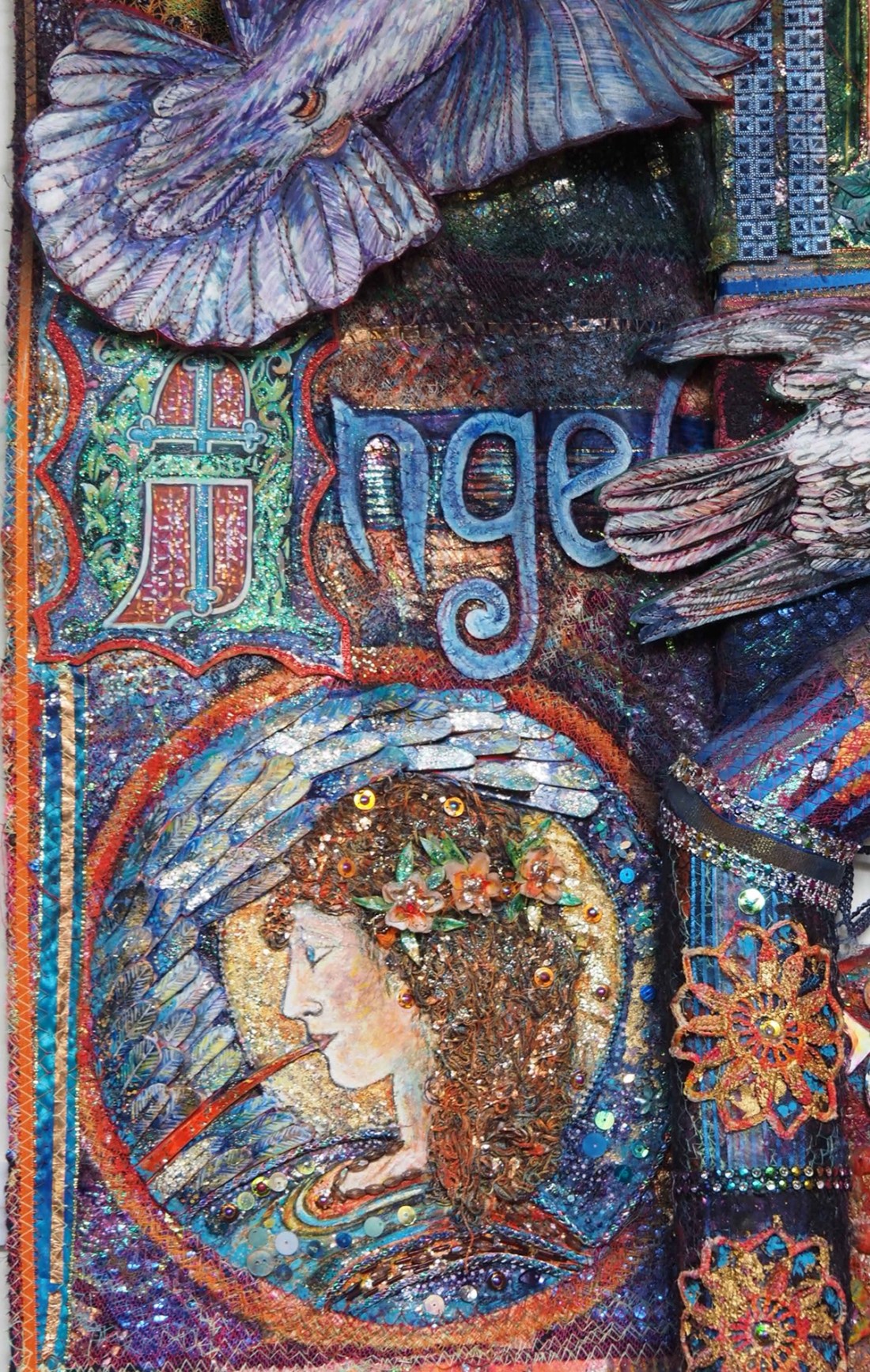
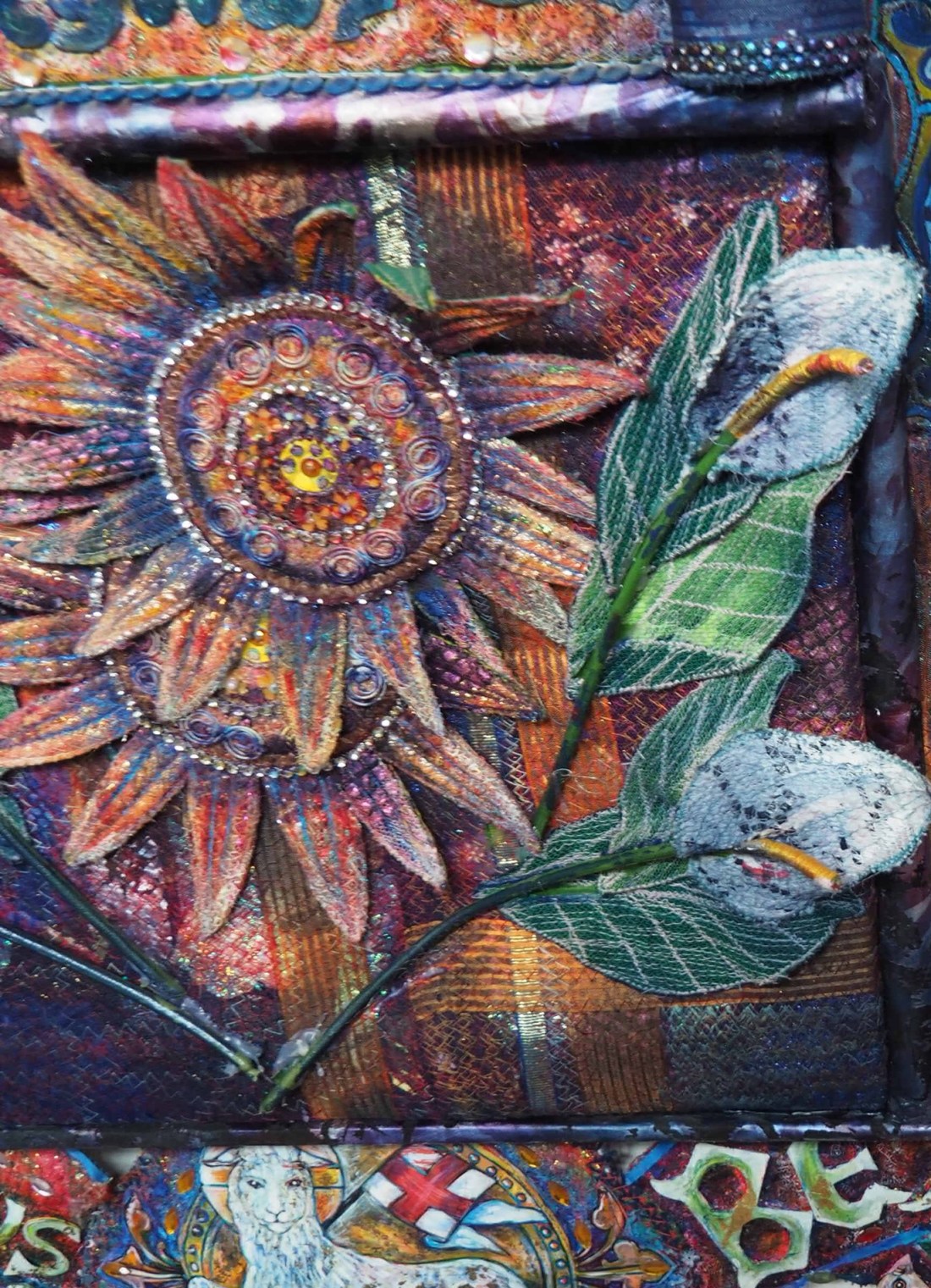
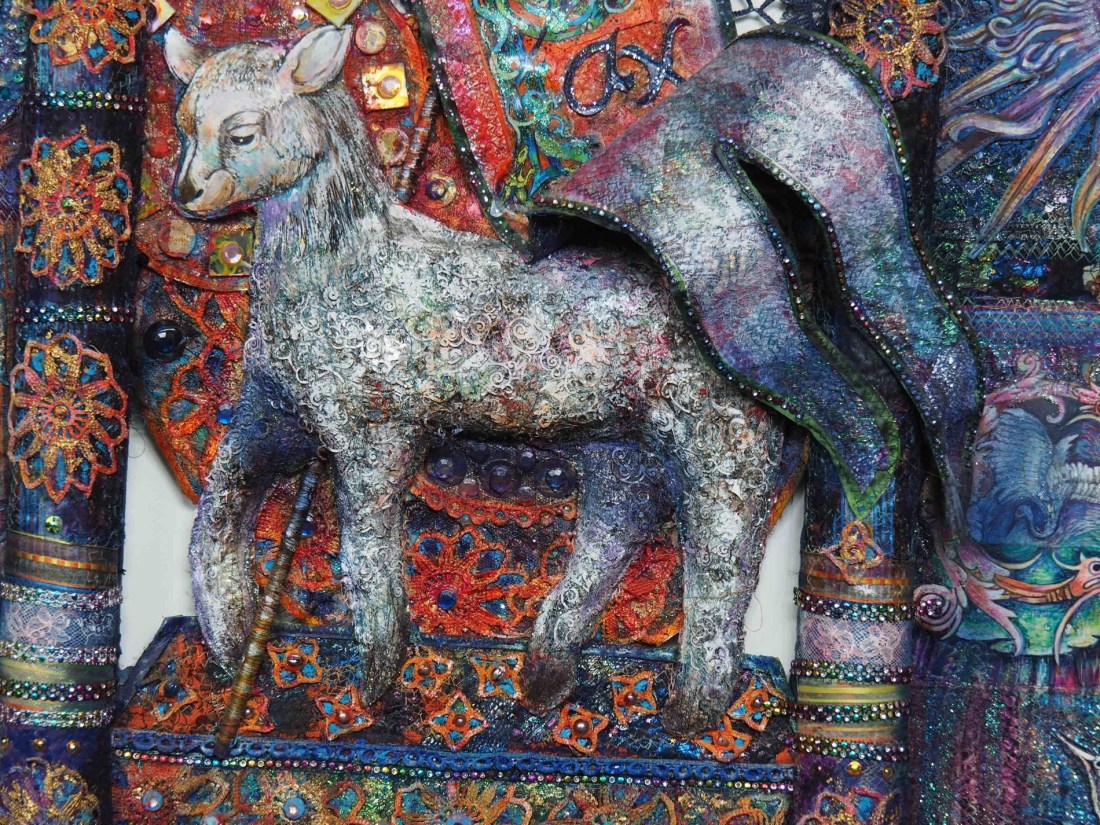
But I digress – we went into Chester Cathedral in the town of Chester today, and the cathedral itself was closed, as it was being readied for the installation of the new Dean of the Cathedral. But we were invited to walk around the cloister, where there was an art show whose theme was peace. The work that caught my eye is by a woman named Nikki Parmenter. It is entitled “Peace is always Beautiful,” and it is a tour de force of the quilter’s art. Some of the figures are actually three dimensional, and stand out from the work.

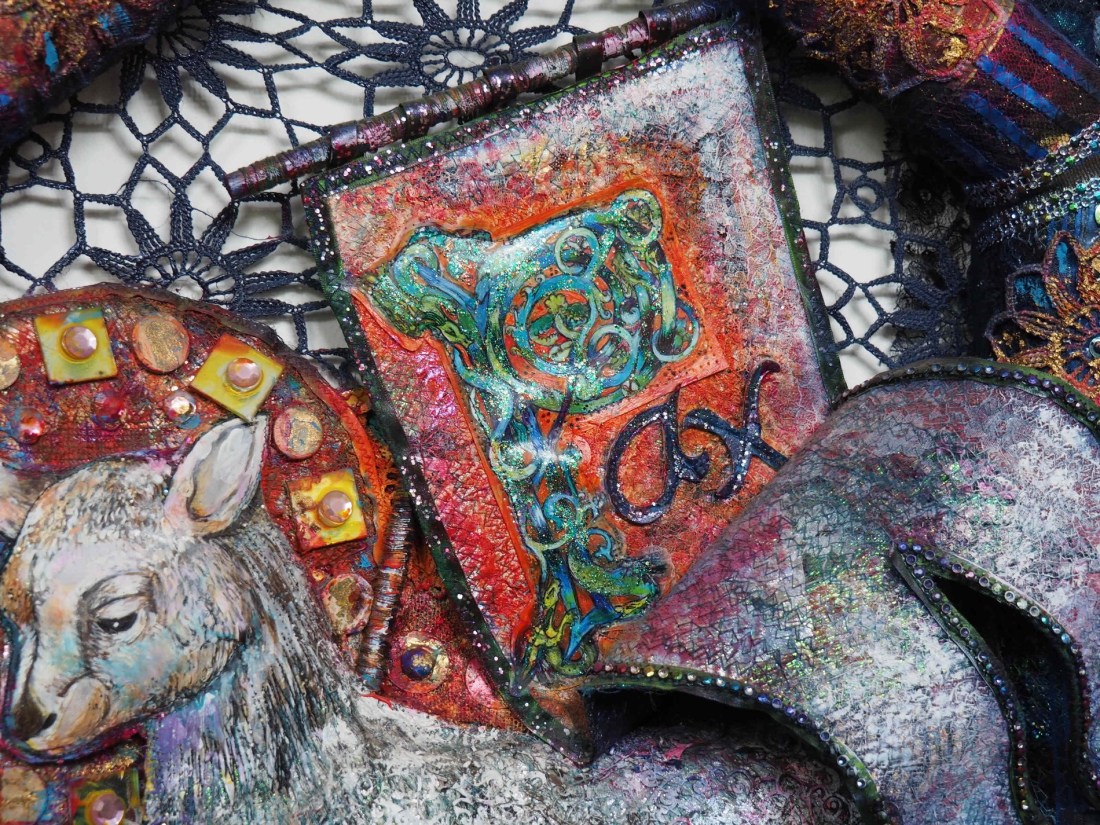
The lamb in the middle stands out from the background, and, I suspect, represents the Lamb of God, because his head is surrounded by a halo embellished with gold medallions.

A banner with the word “Pax” is above him and drapes over his body. Behind him you will see that the artist has created crocheted stars that give the effect of a stained glass window

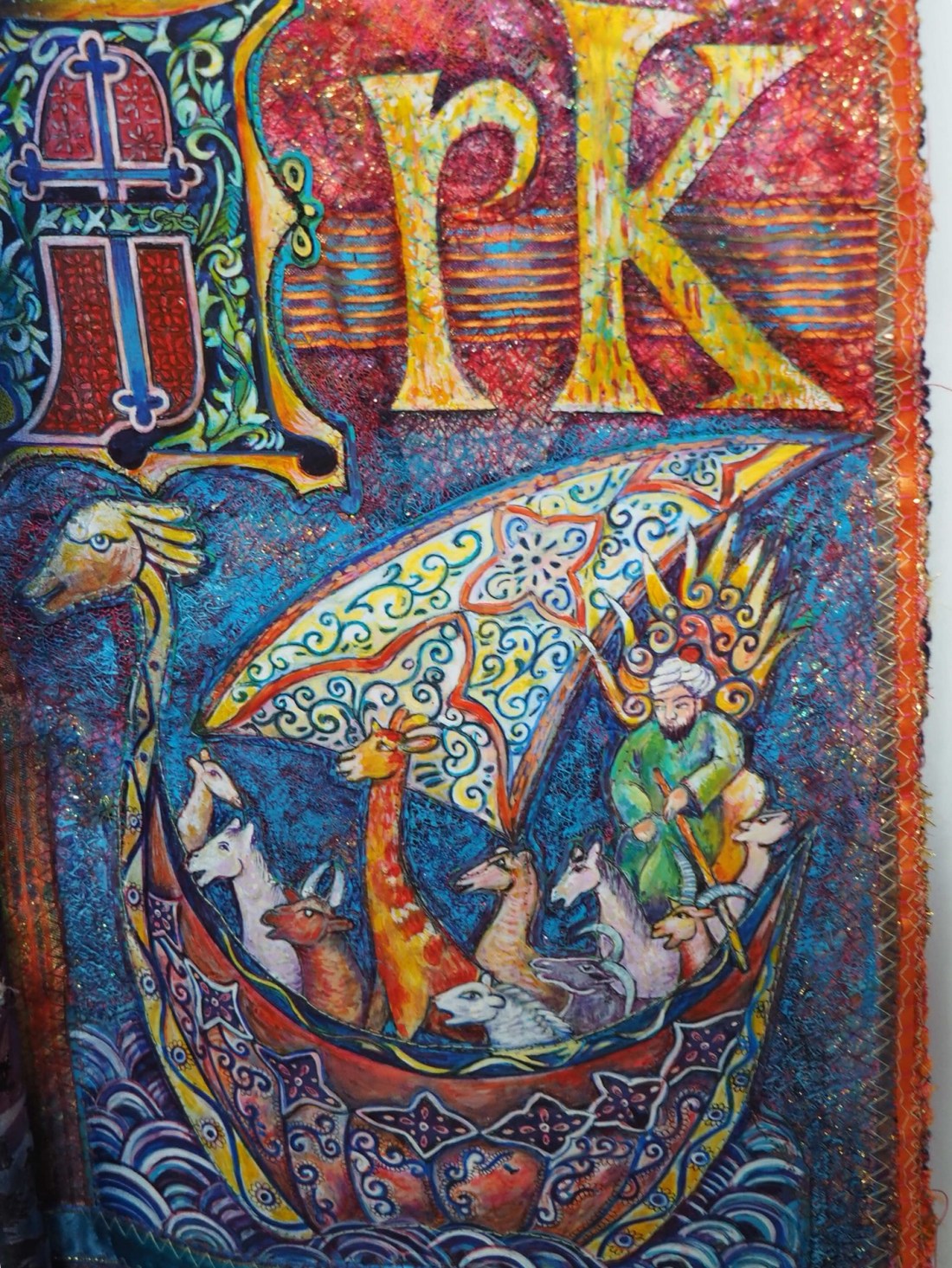
Around the central figure are many others – the ark, for example, is shown almost as a dragon boat,

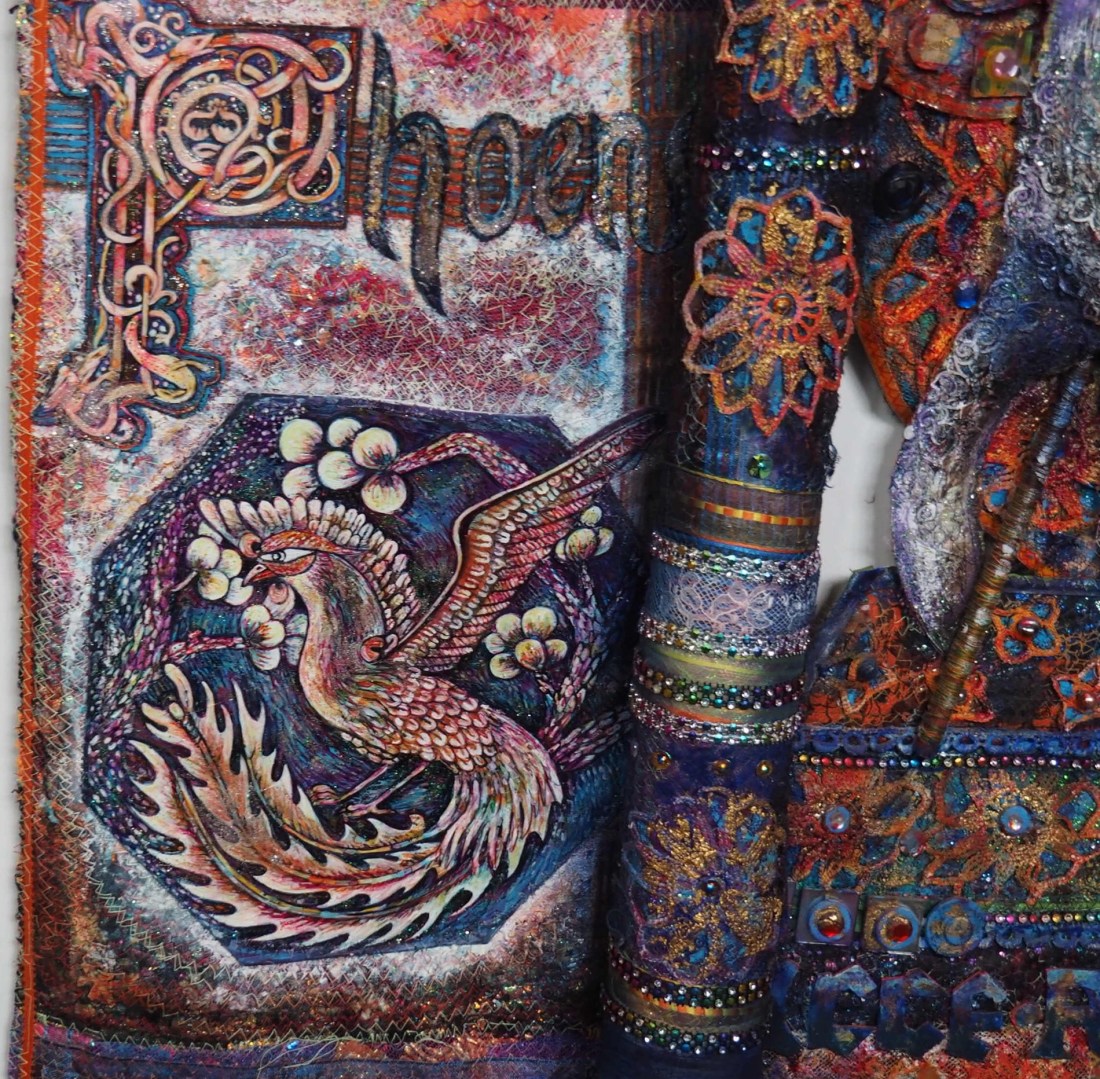
A phoenix appears,

And there is a wonderful angel,

The sunflower has dew on it, made up of individual pearls,

And surmounting it all and supported by doves, is the word “PAX” that looks as though it came from a medieval Book of Hours,

Clearly, the work is a plea that such a war may never again occur and that we shall have peace.

Mary

Posted from York, England 9/8/18

London Architecture

To remind you where I am as I am writing this, here is a picture of one of the most famous of London’s structures – the Tower Bridge. My hotel is immediately adjacent to this bridge.

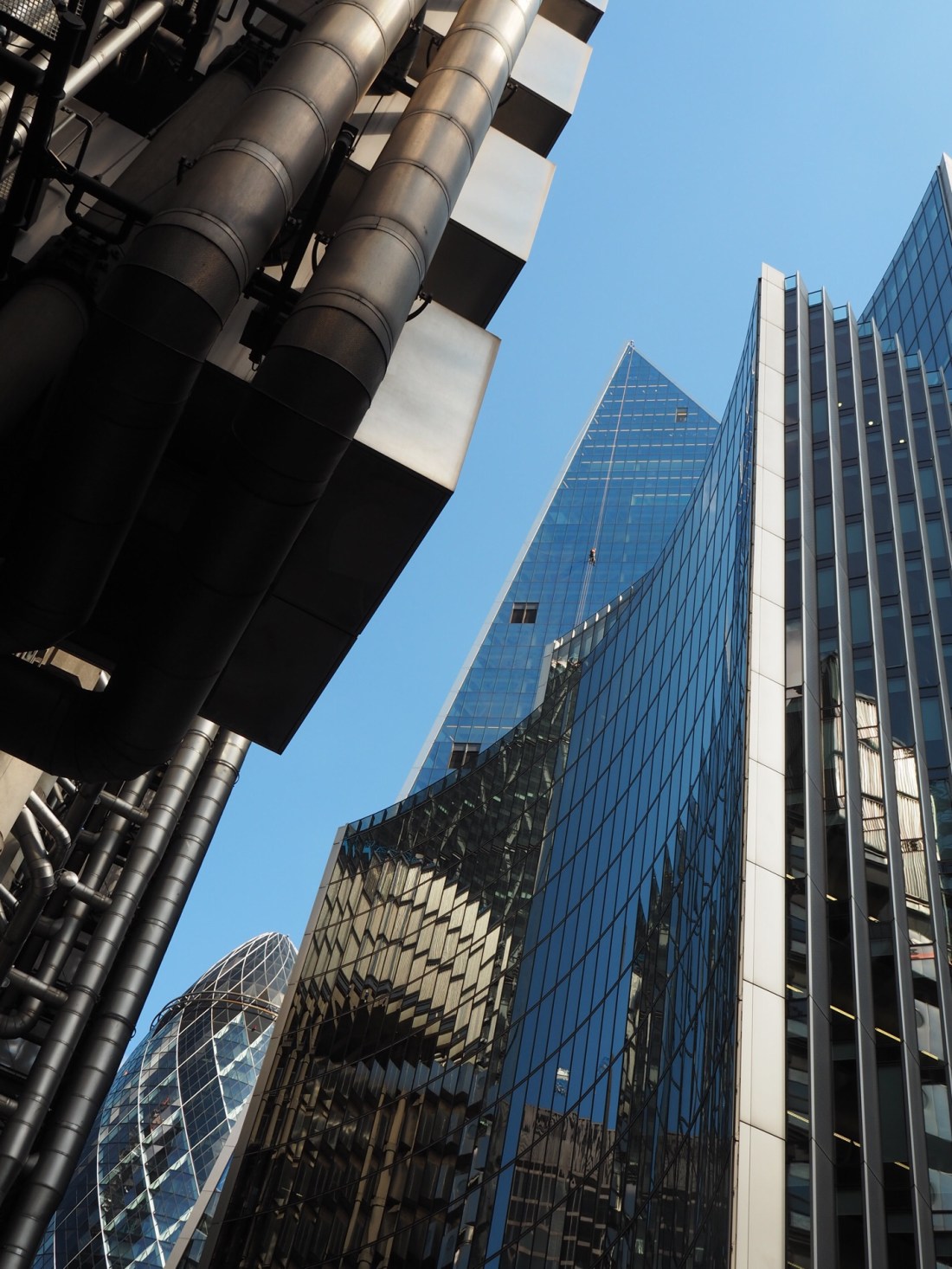
I last spent time in London about 30 years ago, when I came several times to negotiate for Reinsurance with Lloyds of London for a malpractice insurance company that I helped nonprofit community clinics in California set up. At that time, Lloyds’ building was new, and thought to be very controversial, and because all of its plumbing, heating, and air conditioning pipes were on the outside of the building, it was known as “Lloyds Loo”.

I got to London a day before most of the other people traveling on this trip to England, Scotland, and Wales, and desperately needed to stay awake until the normal going-to-bed time (after a 10 hour flight from SFO that landed at Heathrow at about 6AM on which I got about 4 hours of sleep). So I took my camera and started out to explore the area between the Thames (and the Tower Bridge and the Tower of London) on the south and Lloyds on the north. An area of 2800 sq. Meters, which I think is about 1 square mile (although I’m not sure that this calculation is correct).

I was looking for new buildings and how they fit into the landscape. I was astounded at what I saw! London has obviously undergone a serious building boom. My hotel was in the neighborhood of the Tower of London, whose White Tower, was, for a long time, the tallest building in London. Here’s a picture of the Tower with the current tallest building, known as the “Shard” behind it.

To understand truly why it’s called the “Shard” look at the detail photo below.

Yes, the building IS finished! The Architect, Renzo Piano, designed it that way. (He is also known for designing, amongst other things, the Centre Pompidou in Paris.)

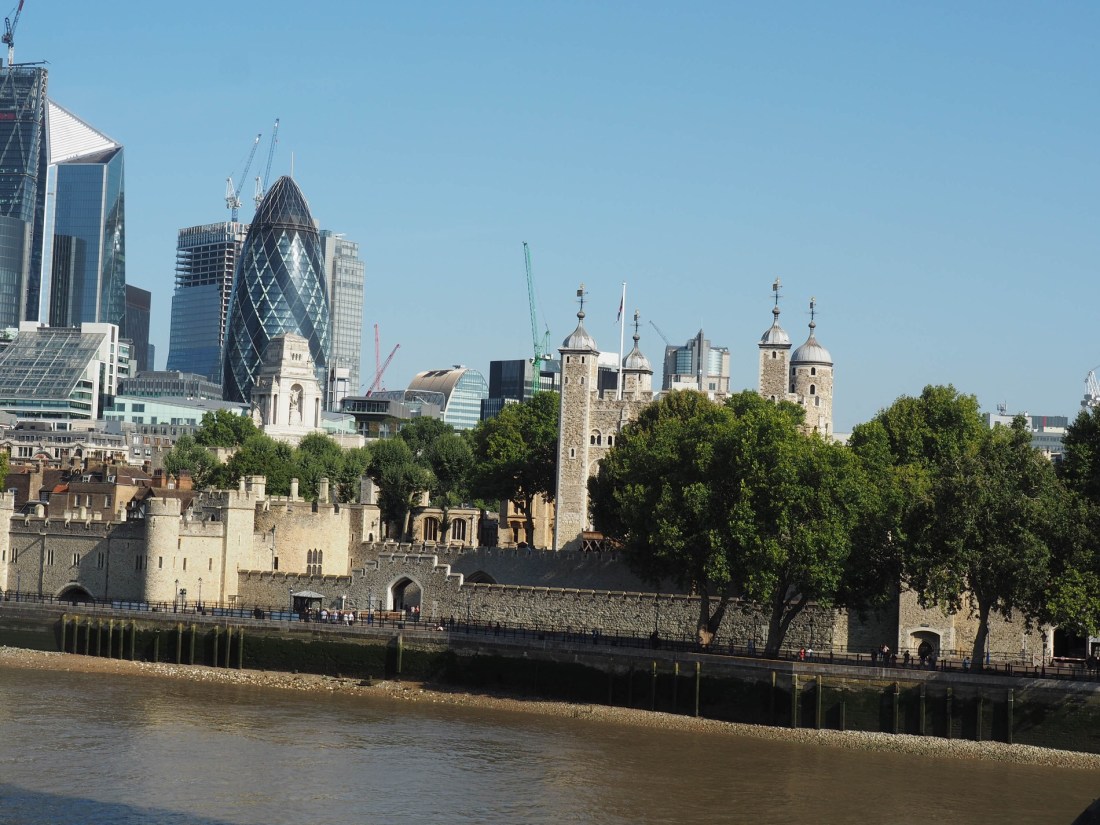
I walked across Tower Bridge to take a picture back looking towards the Tower (with my back to the Shard, as it were). This immediately told me that the face of the City of London had changed radically. (The City of London is the name of the area that was originally settled in London, and it is now the home of most of the banking and insurance businesses). That’s the White Tower of the Tower of London just behind the trees, the “Gherkin” to its left, and the “Scalpel” further back to the left.

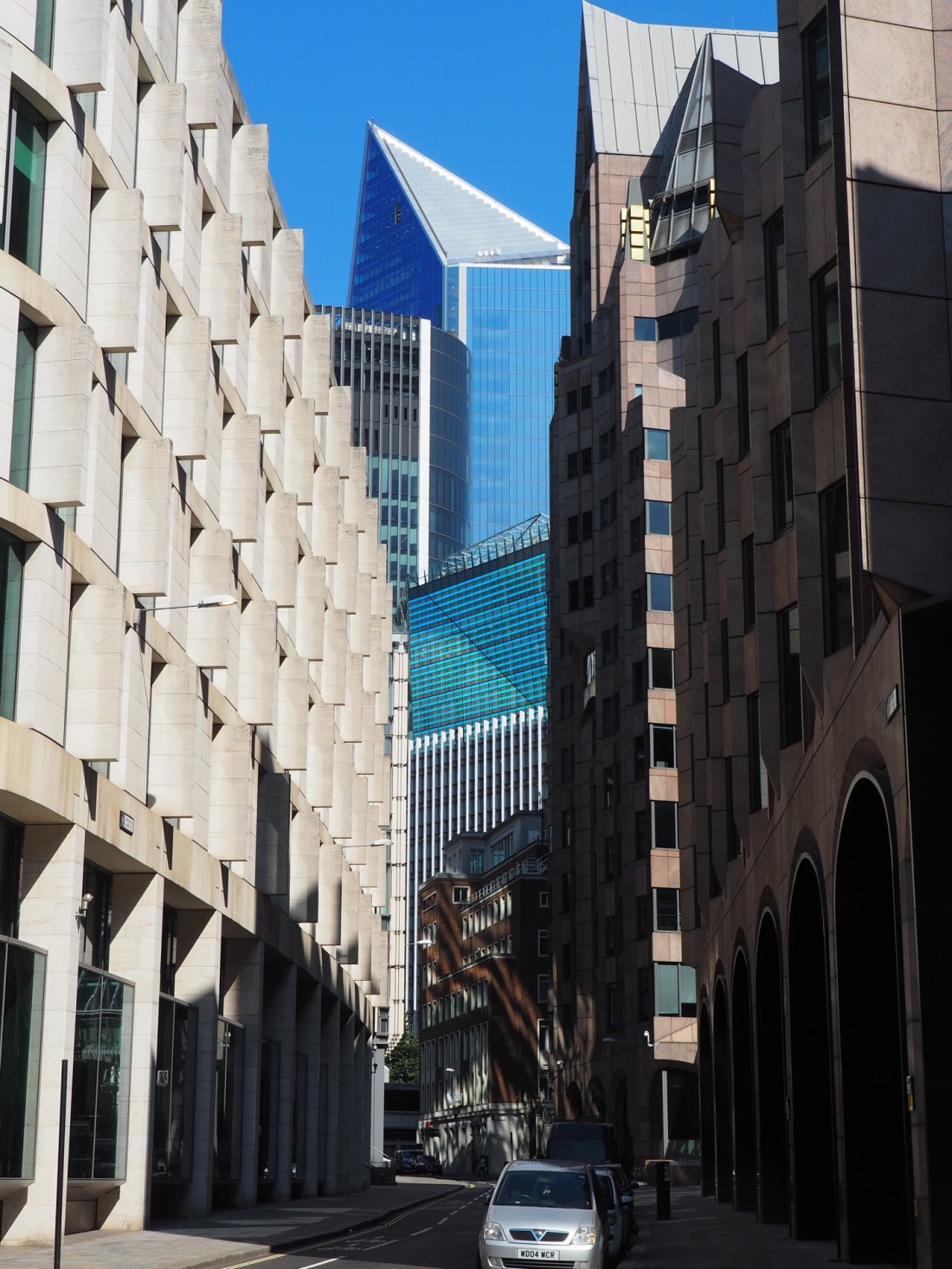
What interested me the most was the juxtaposition of the new buildings with the old, for example, the reflection on the lower brown building in the background from the glass of an unseen building around the corner.

And in the juxtaposition of the new buildings with other ‘new’ buildings. That’s a part of “Lloyd’s Loo” on the left, with the Willis building (not nicknamed – that’s the name of the primary tenant) immediately opposite it, the “Gherkin” in the middle, and the not yet completed “Scalpel” to the right.

And did your notice the man rappelling down the side of the “Scalpel” in the photo above?

He casually dropped down to just above street level, seemed to talk briefly to co-workers who were on a scissor lift installing panels under the fascia, dropped his ropes, and then disappeared behind the wall surrounding the construction site….

I wonder if the architect of the “Gherkin” was inspired by the shape of the spires on the church next door?

And whether the architects of the various buildings have ever come to look at the overall effect that their buildings make when viewed together?

Mary

Written in London,

Uploaded from Caernarfon, Wales 9/7/18

Reflections

Somewhere west of Bismarck, North Dakota, headed for London via Greenland at 37,000 feet

Waiting for my flight to London this morning, I met a woman in the terminal who was headed for London to meet her husband and spend a few days there. She is a patent attorney (working with pharmaceutical companies) from Chicago, and she travels a lot. We fell to talking about places we had been, and that started me thinking back to some of the places I have been privileged to visit in the last few years.

A few stand out:

Peru: Waking up to see the sun rising over the sun gate, and then hiking up to it from the Sanctuary at Macchu Picchu on the Inca Trail. How many sunrises did the ancient Inca see when he spent time there, and how many thousands of footsteps trod those same stones? The empire was tied together with thousands of runners who carried messages over those same stones, memorialized in knotted cords (The Incas seem not to have a written language).

And then spending 10 days on the Amazon river in a small ship, waking up to watch the sunrise, then cruising the river and its tributaries, looking for birds and strange plants, then drifting down a tributary one night in an open boat, watching the Milky Way slowly materialize overhead as the jungle came alive with night sounds.

India: Drifting on another river, this time the Ganges, watching a different sunset, seeing a funeral pyre suddenly flare and a skull briefly silhouetted by the flames, then setting little paper boats with lit candles in them afloat, while a priest chanted prayers for the departed.

Seeing the moon rise over the Tai Mahal. Spending time on the backwaters in southern India, meeting young students in a school who eagerly pored over the map of California that I had brought them to understand where I was from.

Russia: Visiting Catherine’s palace and being serenaded unexpectedly by a men’s acappella singing group in her coffee house (she insisted on making her own coffee, making her the world’s first royal barista!)

And attending a performance of the ballet after visiting the Hermitage in St. Petersburg.

The Baltic’s: Meeting a woman who had been deported by the Russians to Siberia in a boxcar as a child, seen her mother die of starvation (and her body put out to be eaten by the wolves because it was impossible to dig graves into the permafrost) and forced to live in inhuman conditions while fishing for the Russians. At the end of her talk, one of the people in our group, an Indian woman, knelt and touched her feet in respect, while the rest of us sobbed.

Cuba: Attending a performance of young children who are enrolled in one of the many children’s musical programs. One little boy stole the show: He seated himself on the edge of the stage and, dead panned, sang a song, while little girls danced behind him, pretending to be chickens who have laid an egg (and the baby chick who hatches). Throughout the performance, he never lost his cool, obviously projecting: “Yes, I know there are girls behind me making fools of themselves, but I am a professional, and I PUT UP WITH IT so that I can sing you this wonderful song!

Iran: Standing in Persepolis, looking at the famous staircase that shows all the envoys who came to bring tribute to the king, and then walking amongst the stone pillars that must have awed their visitors.

Then going to the tomb of the famous poet, Rami, and reading his poetry in what must have been his garden. And suddenly being inundated by school children, who heard that I was taking Polaroid pictures and clamored for one. My tour leader had to come and rescue me when my film ran out!

Turkey: Floating over Cappadocia in a hot air balloon – drifting in the early morning silence, surrounded by a hundred colorful balloons, looking down on the surreal landscape. One of the people in the balloon told the pilot that she had heard that you could pick apricots off the trees from the balloon. “No,” he said, “there aren’t any apricots now, but, here – you can pick a leaf.” And with that, he maneuvered the balloon down to within picking distance of the trees. And, when we landed, he brought the basket in which we were traveling down on top of the trailer that carries it from the field to its hanger. – show off!

Later, attending a worship service of the Whirling Dervish, held in an ancient caravansary. Haunting music, echoing off the vaults, and mesmerizing patterns….

Africa: Sitting (in an open Land Rover) no more than 6 feet from a magnificent male lion, who every so often opened his eyes, raised his head, and gazed at me – letting me know that I was there on sufferance. A day later, finding a young family of lions – the father and several females with at least a half dozen cubs who communicated with lion-sounds. The cubs found a fallen tree to treat as a jungle gym when Dad roared at them not to bother him. But at the end of an hour, as the sun was going down, the elder lioness rose, called to the cubs, and the entire group left – time to hunt!

Being charged by a female elephant who took umbrance at us stopping to take pictures of her and her cub. Sitting in an open Land Rover and watching a (probably) 2 year old male elephant methodically strip a tree of its branches, then wave them with its trunk before placing them in its mouth – when that happened, our driver would say “eek” and back up a couple of feet, otherwise we would have been “Bush wacked” – sorry, bad pun – but you get the idea of how close we were to the elephant!

Australia: Visiting the sacred rock of Uluru, walking around its perimeter, amazed by the life giving springs of water at its base. Then toasting the sunset with champagne as it fell behind the rock. Yes, 110 degrees Fahrenheit the next day, but nonetheless, our tour leader served us ice cream for snack in the afternoon (I had complained that I didn’t get any in Alice Springs!)

Diving on the Great Barrier Reef – what can I say – except that it was indescribable.

So yes, travel is a life changing experience. I am on my way to Great Britain. My ancestry on my mother’s side is Scottish, and on my father’s is English, so it seems like the appropriate place to go. After seeing so many other places in the world, I am going back to my roots.

Mary

Published in London, England 9/2/18

La Terrazas

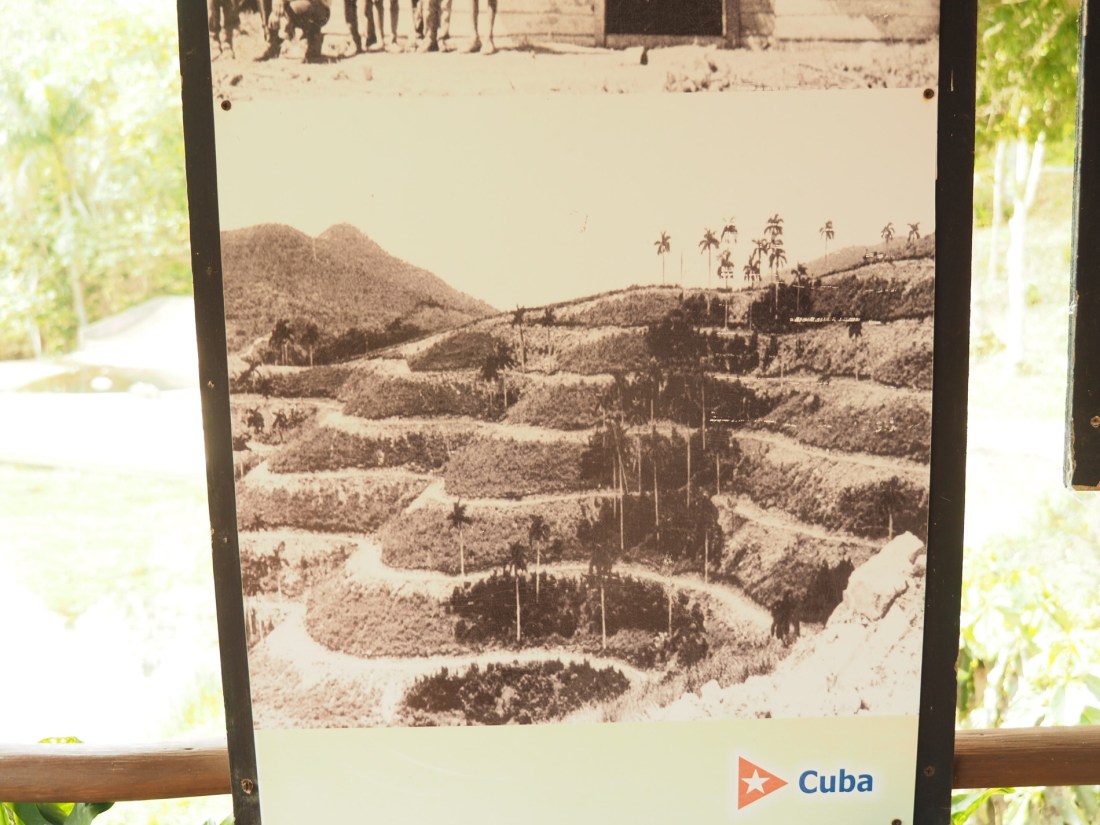
We visited La Terrazas, a UNESCO ‘biosphere reserve” which was established after the revolution to resurrect the land. When the Spanish came, close to 90% of the island was forested, and they cut down a large part of it and shipped the wood to Spain. Then came the French who grew coffee, which does best in the shade, and thus they preserved the forest. But by the time of the Revolution, only about 30% or the forest remained.

The revolutionary government undertook a program of re-forestation. Here is a picture of the land as it appeared in the early 1960s when terracing began to control the erosion that had taken place.

Now the area is lush with vegetation. Dams have been built, and a whole community has grown up, with homes, restaurants, gallery of an artist who lives there, and an hotel.

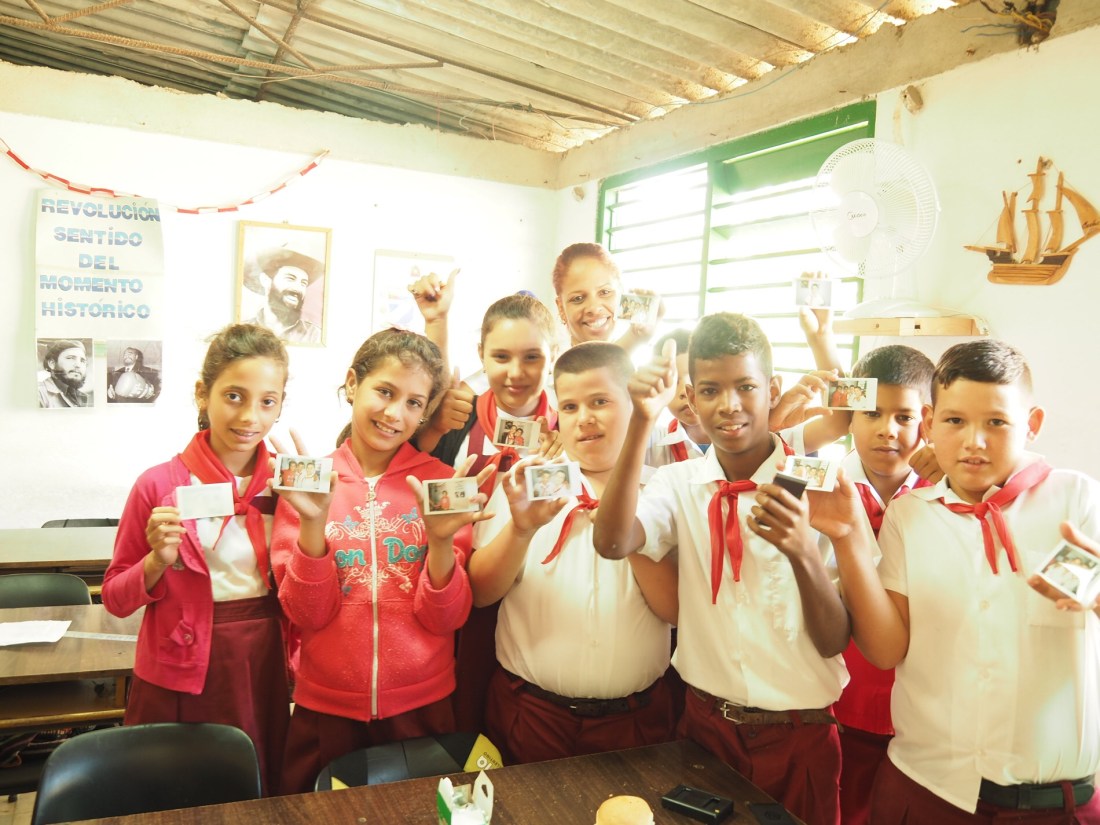
We visited the local school, which serves kindergarten through 12th grade. We learned that there are 260 students plus 45 teachers and 15 volunteers. School hours are 8 to 4:15. The ratio of teacher to student in elementary grades is 25 to 1, in higher levels it’s 30 to 1. English starts in 3rd grade. Art, theatre, dance, music and sports are included in the curriculum.

We were invited into a classroom where we talked to the students about what they learned. I had brought an instant photo camera (Fuji bought the rights to the technology from Polaroid) and took pictures of each of the children and their teacher. They were delighted, and posed for a picture for me!

Some of the 7th graders go to the local vegetarian restaurant, El Romero, once a week to learn about the culinary arts, and served us when we had lunch there. They also learn to tend the organic gardens that supply the restaurant, and about the special diets that some of the local residents require (for example, diets for diabetics or cardiac patients).

I had wondered how hard it would be to be vegetarian here, but I learned just how colorful and delicious Cuban vegetarian cuisine could be!

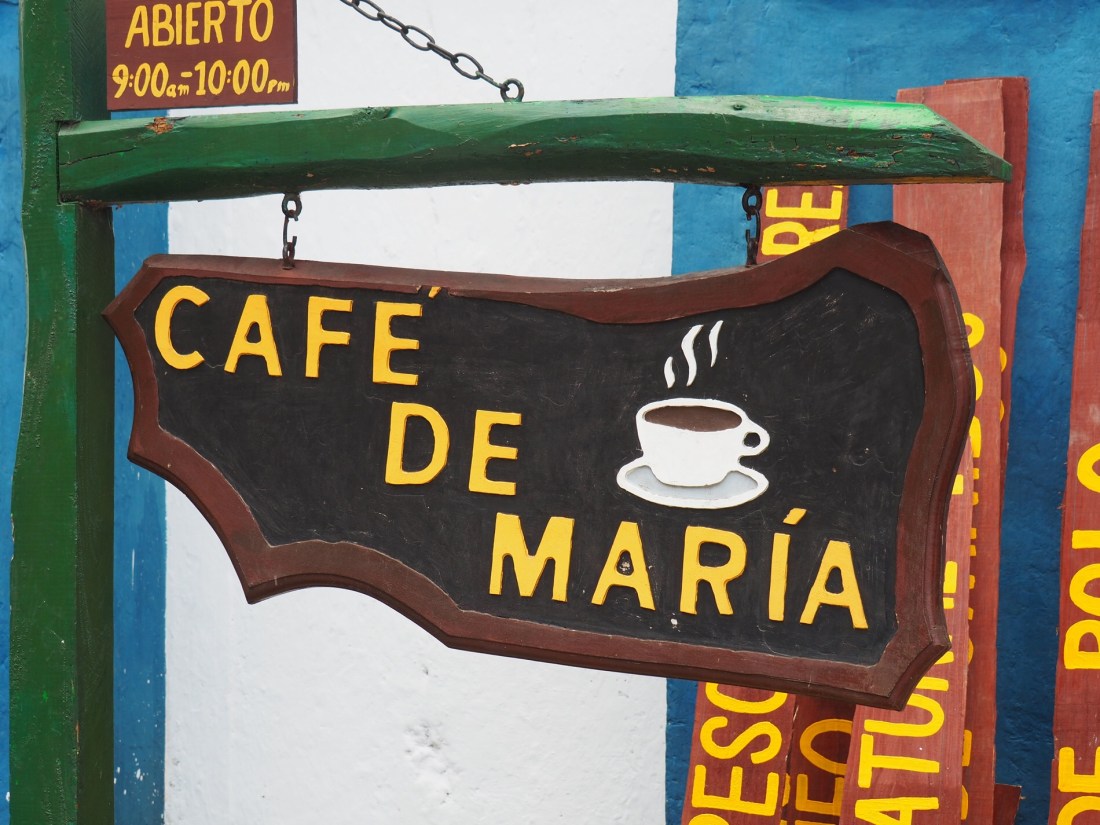
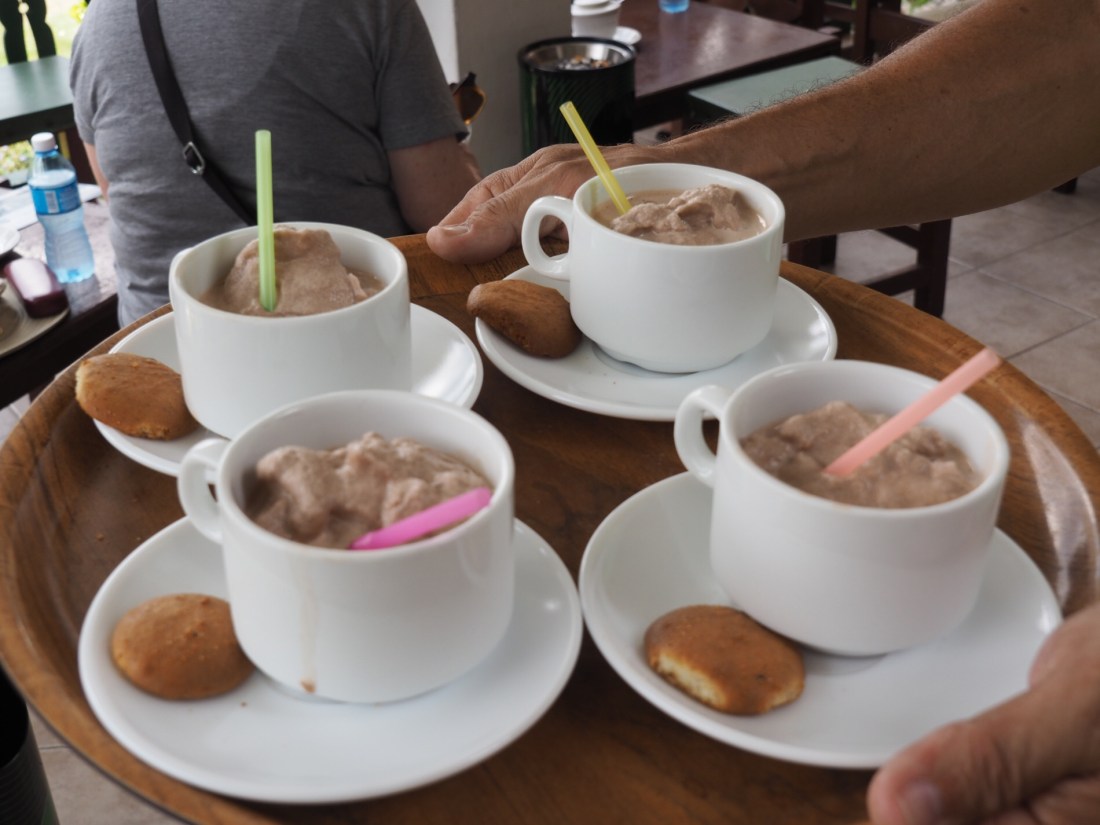
Afterwards, we adjourned to Café de Maria (my namesake Café- get it?) for special coffees designed by Maria, who originally owned the restaurant, and sadly is no longer with us.

Written in Havana, Cuba

4/12/18

Posted from the US 5/20/18

Posted 5/20/18 from the US

Repression

I have always been taught that the Revolution in Cuba brought repression and iron control to the people here, and that the embargoes that the US instituted, starting back in the 1960s were good things and would free the Cuban people from the iron fist of communism. I expected to find angry people with sad demeanors, eager to throw off the communist yoke. And I expected that we would not be able to talk to the average ‘man on the street’ – that they would be forbidden to express their feelings or tell us about their situation for fear of being punished by the government.

What I had not been taught was that the Cuban people were a lot worse off under the previous “democratic” regimes of people like Bautista. Corruption was rampant, as was prostitution, and the mafia was widely known to be in control. Healthcare was non existent, and 45% of the population was illiterate.

Our current government seems more and more eager to keep its citizens from traveling to Cuba and engaging with its people. God forbid that we might learn the following:

• 85% of all Cubans live in homes owned by their family (whether this is an apartment in a multi-unit building or a single family dwelling).

• 0% of the population is homeless.

• Education is free starting with childcare and going through advanced University degrees. Attendance at school is mandatory from kindergarten through 12th grade.

• Medical care is free, and prevention is emphasized. Because of this, infant mortality is 4.04 infant deaths for every 1,000 live births. Life expectancy is 78.45 years (80.45 for women, 76.50 for men).

• Every woman who works for the government is entitled to a paid year to care for her child in the first year of its life. (If for some reason the father is the child rearer, he has the same right)

• Every person who works for the government gets 4 weeks of paid vacation, and a pension. (The same is not true, however of people who work for the private businesses that have only recently been allowed).

• Artists and musicians are paid to teach the arts, not just in schools, but also in community art programs.

• Sexism is not an issue – I asked a young woman who is an attorney if a man was given priority over her for a job, or receives a higher salary, and she looked at me as though I were crazy. “No,” she said, “not here.”

• Racism is not an issue – after all, the majority of people here have at least some black ancestors and skin and eye colors are not considered.

• 52% of the parliament is made up of women. Ages of parliamentarians range from 18 to 60. Presidents and legislators serve terms of 5 years and may not serve more than 2 terms.

• Cuba has greatly reduced its dependence on foreign oil. Hand in hand with this is the almost universal use of organic farming practices, with no chemical fertilizers or pesticides. Many fields are plowed by oxen, rather than tractors (less gasoline required, less pollution). Away from Havana, in the ‘countryside’ you see lots of horse drawn taxis and delivery carts.

• The government is very concerned about the effects of global warming, and has a plan known as “Teresa Vida” (Life Task) for dealing with its effects. For example, the government prohibits any new construction of dwellings in threatened coastal areas, in other areas it is re-planting mangroves to reduce coastal erosion.

• After Fidel Castro retired and his brother, Raoul became President, private businesses began to be allowed. Everywhere you see the benefits of this – little shops in the front room of the house, people selling arts and crafts from a little cart, farmer’s markets where fresh produce can be bought.

• And, perhaps most importantly, people are HAPPY! Musicians perform on street corners, and everywhere people are dancing.

O.K., reality is that

• The average Cuban working in a government job is paid a very small amount of money. Pay is based upon qualifications and experience. So, a teacher straight out of university makes less money than a teacher who has been teaching for 5 years, for example. And the person sweeping the streets is paid very little.

• Pensions are correspondingly small. We met women selling little paper cornucopias of peanuts – they buy a quantity of raw peanuts, roast and salt them, then wrap them in white paper and sell them on the street for a few pesos. One of them told us that her pension was 300 pesos per month and although medical care is free, medications are not. She spends 30 pesos a month for her asthma inhaler, and another 20 for her cardiac medication.

• Each family receives a ration book that guarantees the right to buy at subsidized prices certain amounts of basic food stuffs per person, like rice, beans, salt, cooking oil, eggs (and even rum and cigarettes!). The guaranteed amounts are supposed to be the minimum required for good nutrition, but the person still has to have the pesos to pay for them.

• Education is free, but in return, the person is required to do three years of PAID community service – working in his or her specialty, but in a location determined by the government as one that needs those skills.

• Most people are too proud to beg – they sell peanuts, for example! – but I was approached by several elderly people asking for money (or a t-shirt, probably to have something to sell or wear). I saw NO young people begging however.

• Homes are very small, shared by several generations, and many buildings are in very bad repair. We visited a family in Trinidad that lives in a small 3 bedroom house. The family consists of the owner/mother and her three sons, her brother, his wife, and their 2 children AND the roof collapsed a month ago! They have managed to get a bank loan to repair the roof and meanwhile are camping in a very small space, surrounded by dust. Nonetheless, two of the sons are attending university.

• Although no one is homeless (no one is living in tents next to the railroad tracks), some of the homes we drove by were very dilapidated, some little more than shacks.

• As in the US, there is a ‘glass ceiling’ for women. This is changing, however, especially in the tourism industry, where 40% of managers are women.

• To have a small private business you must purchase a license (whether you are a bicycle taxi driver, a street vendor, or the owner of a small paladar (a restaurant/bar in a private home). AND the government imposes quite high taxes on the profits. Nonetheless, people are beginning to enjoy a higher standard of living than they previously could.

• Tourism is making a great deal of difference – although some hotels and transportation services are 100% owned by the government, while some are 51% owned by the government, 49% by ‘partners’ such as foreign companies, people working for them receive tips in addition to pay. And, of course, the new private businesses are enjoying the large volume of tourist business.

So you ask yourself: Why have we imposed such punitive embargoes on Cuba because it is Communist? Why isn’t there a embargo against Russia or the Communist countries of Southeast Asia (which, by the way, I learned when I visited Laos, Cambodia and Vietnam 2 months ago do NOT provide free medical care or education)?

When the Soviet Union collapsed and no longer provided support to Cuba in the form of oil and food, Cuba’s economy collapsed. The average Cuban lost 20 pounds during the 1990s and children suffered from malnutrition because they were literally starving. Medicine was not available.

In response, the US just tightened its embargoes, and, in fact, retaliated against any business that did business with Cuba. No humanitarian aid – just embargoes that punished the people of Cuba.

I am embarrassed to say that I am an American whose taxes support the government which turned its back on starving people because they lived in a Communist country. And which continues to believe that it is doing a better job of caring for its citizens because they live in a democracy, a democracy in which racism is rampant, people are without health care and homeless live in tents, higher education is beyond the reach of many, and the gap between the ‘haves’ and the ‘have nots’ is widening every day.

Written at various places in Cuba

Posted from the US

5/20/18
Licenses

Licenses

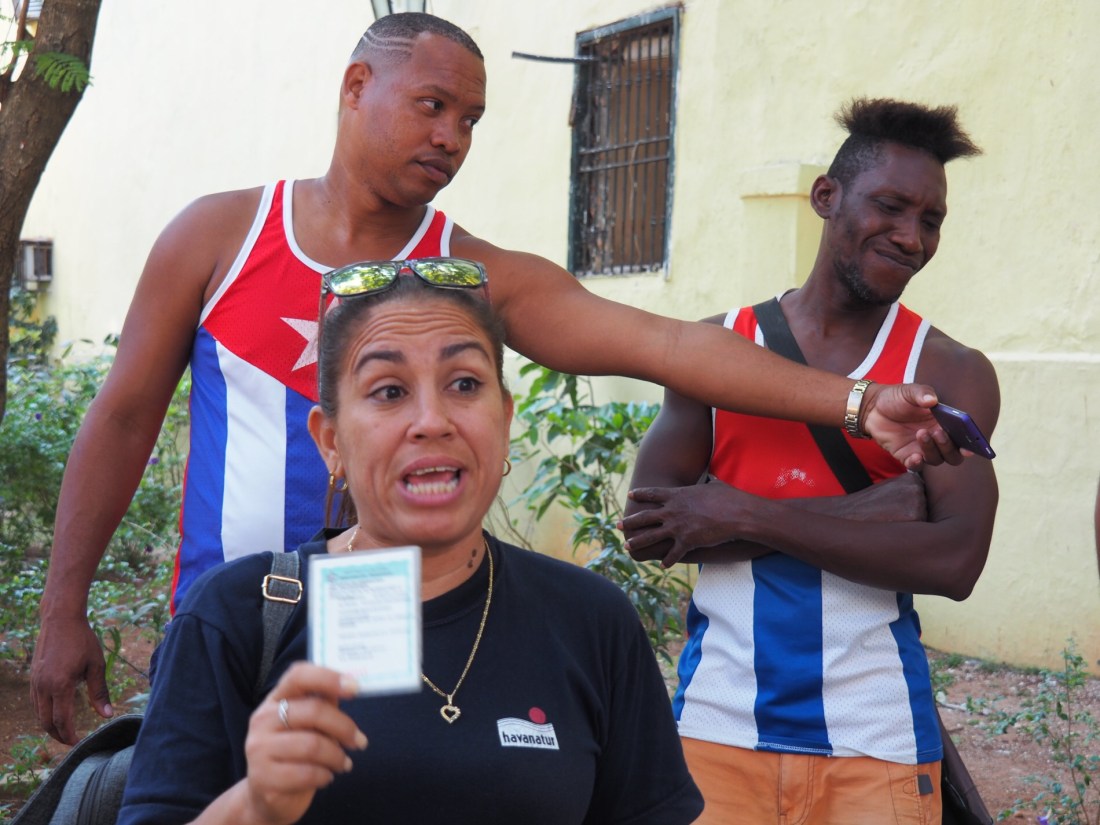
After Raoul Castro become the President of Cuba, private enterprise became possible. But to have a private enterprise, one must first have a license. The initial cost is fairly small (based upon the type of enterprise, of course) but then the entrepreneur has to pay tax on his/her earnings.

For example, the bicycle taxis driver must have a license. These are the guys who took us to the farmer’s market one day (the woman displaying the license is our tour leader).

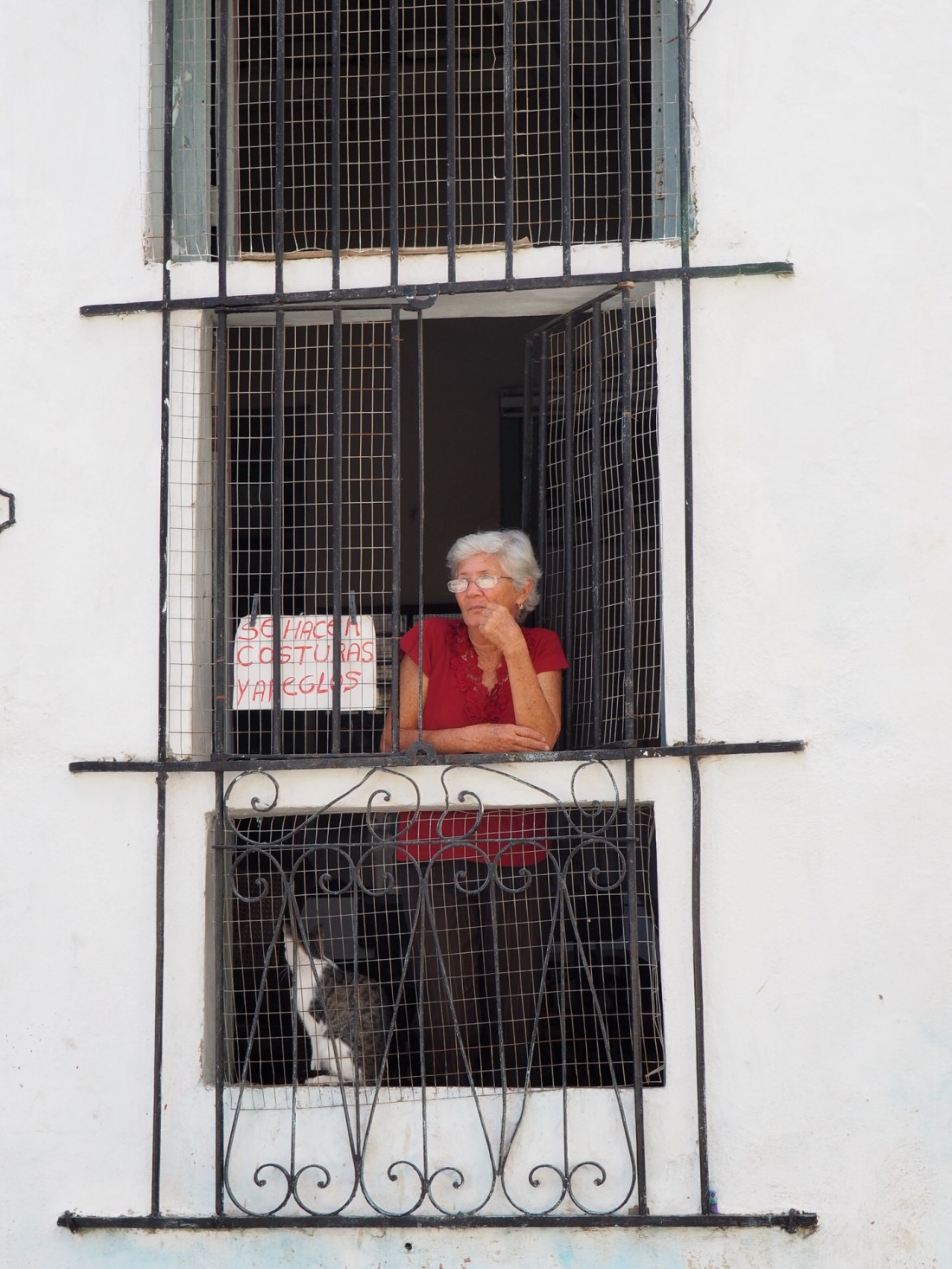
The seamstress working out of her home needs a license,

People who own private restaurants (paradars) pay a lot for a license, then about 50% or profits in taxes. And, of course, vendors on the street have to have a license

Even the ‘living statues’ who come alive when you put some money in their basket (the guy on the right in the pictures is NOT a statue, he’s one of my fellow travelers, who put some pesos in her basket and turned her into an automaton).

And, not but not least, dogs! (Who apparently have the right to ask you for a tip to allow a picture).

Havana, Cuba

4/11/18
Posted from the US 5/20/18