Magnolias

Magnolias

I have been a fan of magnolias for years, and have two deciduous and one evergreen variety in my yard. The deciduous magnolia is one of the first trees to bloom each year, and usually blooms on bare branches before leaves emerge, which makes the blossoms even more spectacular.

My favorite is a magnolia Campbellii. This one is named “Vulcan’s Forge” for obvious reasons.
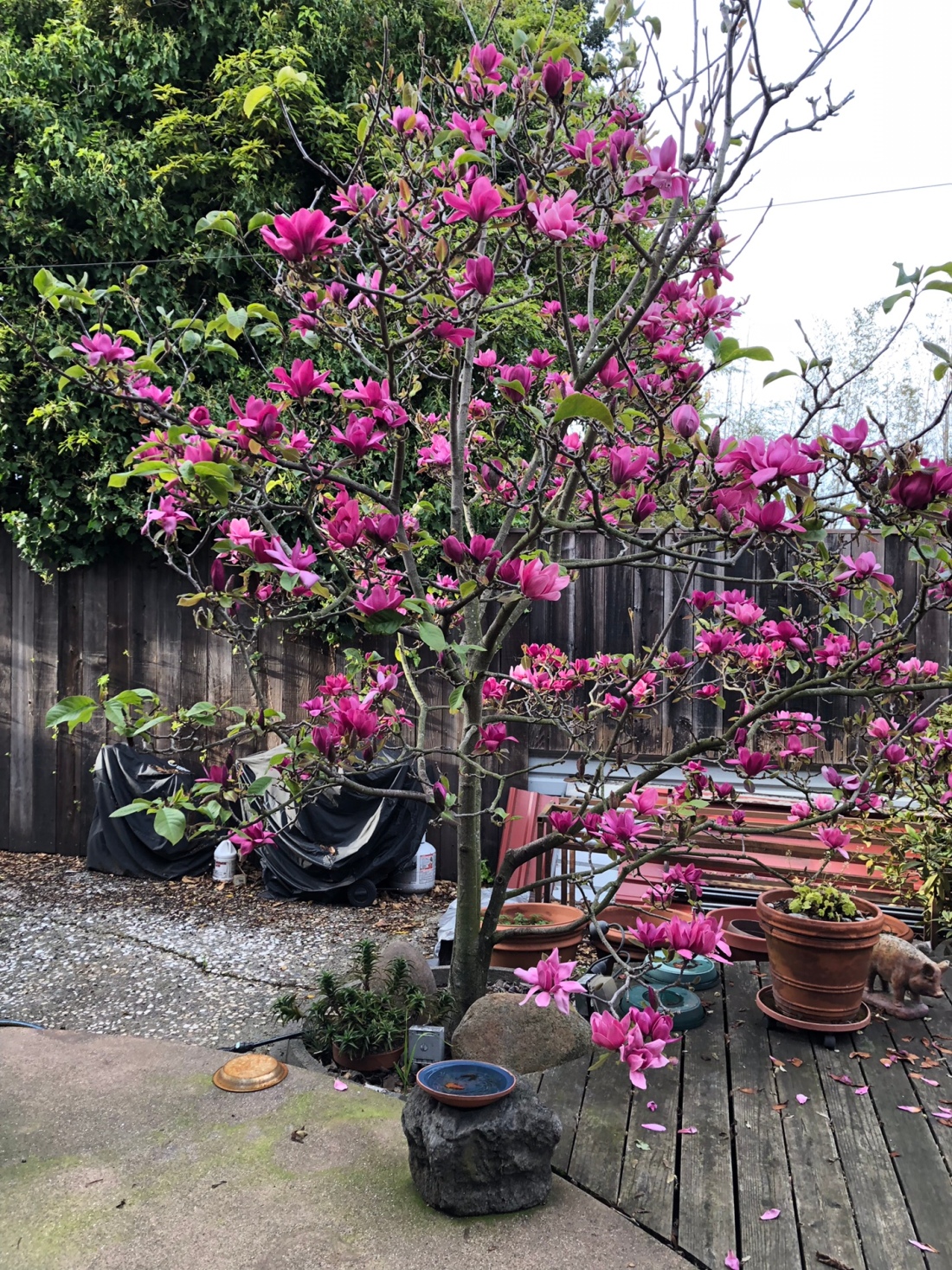
The second deciduous magnolia is a magnolia soulangeana commonly known as a “saucer magnolia.”
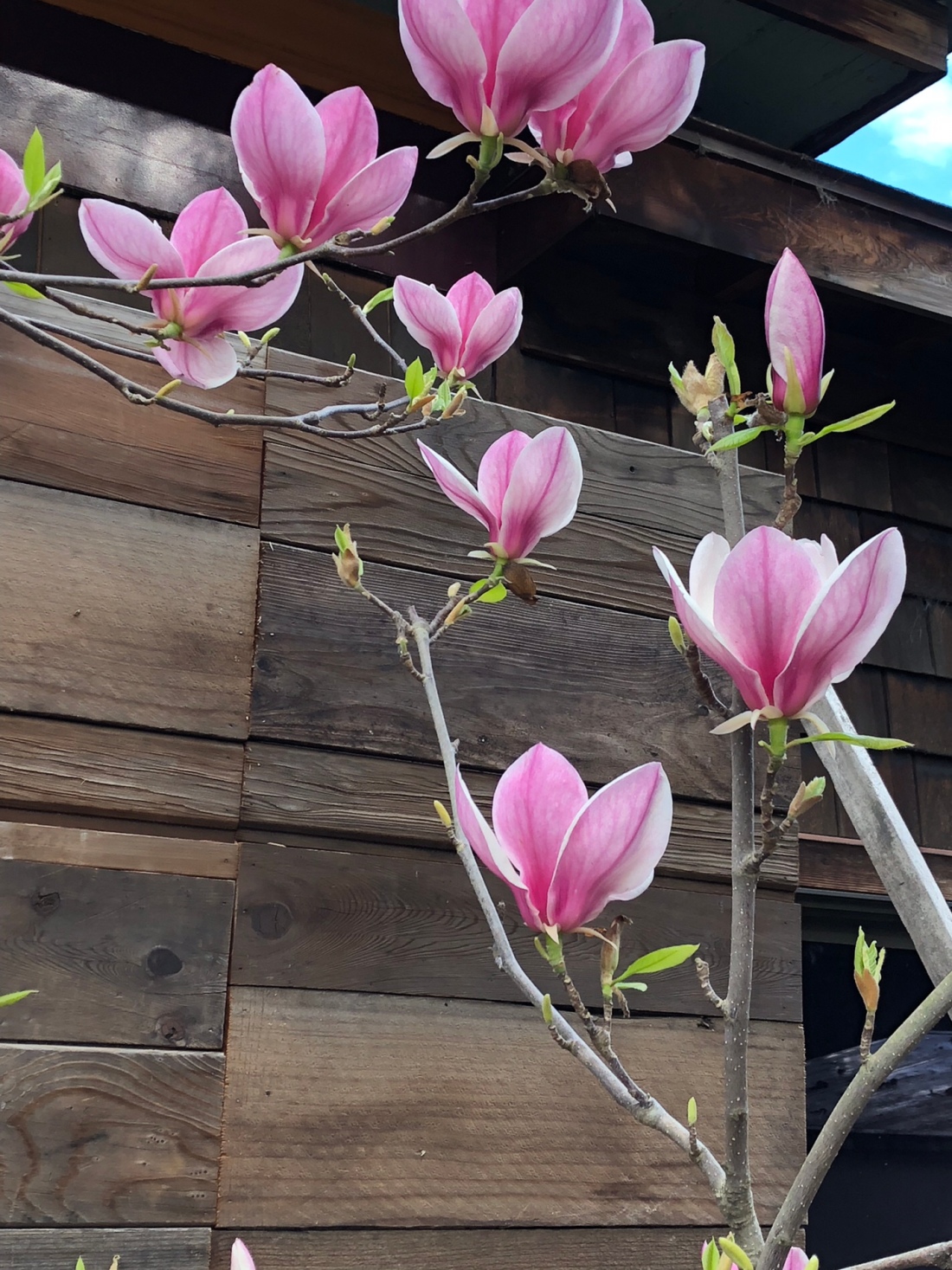
But these are just two of the many varieties of magnolia. The Botanical Garden in Golden Gate Park is known for its collection of magnolias, and I ventured there with my camera a couple of weeks ago to stroll and enjoy them. Here are a few:

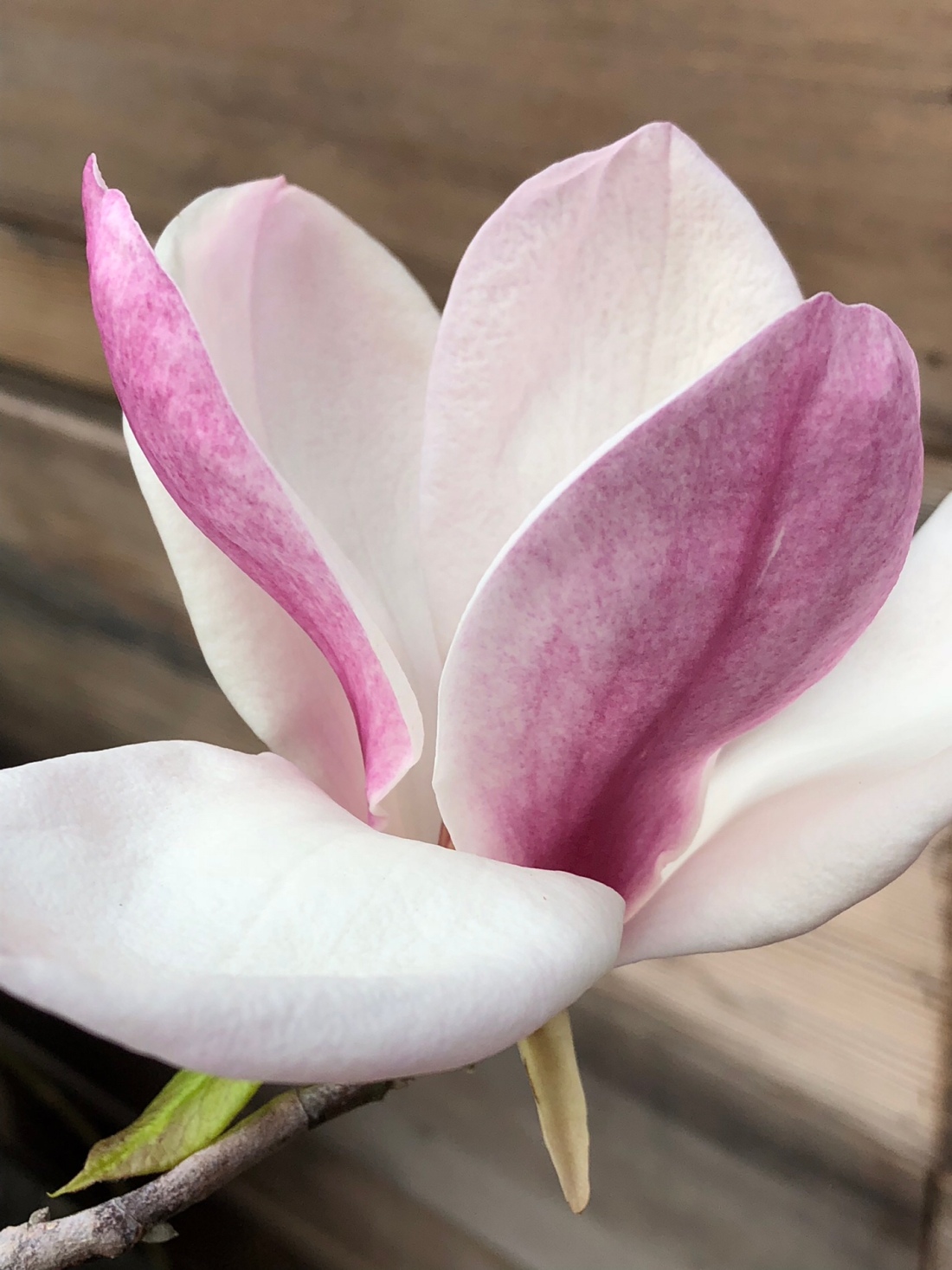
First of all, a variety of the soulangeana that has much deeper color on the outside of the petals than mine (but note that the inside of the petal is white).
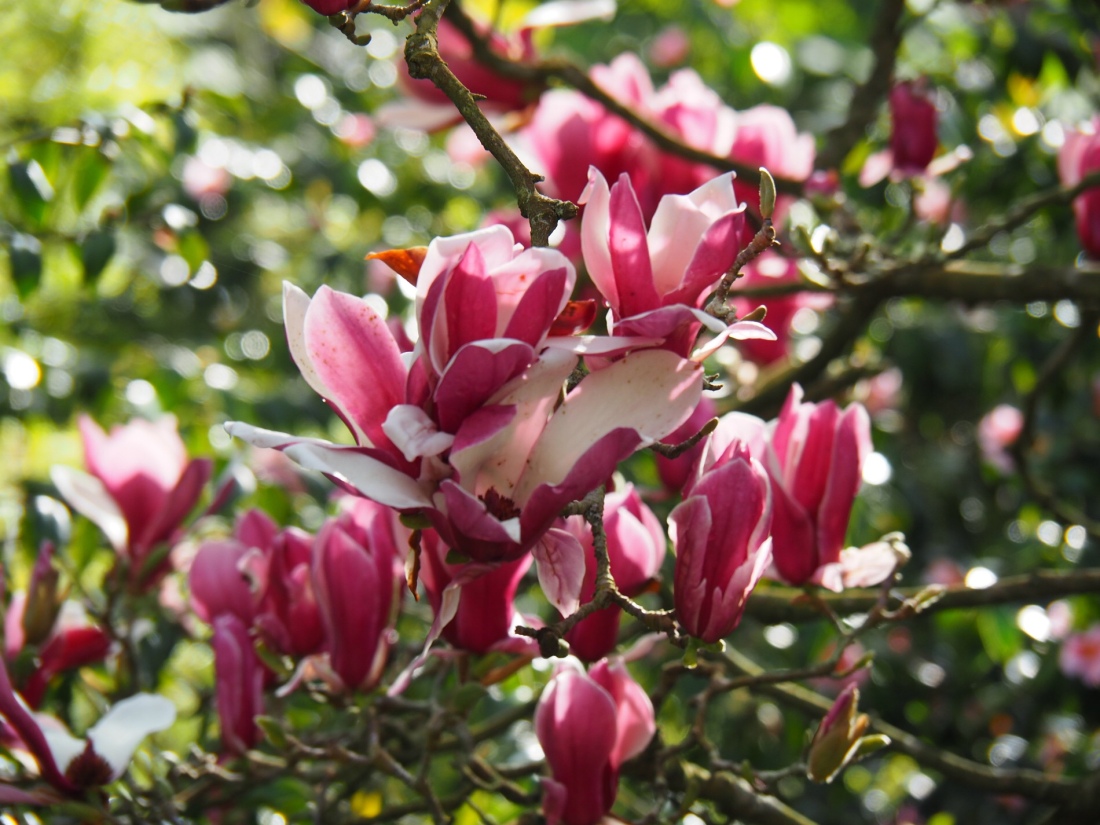
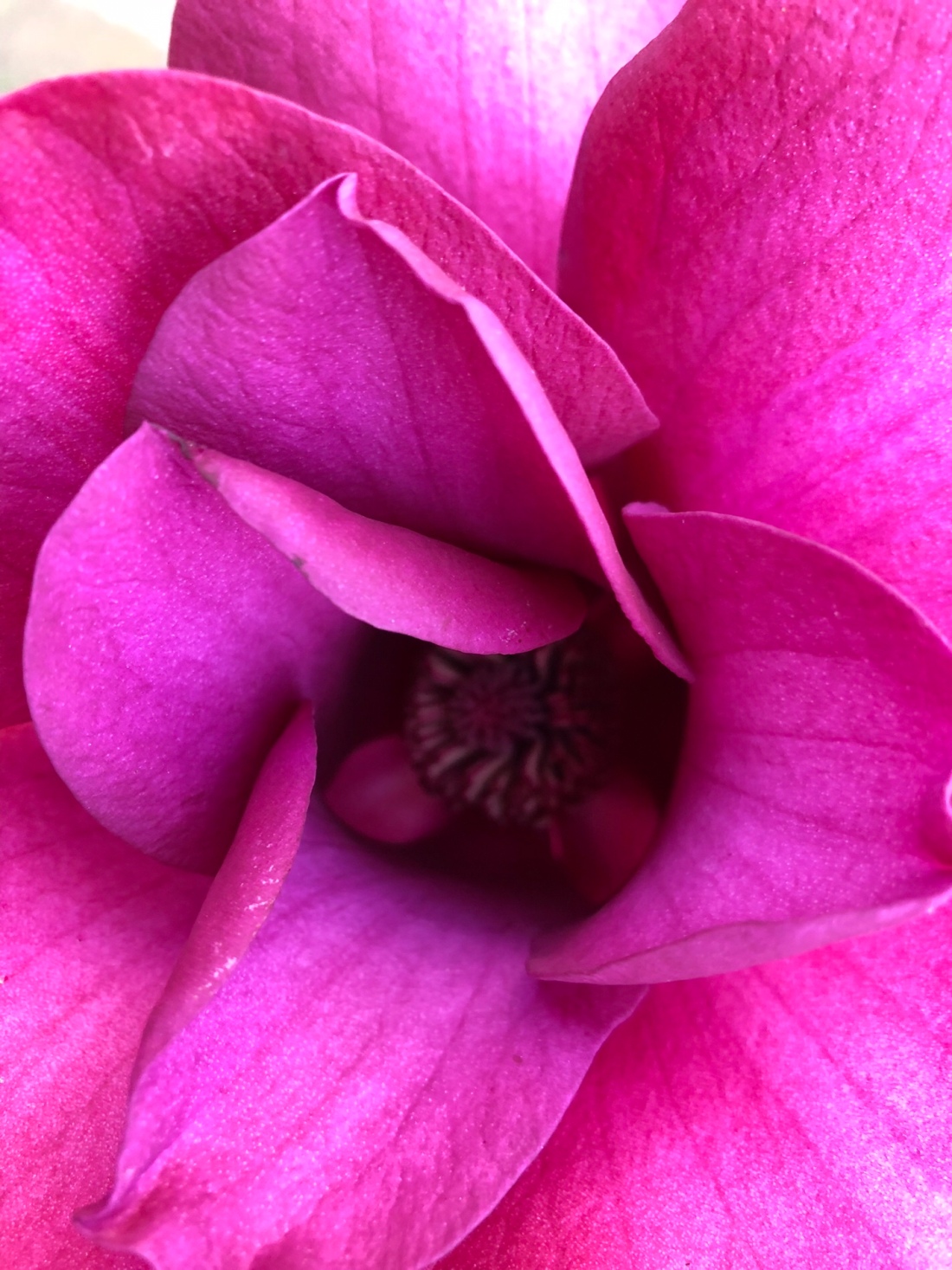
And here’s what the flower looks like inside – no, I didn’t cut it open, this is how I found it.

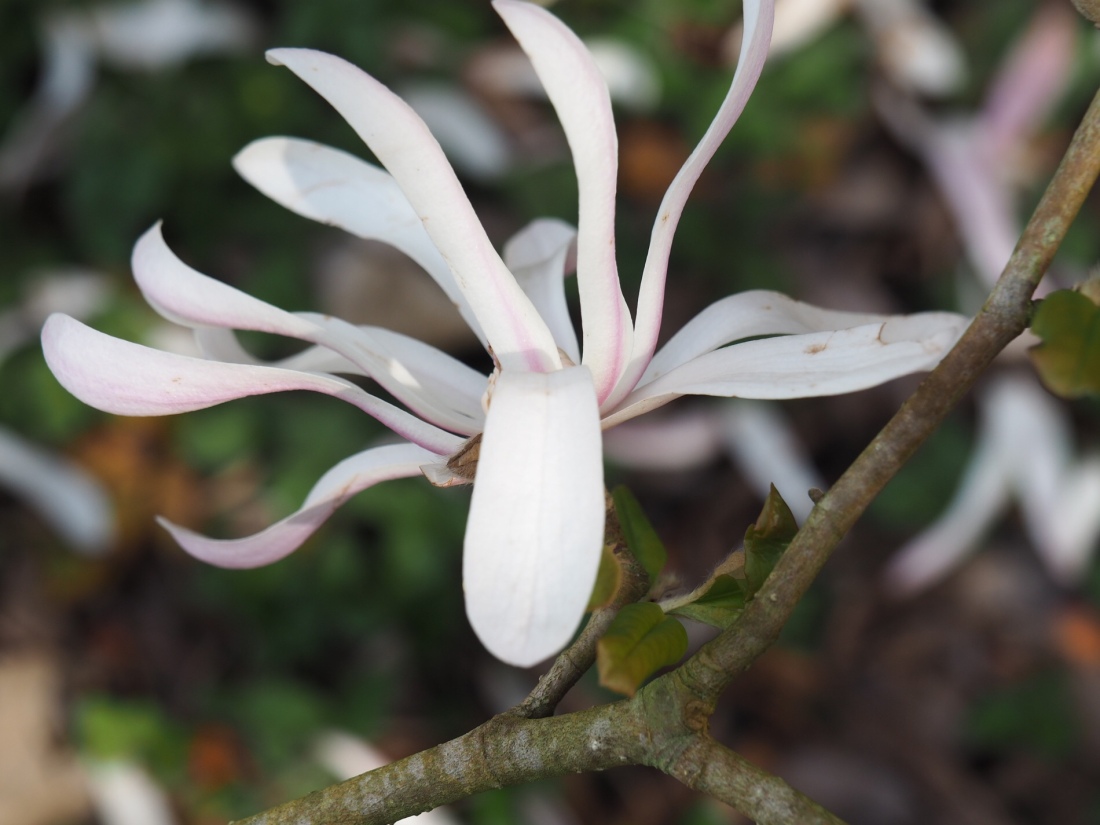
And there are “star” magnolias, magnolia stellata. These magnolias have “tepals”. (When both the sepals and the petals are the same shape and color, they care referred to as “tepals.”)

The SF Botanical garden also has a Campbellii. This one is known as the “Darjeeling,” because it was propagated originally from a tree in Darjeeling, India. As you can see, the shape is a little different from that of my “Vulcan’s Forge”
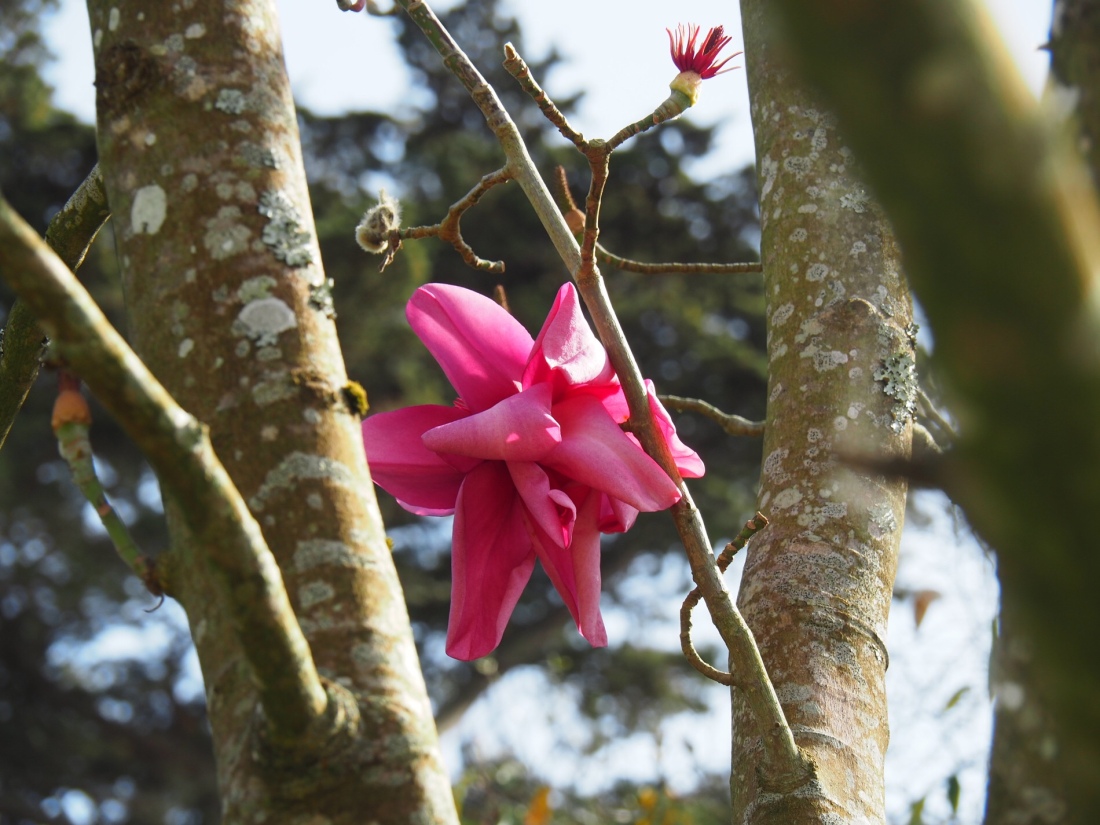
And then there’s a magnolia dawsoniana. This species is native to western Sichuan Province, China. It was introduced to the US in 1908, and named after Jackson T Dawson, the Arboretum’s first propagator. It is distinctive in that as the flowers open, the tepals begin to droop and then hang limply.
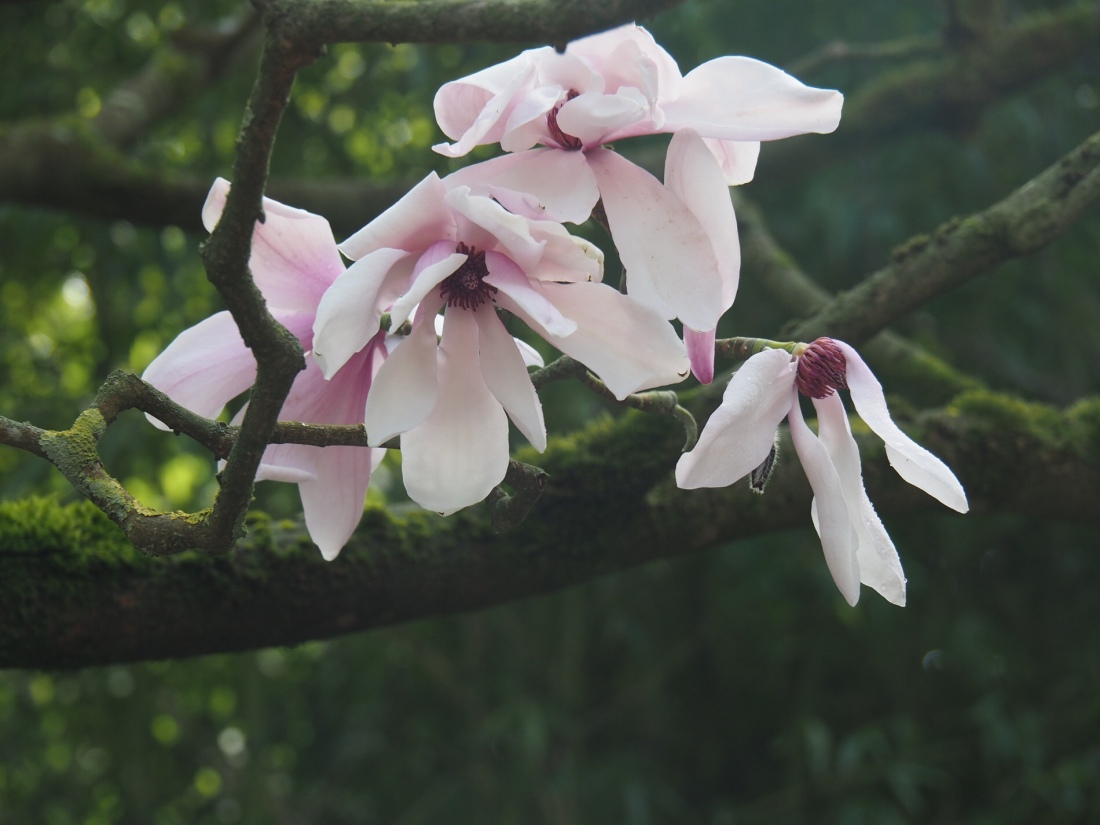
I love magnolias because of the textures of their petals/tepals. Here is a closeup of a petal of Magnolia veitcheii.
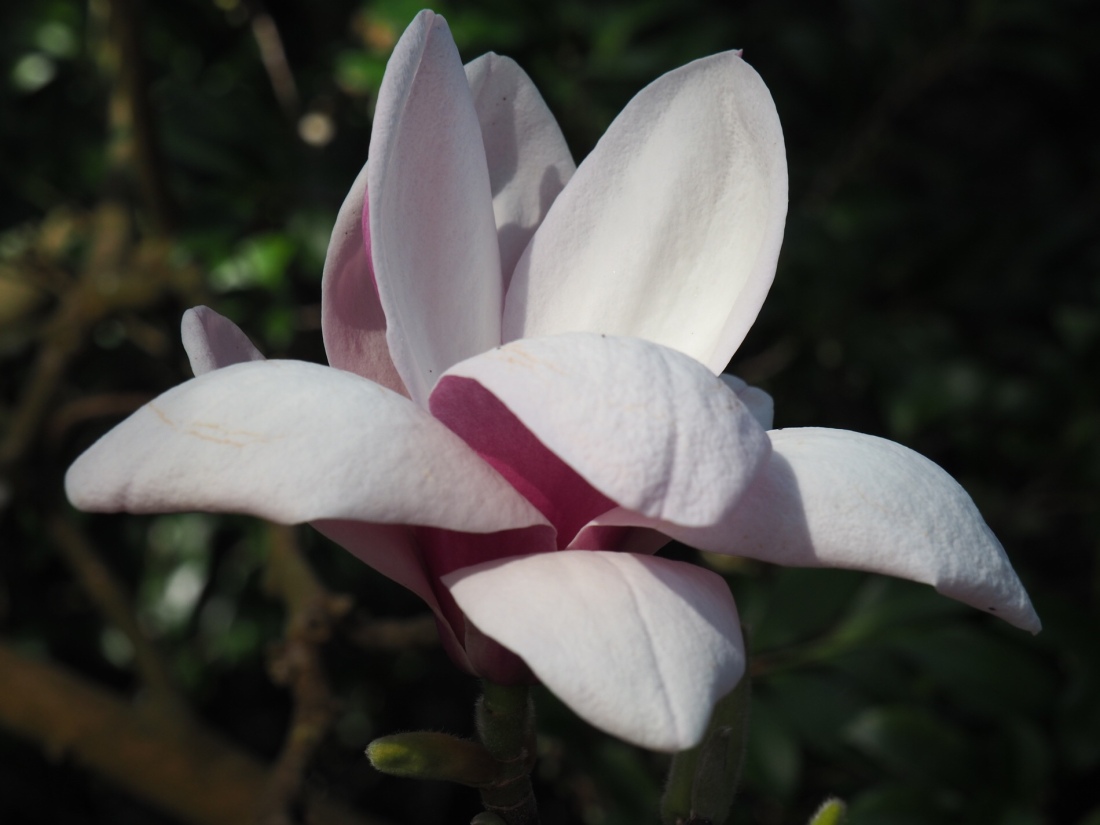
So now you know why I love magnolias so much!

Mary

Posted 3/18/18 Berkeley

PS: People have asked me about the camera equipment I use. The camera is an Olympus OMD E-M5 Mark II, and the lens for all of these pictures (except of the magnolias in my yard) is an Olympus 14-150 mm M.Zuiko Digital 1:4 – 5.6. Photos of the magnolias in my yard were taken with my iPhone.

I am leaving for Cuba on April 3. I’m hoping to be able to upload posts from there – so, if you haven’t signed up as a ‘follower’ yet, do so, and you’ll be notified when I do manage to upload posts! Or, just log on every so often!

The Garden in Winter

I recently visited FiLoLi in Woodside, California, a home and garden on the National Register, to experience its garden in winter.

Looking through the garden gate you see some of its evergreen hedges, and a glimpse of color

And as you walk through the rose garden, you see that the gardeners have been hard at work pruning the bushes.

Soon, you see some tentative shoots looking for sun

In the orchard, you find a tree that is bare except for one desiccated fruit still clinging to the branch that bore it.

And then you begin to see evidence that the trees are responding to the spring warmth and starting to bud

But it’s the golden carpet of daffodils surrounding the trees that loudly proclaim that spring is here!

There seem to be so many different kinds of daffodils!

And there’s a flowering hedge

Pots of hyacinths

With bees collecting pollen for this year’s honey

And one gnarled magnolia covered with lichen

Struggling in the shade and cold to produce at least one bloom

What a wonderful gift Spring is!

Berkeley, CA 2/24/18

The End of the Story

We have now come to the end of our 3 week trip to Southeast Asia, and are packed to return home. As you may remember, if you have been reading my blog, we attended a “Baci” ceremony in Luang Prabang, at which we were blessed and had sacred strings placed on our wrists to keep all of the 32 spirits in our body inside and intact.

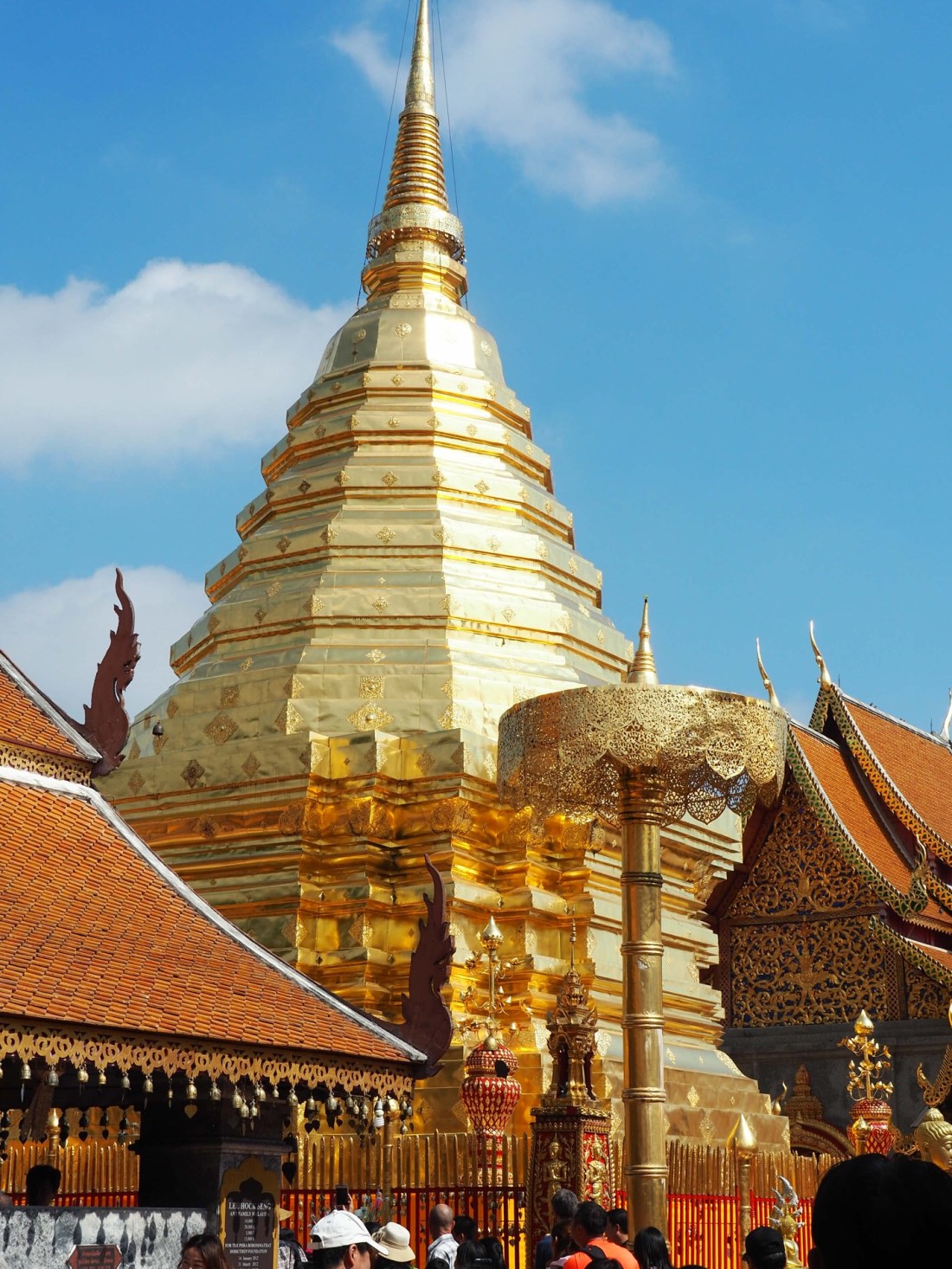
Now was the time to remove those strings and leave them behind. We did this at another temple, Wat Phrathat Doi Suthep, which is high in the hills above Chiang Mai. It has a golden pagoda which is said to contain a relic of the Buddha.

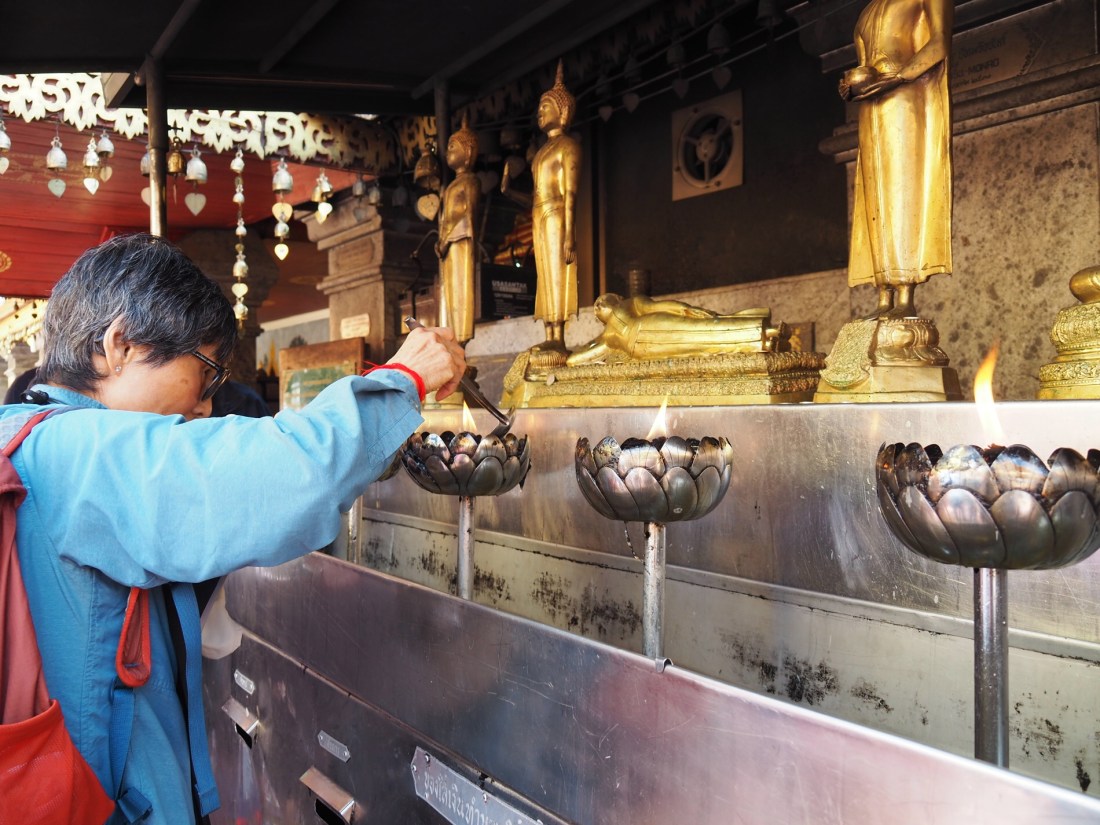
Our tour leader had an app that calculated the day of the week on which we were born. I was born on a Friday, my traveling companion, In Ja was born on a Wednesday. This is important because there is a different Buddha figure for each day. We were given the opportunity to pour oil into the lamp before our Buddha so as to keep it burning longer. Here’s In Ja before her Buddha, which is reclining.

Then we were told to remove the strings from our wrists, and led into a small room where a monk blessed us and the strings.

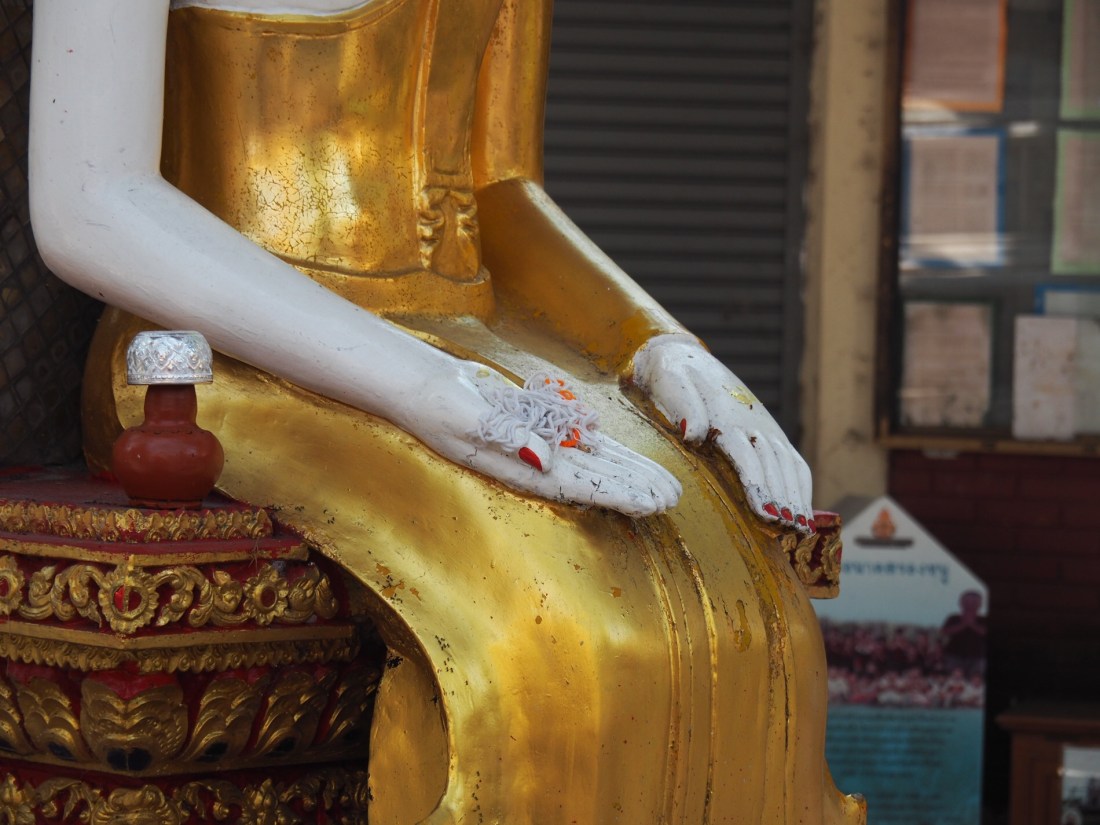
Next we took the strings and laid them in the hand of a Buddha who sits under the “Buddha tree” – the species of tree under which he was sitting when he reached enlightenment. This apparently imparted his direct blessing.

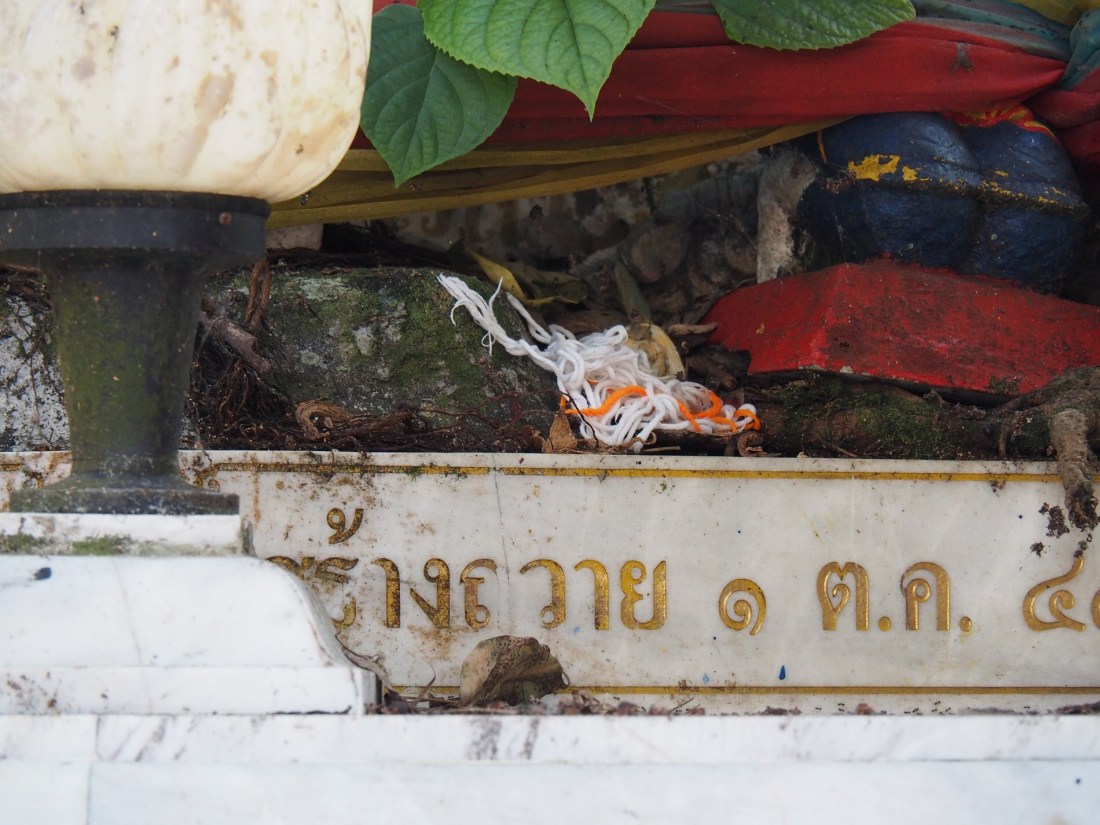
And finally, because it is disrespectful to leave things in his hand, we placed the strings at the root of the tree, where they can disintegrate naturally over time.

O.K., I cheated: I was worried about one or more of my ‘spirits’ getting out during the flight home, so I kept 1 white and 2 orange strings. Our tour leader told me that these are holy items, and must be untied (not cut) and burned when I get home.

Chiang Mai, Thailand

2/4/18

Posted from home, Berkeley, 2/8/18

Wat Sri Suphan, Chiang Mai, Thailand

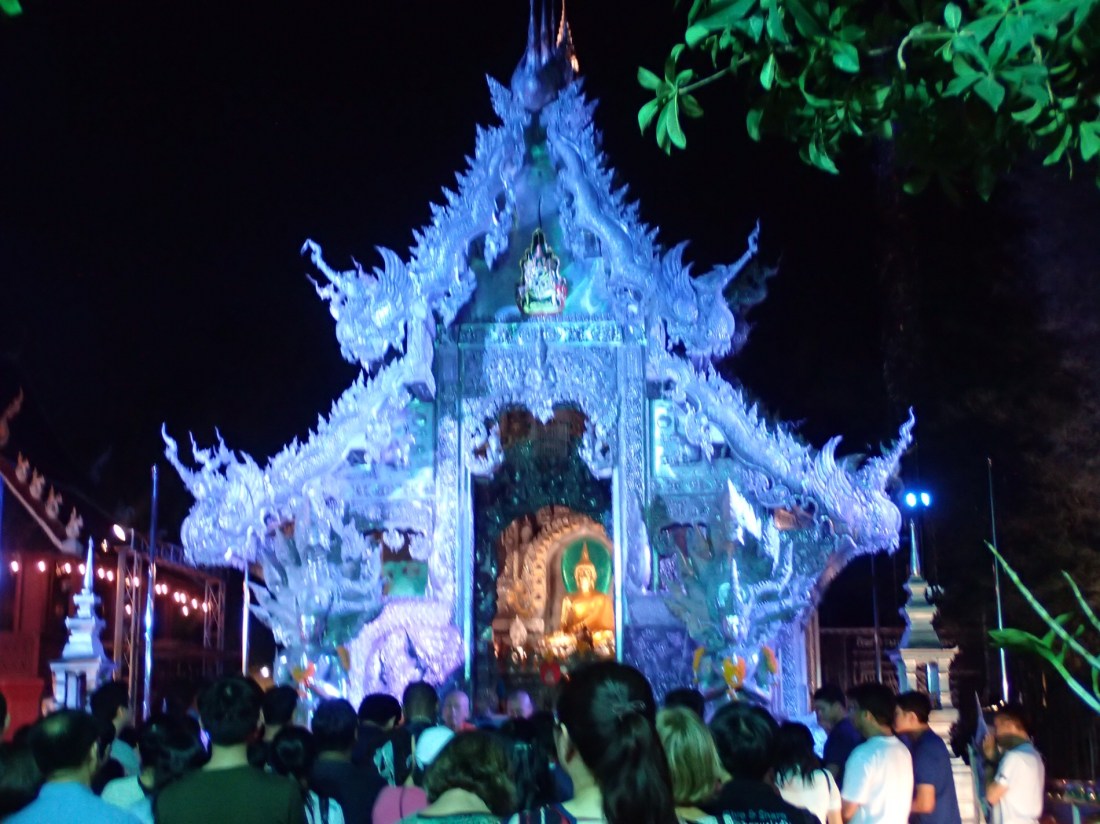
This temple, known as the “Silver Temple,” was begun in the 1500’s as the main temple for a village of silversmiths. It was only fully encased in silver starting in about 2008. YES, I mean FULLY ENCASED in silver.

We had learned about the temple from my traveling companion’s husband, and, because we wanted to go to the Saturday market on the street leading to the temple, we decided to include that in our evening’s adventure. We had a map given us by our tour leader, and, with some advice from the hotel’s concierge, we walked there one evening, finding our way over sidewalks that frequently were cracked and broken, more frequently blocked by parked motorcycles, or just plain not there.

We found the market street so jammed with people that at times we could hardly move forward (we also couldn’t see the stalls, so we couldn’t shop, either).

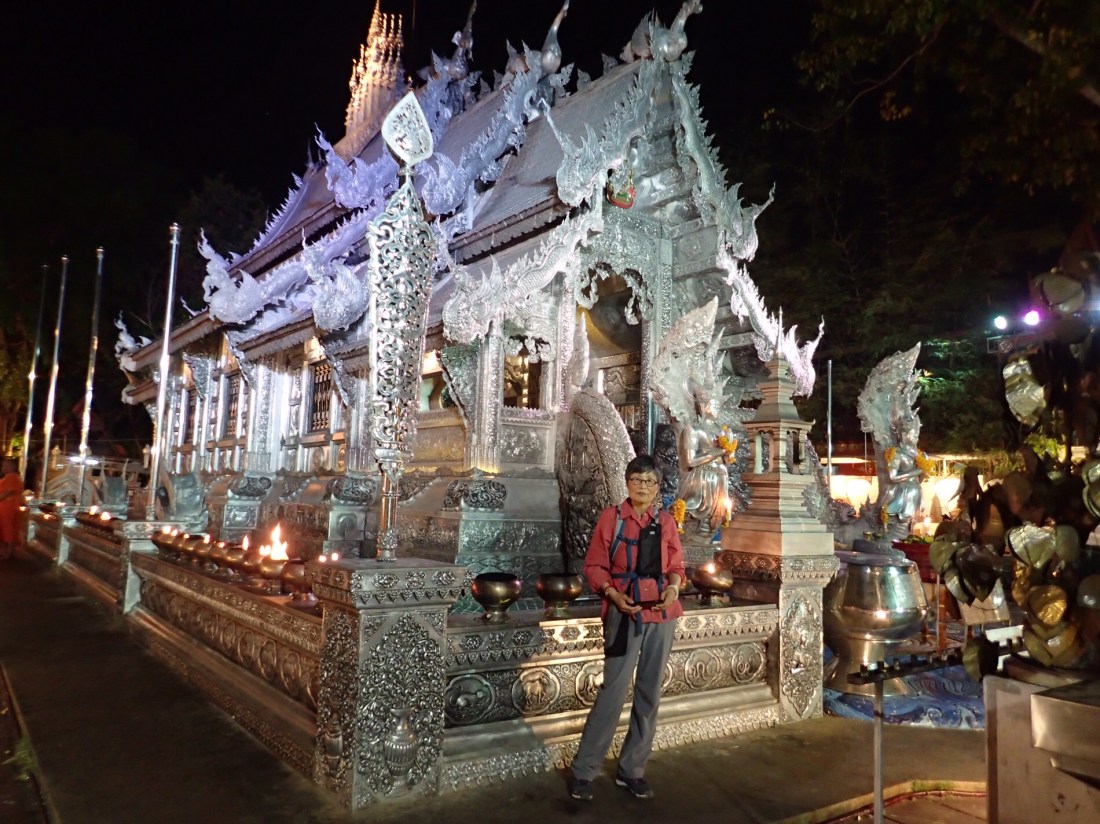
Finally we reached the relative peace of the temple, and were astounded by what we saw. When we first got there the lights were relatively high, and I took this picture of In Ja beside the temple. It shows the very ornate decorations embossed in the silver.

I was interested to see that the late King, who died not too long ago, was also enshrined:

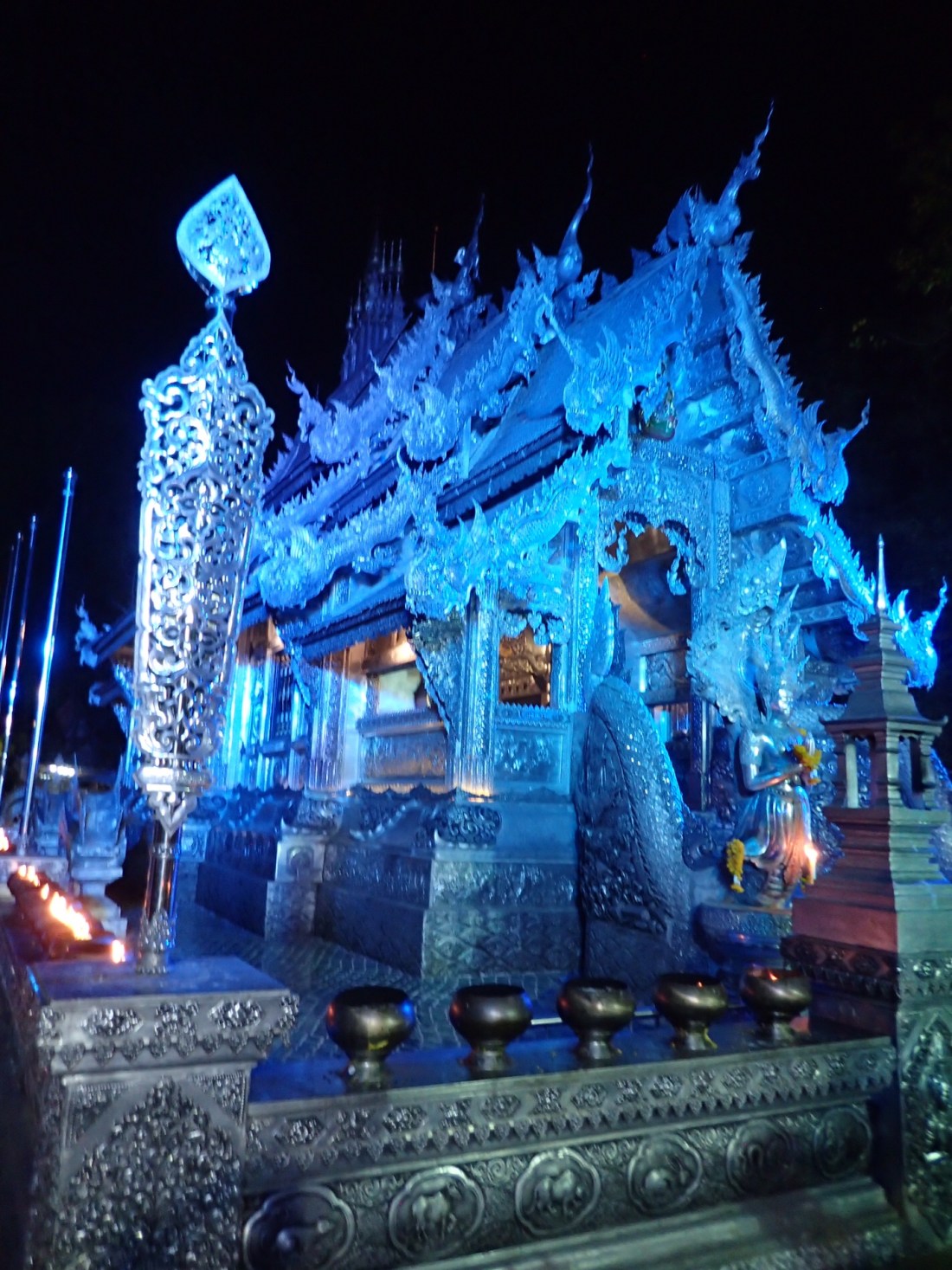
Soon, however, the lights changed color,

And a period of ‘walking meditation’ to the music of a chant, took place. The monks led the group which was joined by many devotees as well as people who looked as though they were tourists who just wanted to be part of the experience. They circled the temple three times, going clockwise (apparently, counter clockwise circling is only done for funerals).

At the end, the head monk chanted a blessing.

Men could then go into the temple to pray (because of ancient Buddhist laws to which this temple adheres, women are not allowed to go inside.) I apologize that this picture is out of focus, but it was the only one I could take that shows the statue of the Buddha inside.

Although getting to the temple through the crowds in the market was harrowing, we both agreed that seeing the temple and the meditation ceremony made it all worthwhile.

Chiang Mia, Thailand

2/4/18

Batik

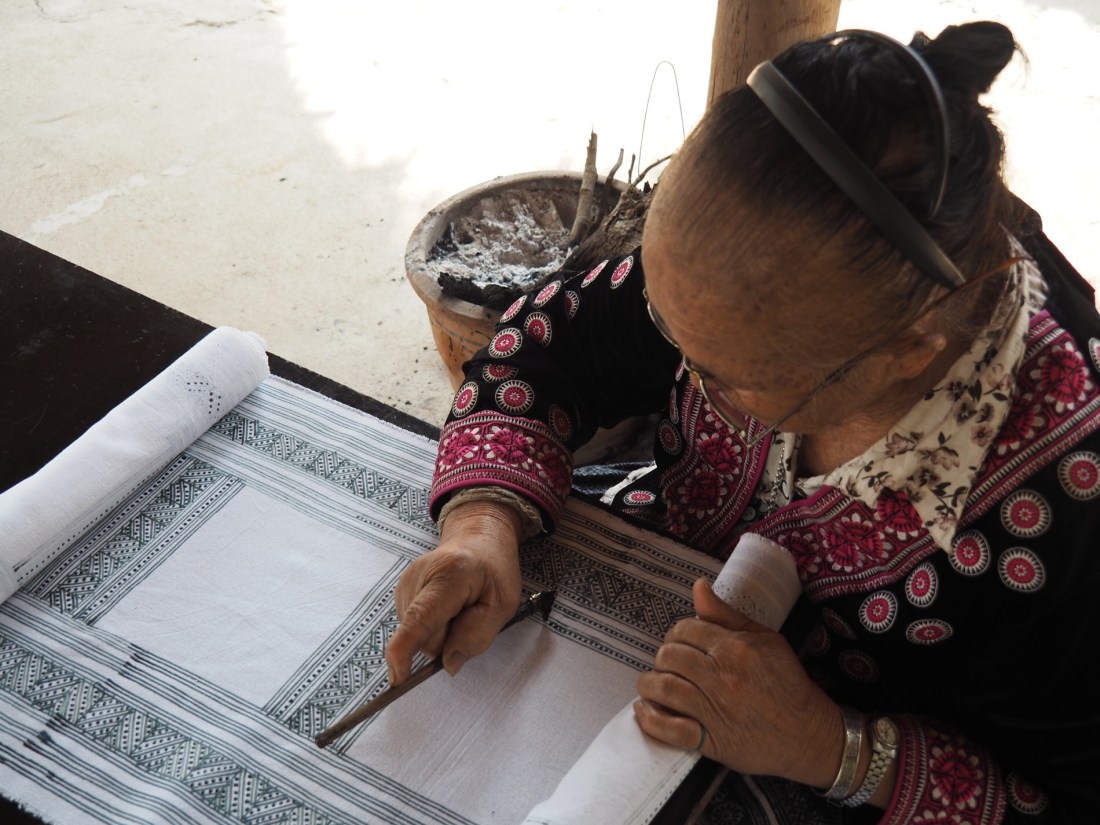
In the village of Baan Tong Luang (see separate post) I came across an elderly Hmong woman making designs on a piece of white cloth.

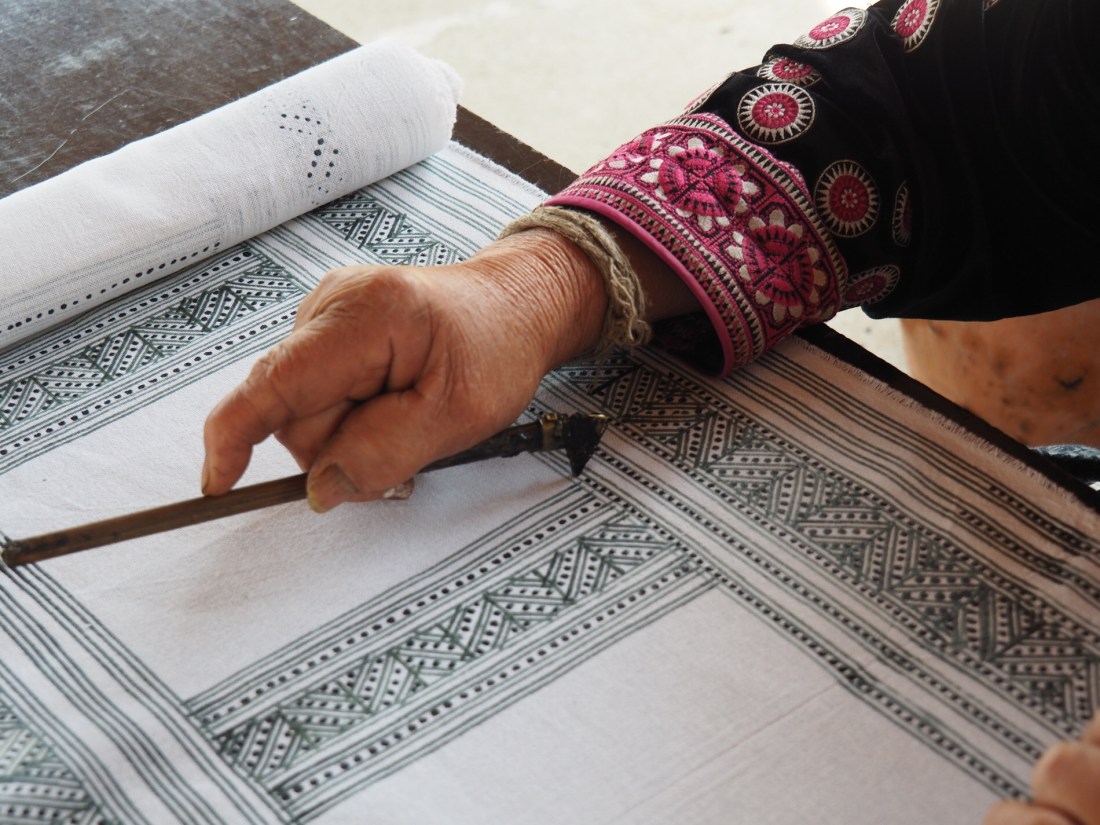
She had a small brazier (visible in the picture above behind her right elbow) which warmed a pot of black fluid. She held what looked like a chopstick with a pointed funnel at one end, and she was carefully making dots between lines with black wax to make a batik.

Interestingly enough, she held the tool at what I would have considered to be the reverse direction.

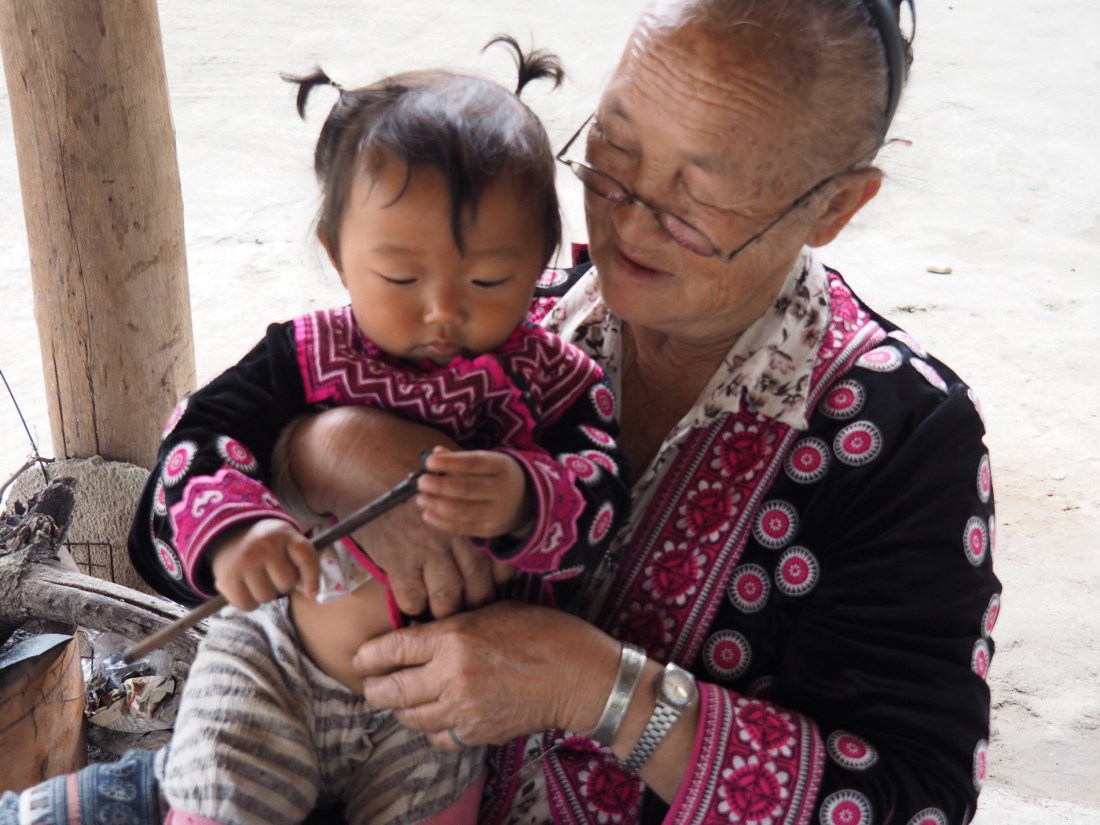
I watched her for awhile, asked permission to take pictures, and noticed several rolls of fabric that seemed to be complete, so I asked how much she would charge to sell me some. She didn’t speak English, and I didn’t speak Hmong, but her daughter appeared, carrying a small child who turned out to be the elderly woman’s granddaughter.

While the daughter and I finished the transaction, Grandma held the child, who seemed fascinated with the tool.

And curious about me.

Unfortunately, I didn’t find out how long it took Grandma to complete one meter of cloth. I do know that I paid 300Baht, about $10 (pus a balloon for the child). I wonder how long the making of Batik will continue, and whether the granddaughter will carry on that tradition….. Sadly, it seems unlikely.

Chiang Mai, Thailand

2/4/18

Children and Balloons

Children and Balloons

When I travel to foreign countries, I always bring balloons to give to the children I meet. They are light, take up no room in my suitcase, and bring delight everywhere. In fact, the first time that I brought balloons I went to Peru. One day we went far up a tributary and visited a village that hadn’t seen many visitors before. The children were confused – what do you do with balloons? They had never seen them before, but they soon caught on!
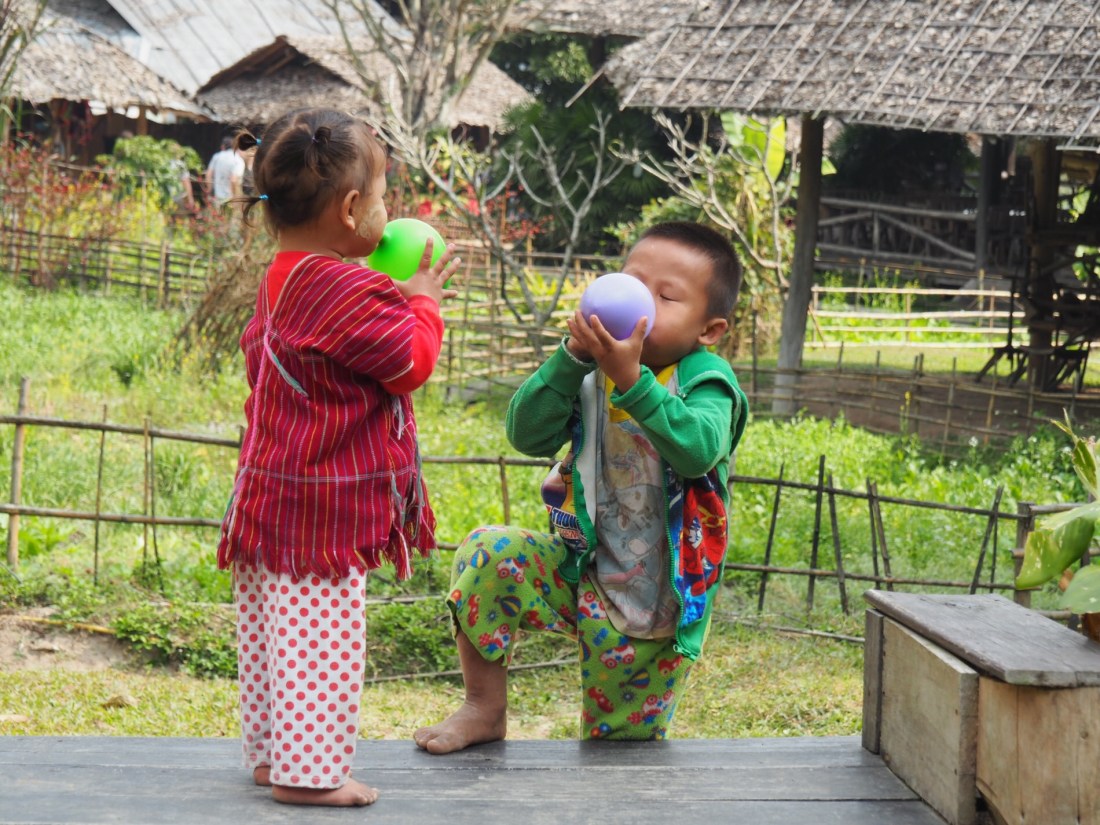
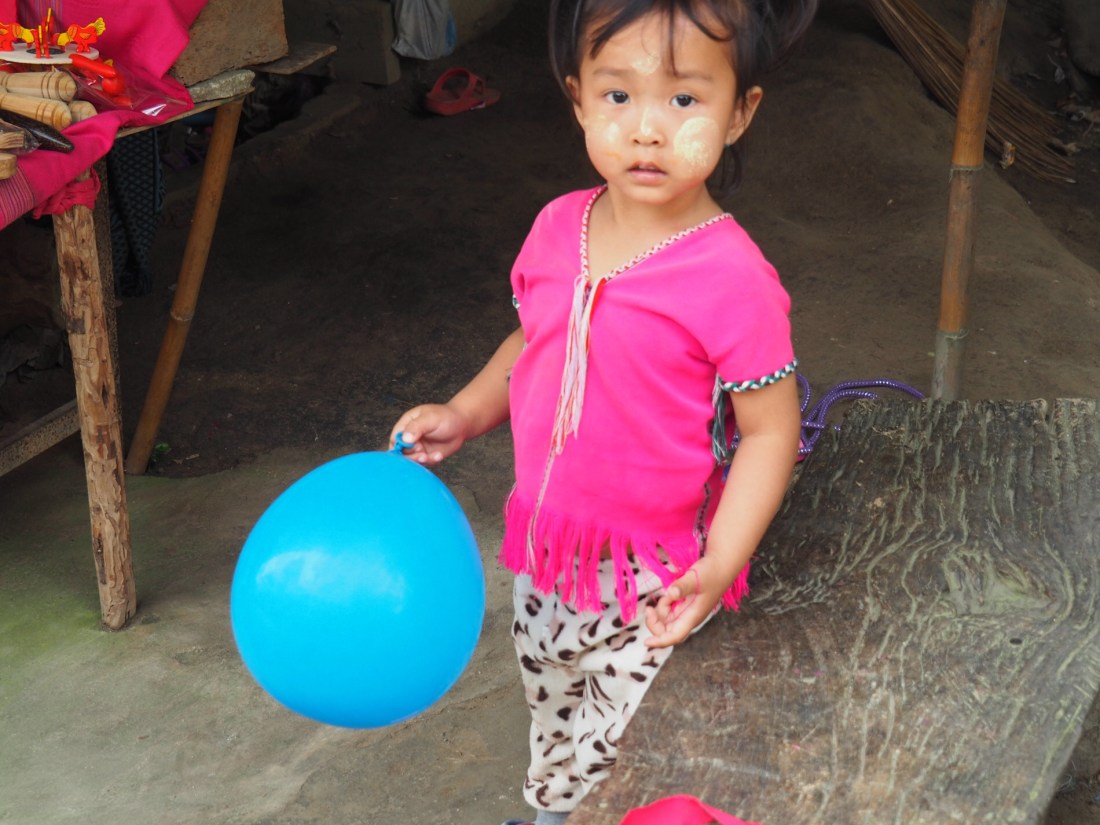
But children in Southeast Asia certainly know what balloons are for. I took them to a village near Chiang Mai. (See separate post about Baan Tong Luang) Here are pictures of the children who obviously enjoyed them a lot.

And then, for the first time in my life, I found a child who did NOT want a balloon! He motioned me away, and then gave me the cold shoulder.
So I wandered on and gave away my last balloon to children who DID want them!

Chiang Mai, Thailand

2/4/18

Baan Tong Luang

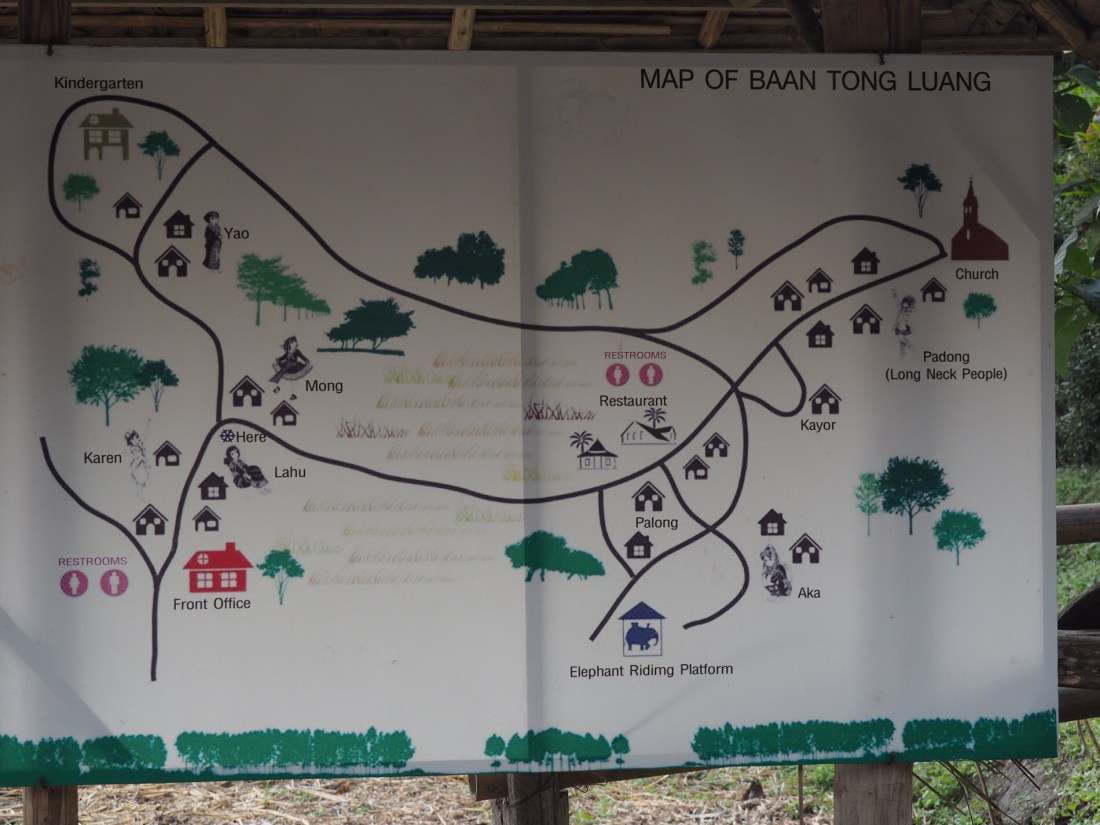
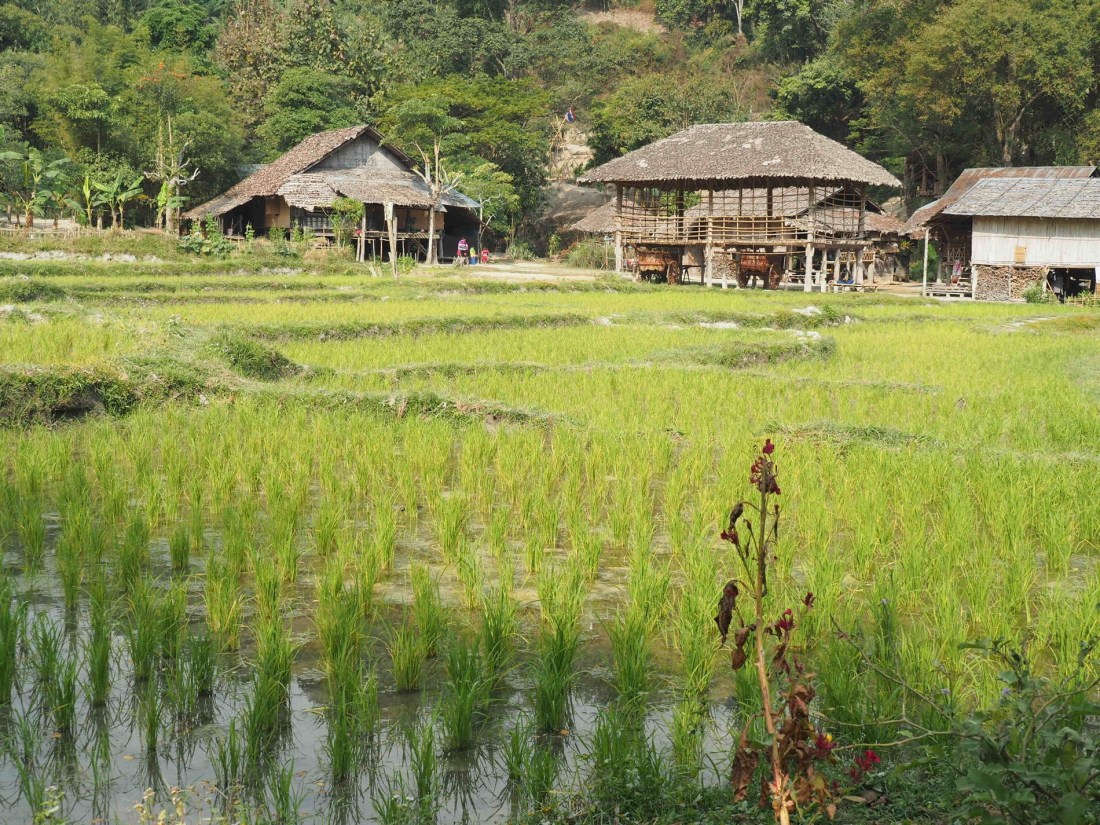
We visited a village near Chiang Mai called Baan Tong Luang. It was established by a man who owns an elephant sanctuary in the area to house people who had escaped from Burma (now known as Myanmar) and who had long worked with elephants there. Gradually, it came to house people from many different hill tribes pushed out of their ancestral areas.

It is open to the public (fee charged) to visit.

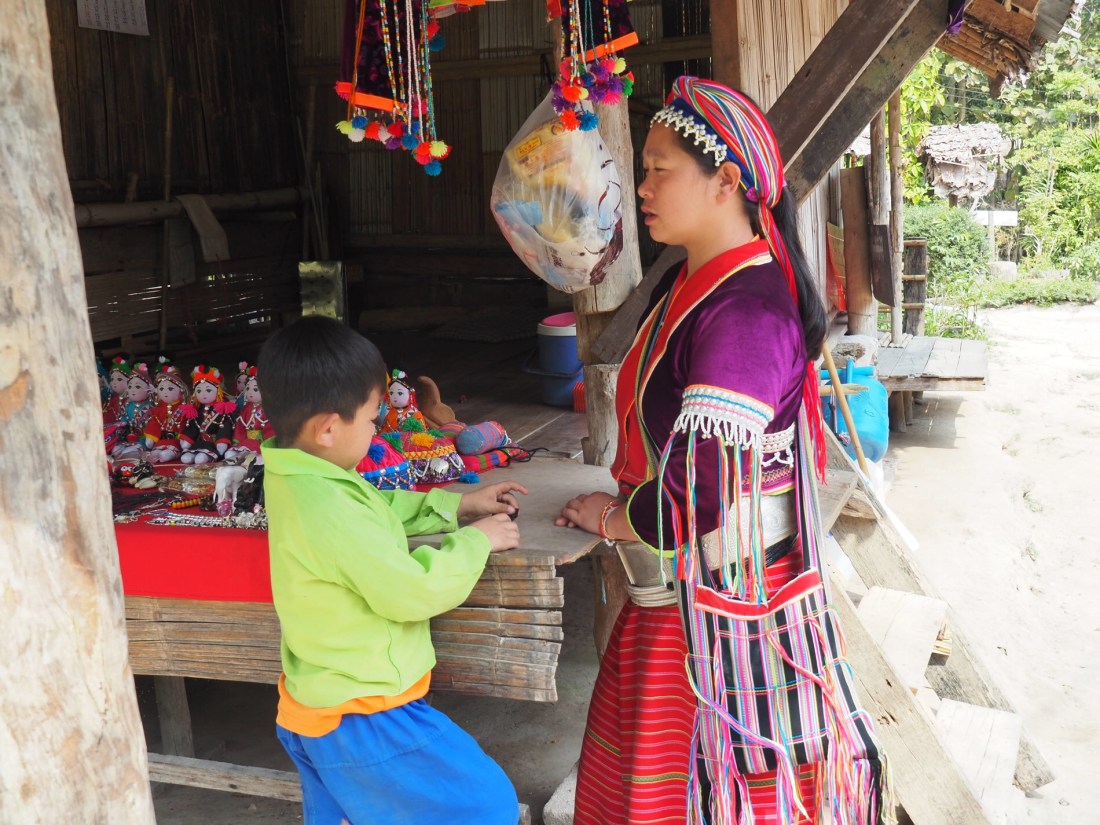
I am of several minds about the village – it does give the people a place to live and sell their goods, and it seeks to continue traditional crafts and customs. It includes a Catholic Church and a Buddhist temple, and a kindergarten for the children. There are terraced rice paddies with water piped in so that they can grow 2 crops a year.

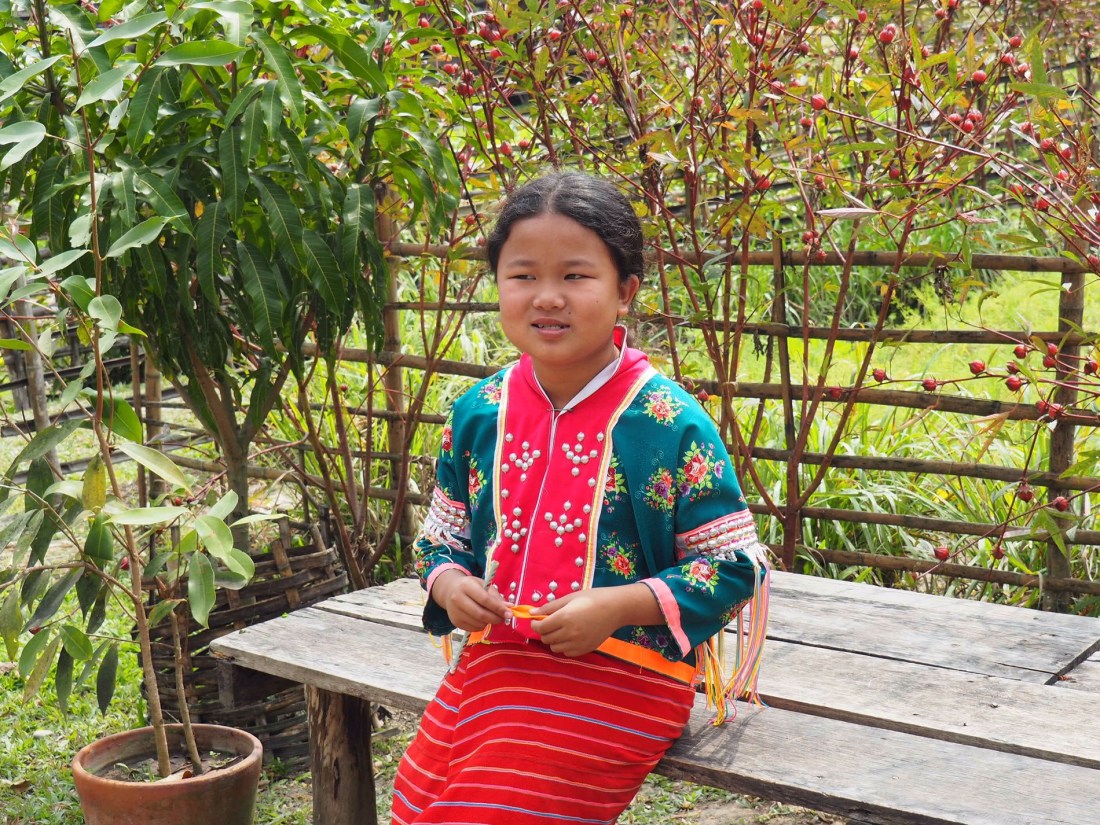
But it also might be considered to be exploiting the people – especially the children, who dress in their native costumes and seem to be ‘on show’ for the tourists.

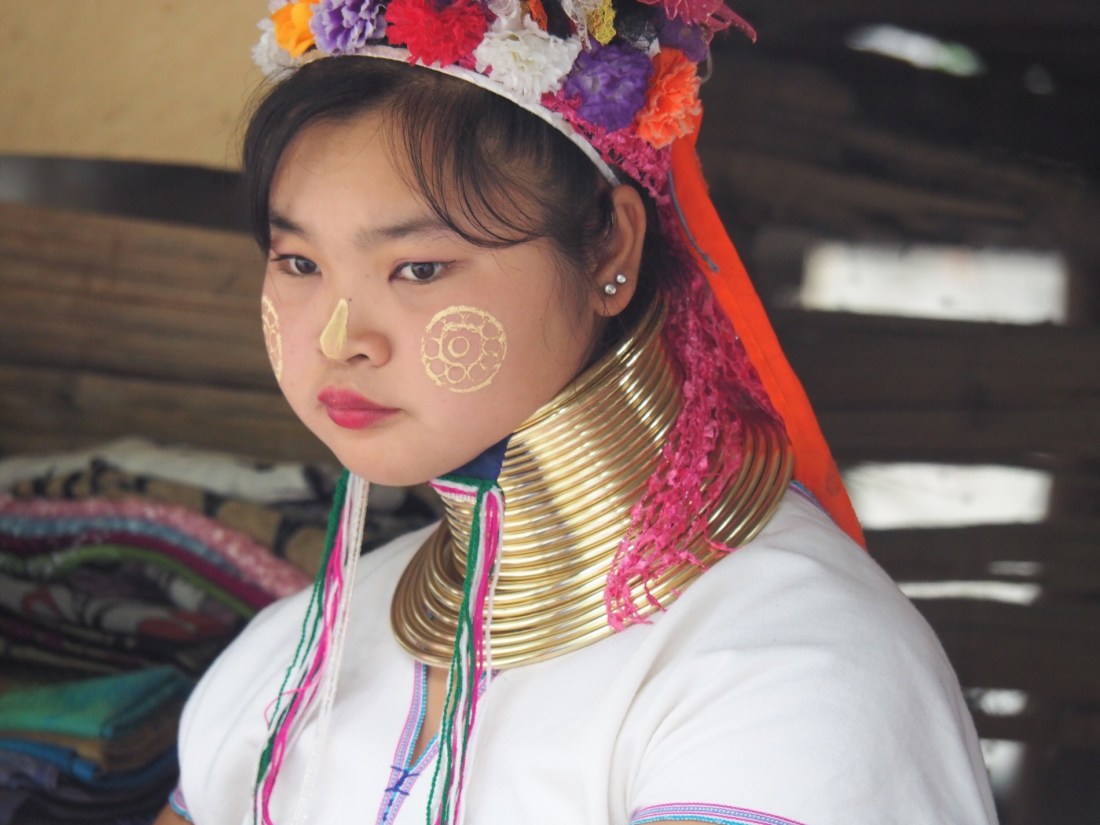
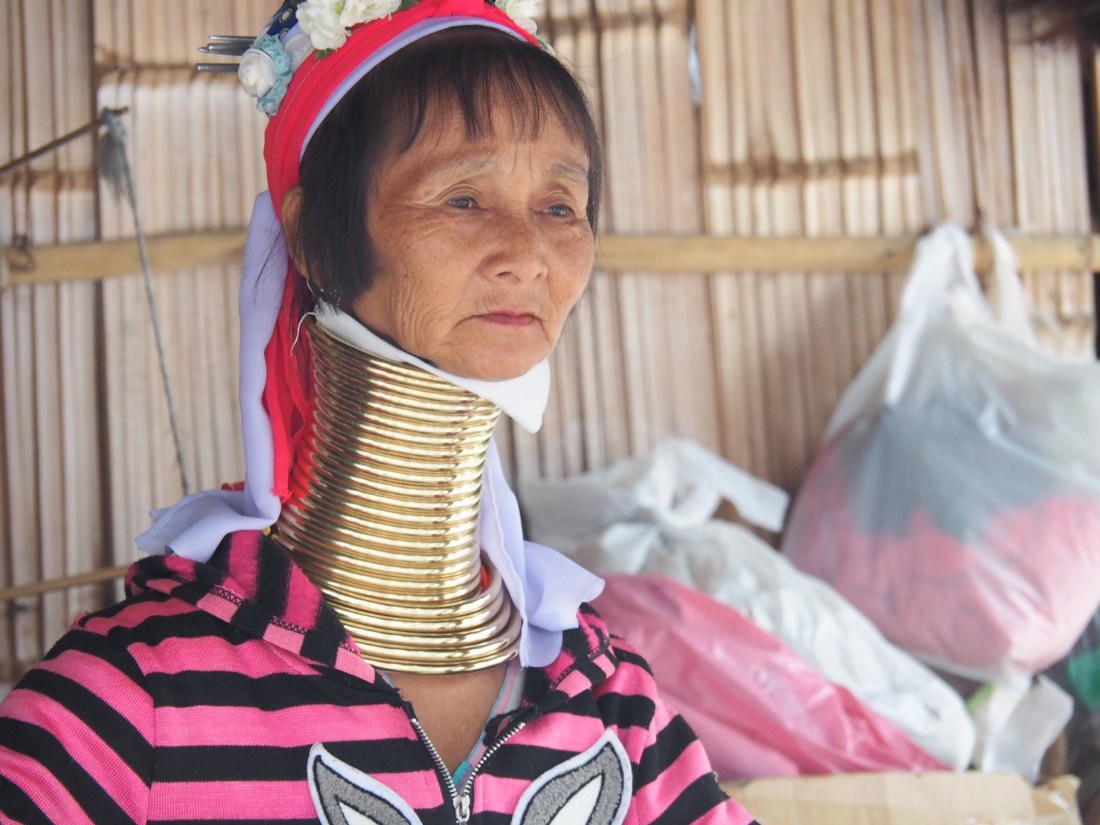
Some of the young girls from the “long neck” tribe still wear the rings, starting at age 5. This has apparently been outlawed in Myanmar, but it certainly follows a long standing cultural tradition.

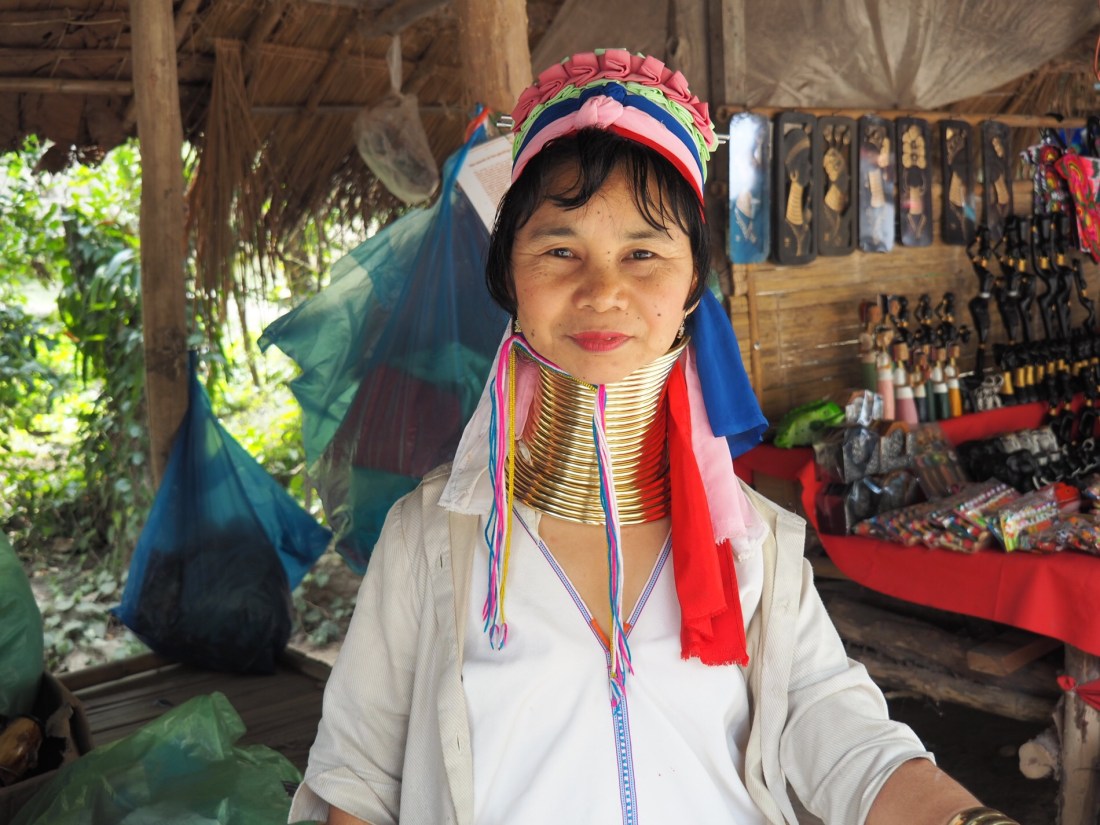
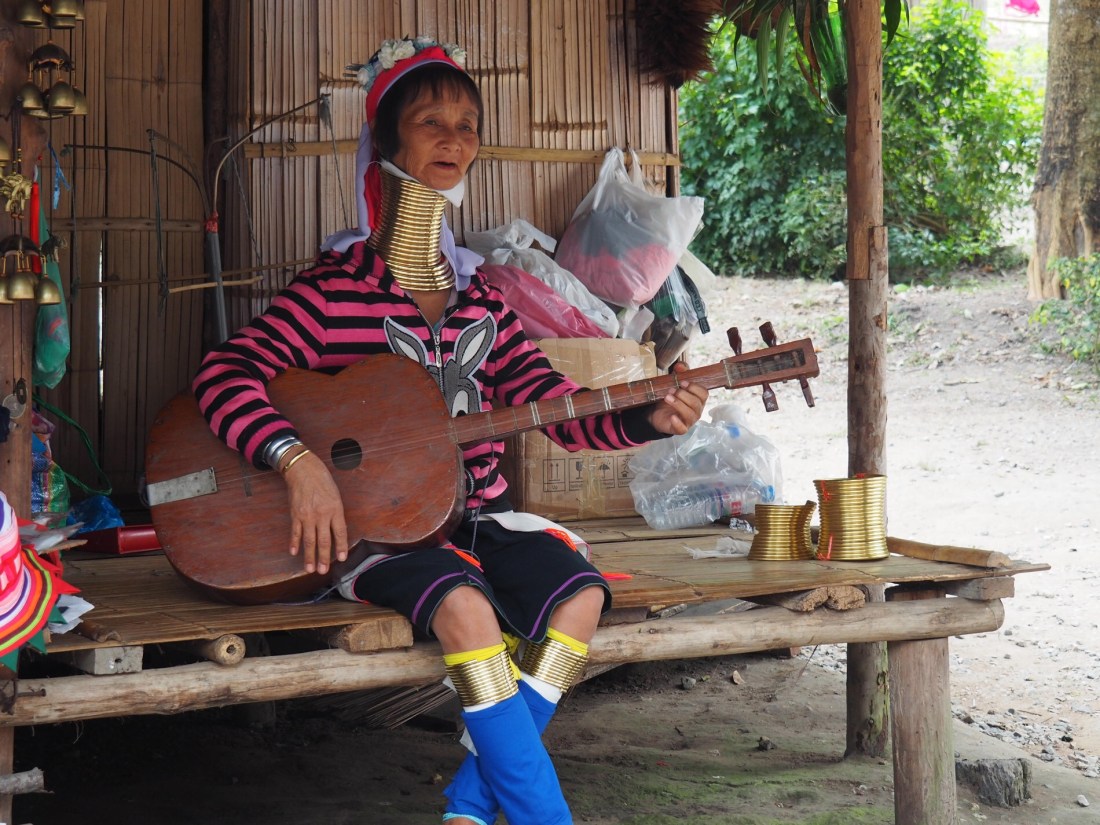
We met a woman who is 65 and has been wearing the rings now for 60 years. (Yes, that’s not traditional dress she is wearing, unless Bugs Bunny is a part of her tribe’s tradition!)

She sang two songs for us, accompanying herself on a 4 string instrument much like a guitar.

The women weave cloth in the traditional manner.

I bought a scarf from this woman, who told me it took her 3 days to weave it. Cost to me: 250Baht, about $8.50.

I brought balloons and handed them out to all the children – another post will chronicle that – so we left the village with the people a little richer in money and children in balloons. And we are a little richer in having met and interacted with these people, and gotten a glimpse into their lives. Who knows how long they will be able to continue their traditions in a fast changing world?

Chiang Mai, Thailand

2/4/18

Chiang Mai’s Version of the Rose Parade

This morning our tour leader told us that we were in luck: Once a year there is a flower festival that lasts 5 days and on one of those days there is a parade – yes, we were here on that day!

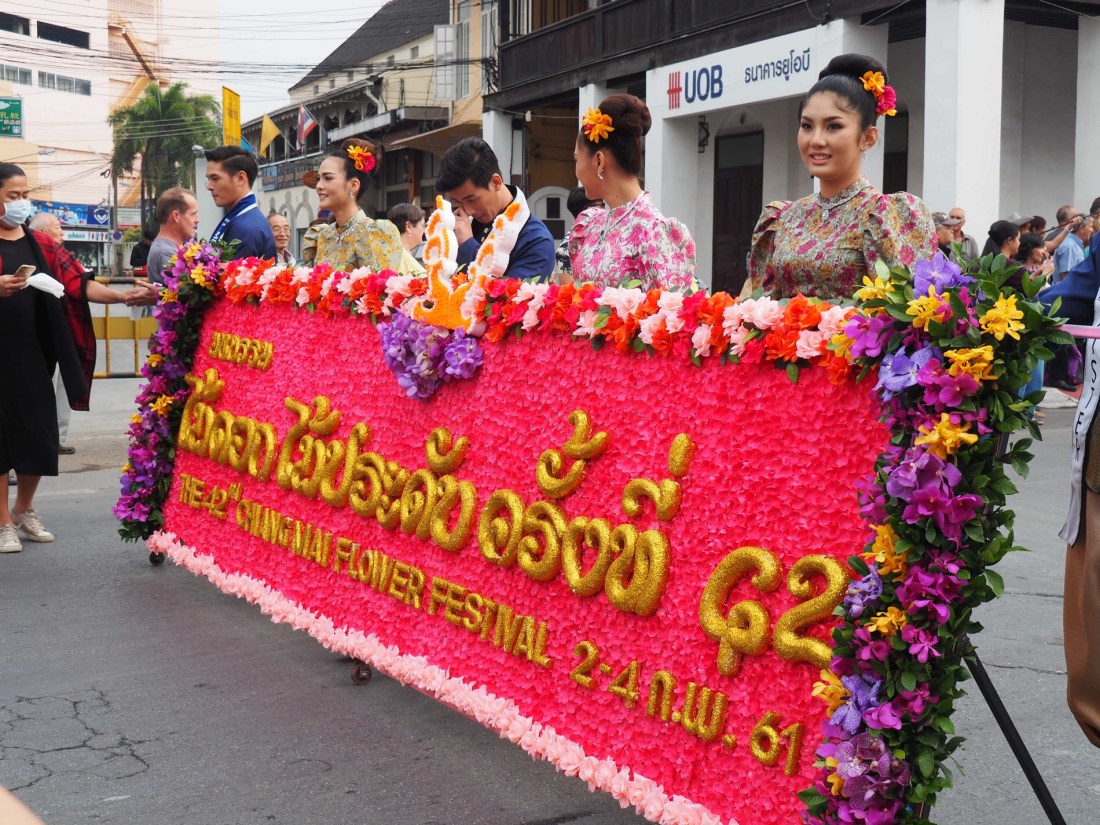
So we walked a couple of blocks from the hotel and very soon we heard music and saw banners announcing the flower festival.

I don’t know how long the parade route is, but the women with the banners were walking in high heels!

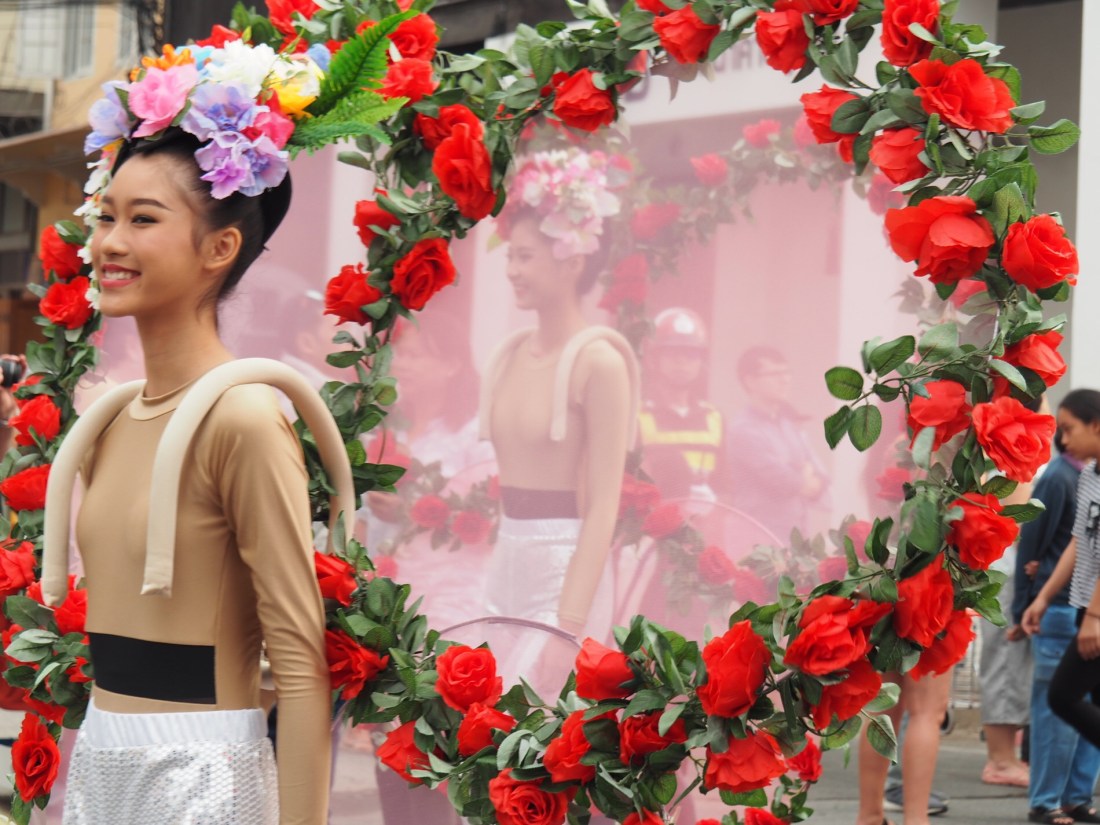
Then came women wearing what looked almost like wings, which were edged with flowers.

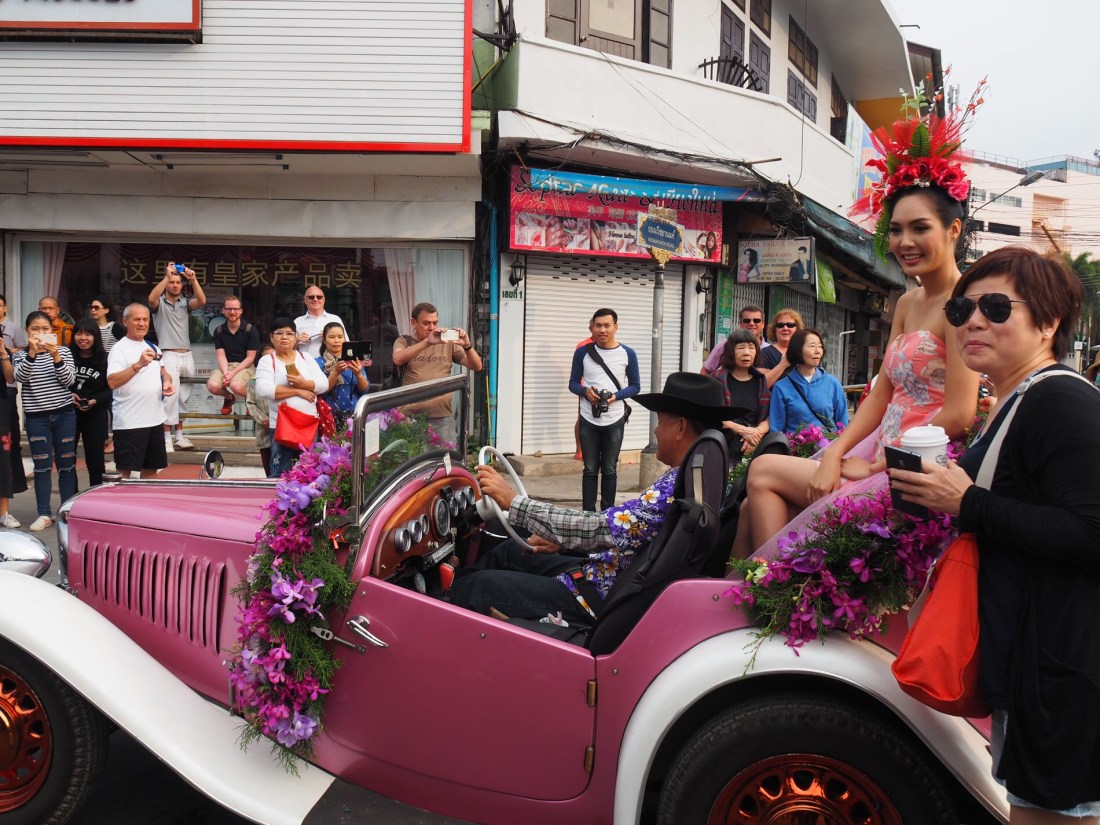
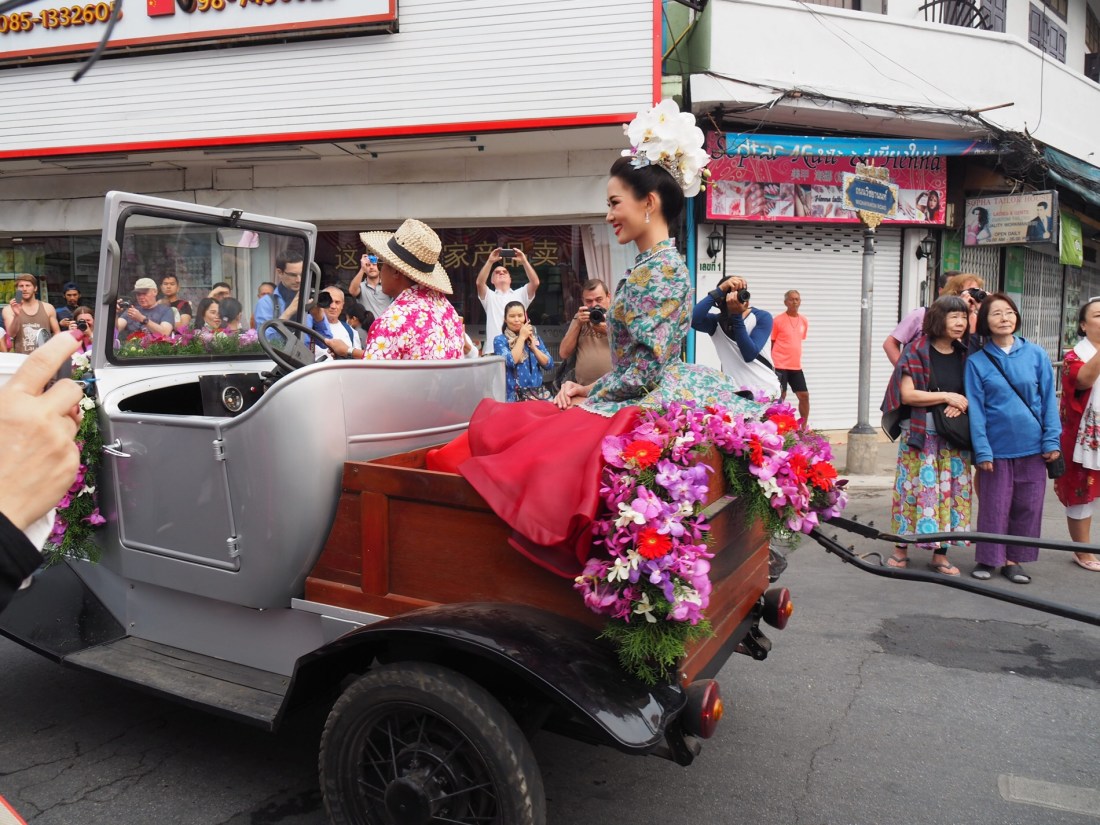
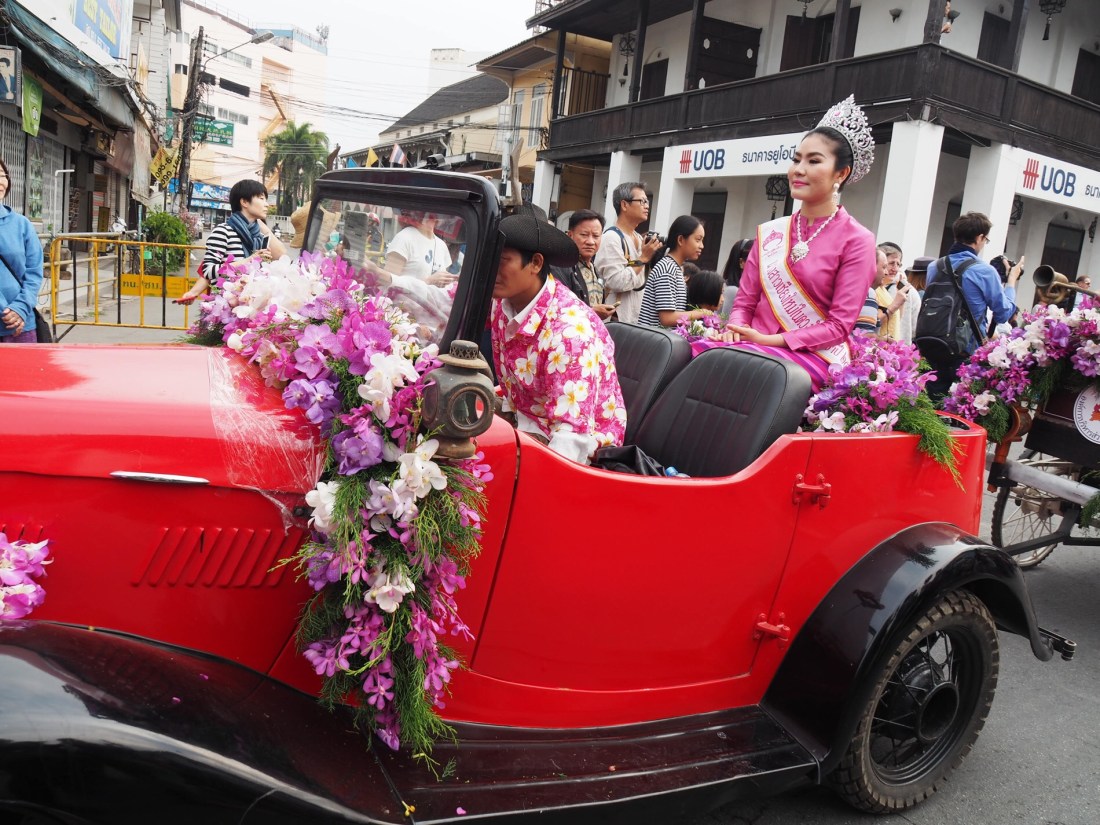
As is true with the Rose Parade, the event centers around a beauty contest. There seemed to be many princesses, some of them riding in antique or one-of-a-kind car, all of which were lavishly decorated with flowers. We were told that most of the flowers were actually silk or plastic, because fresh ones wouldn’t last long in this climate. (I am posting this at 6PM and it’s 81 degrees outside).

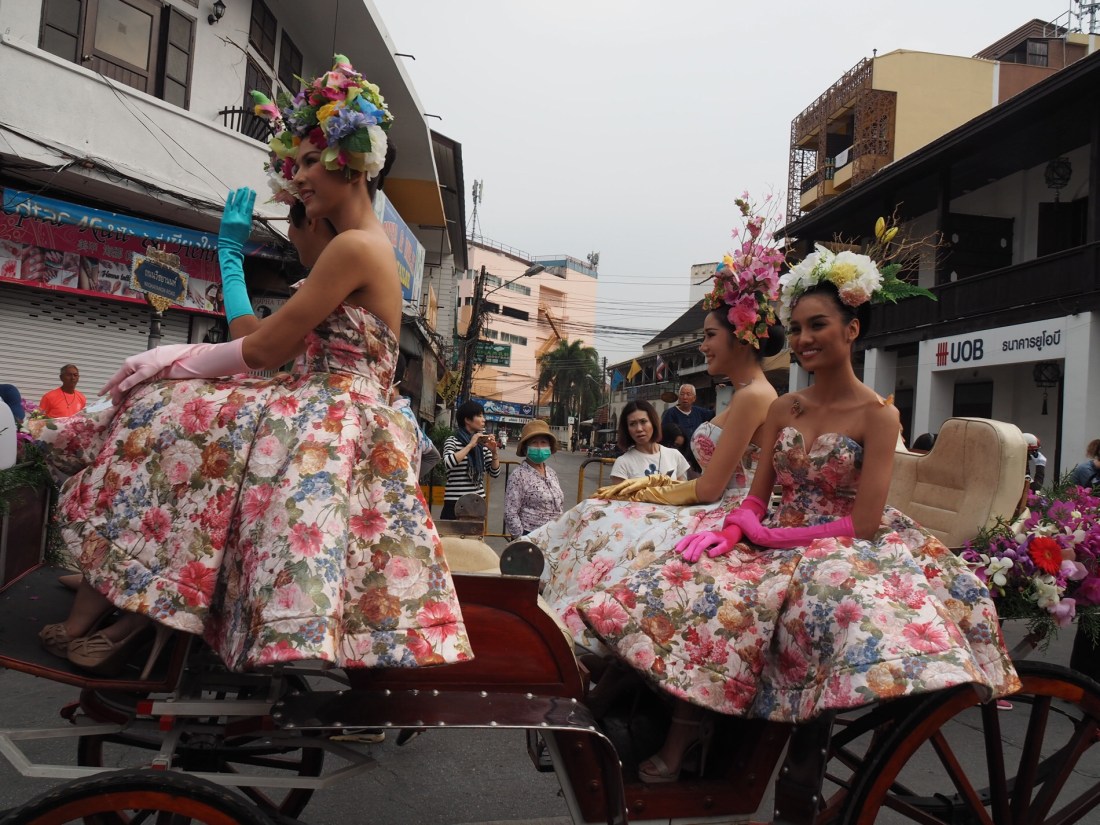
Many of the women who came first wore very colorful floral headdresses.

One of the cars seemed to be a MG

Driven by a man who was obviously having a very good time.

Another car seemed to be ‘woodie’ pick up truck

And it pulled a wagon behind it.

We never figured out just which people had won, but soon we saw a woman wearing a crown

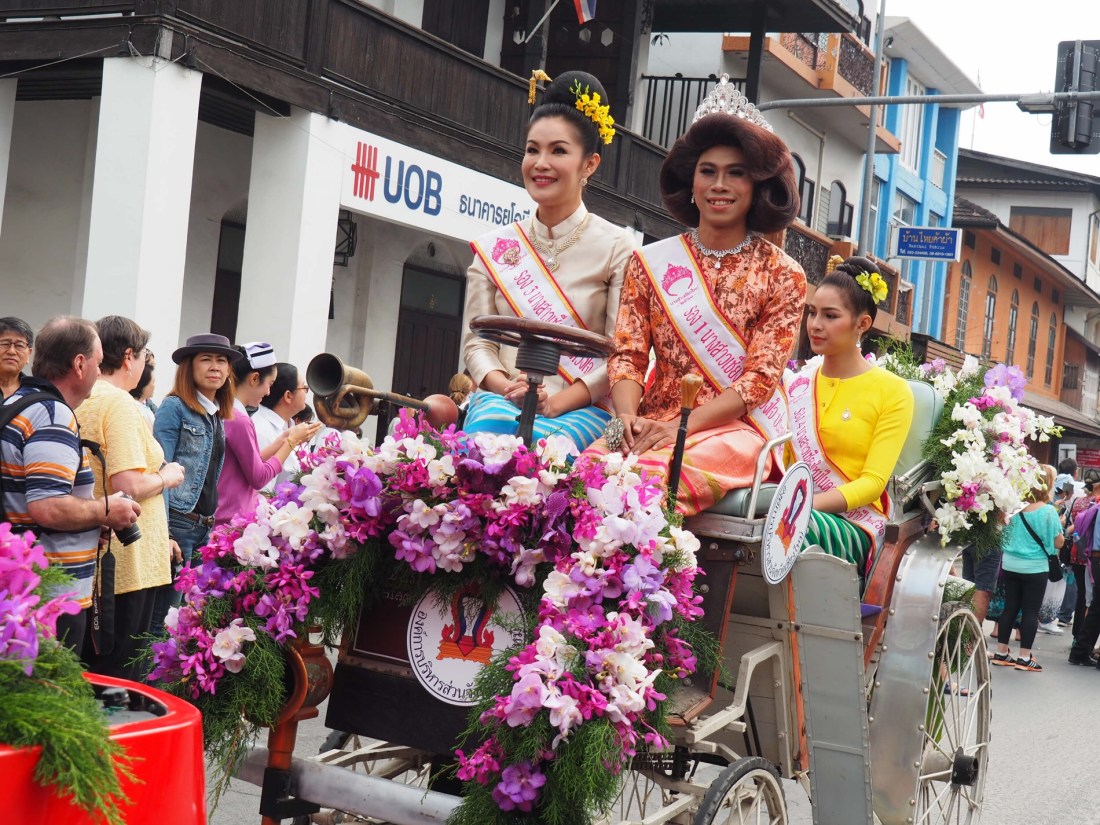
And behind her came a car with two people wearing crowns in it. Our tour leader then explained to us that, in Thailand, transgender and transvestite people are accepted, and that part of the contest was for the most beautiful transvestite contestant – he is sitting on the right in this picture, wearing a crown and an orange dress.

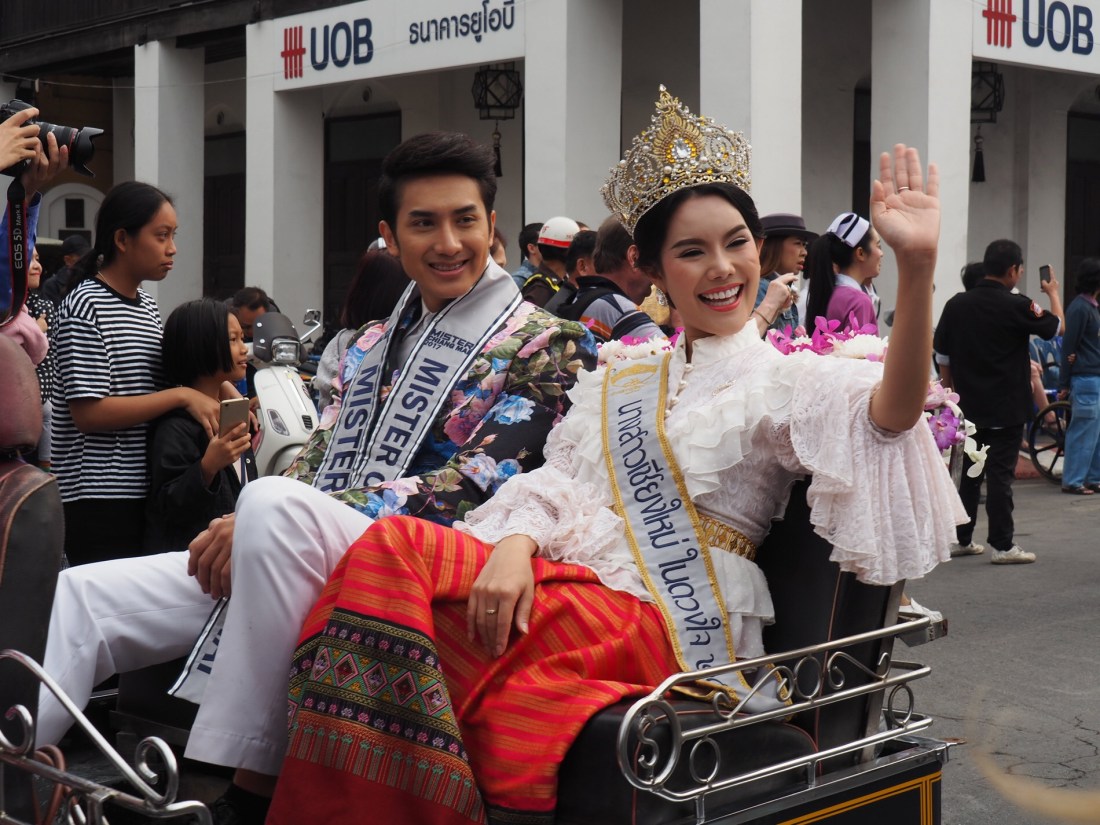
The cars just kept coming – here are a man and a woman, he apparently is “Mister” Flower Festival.

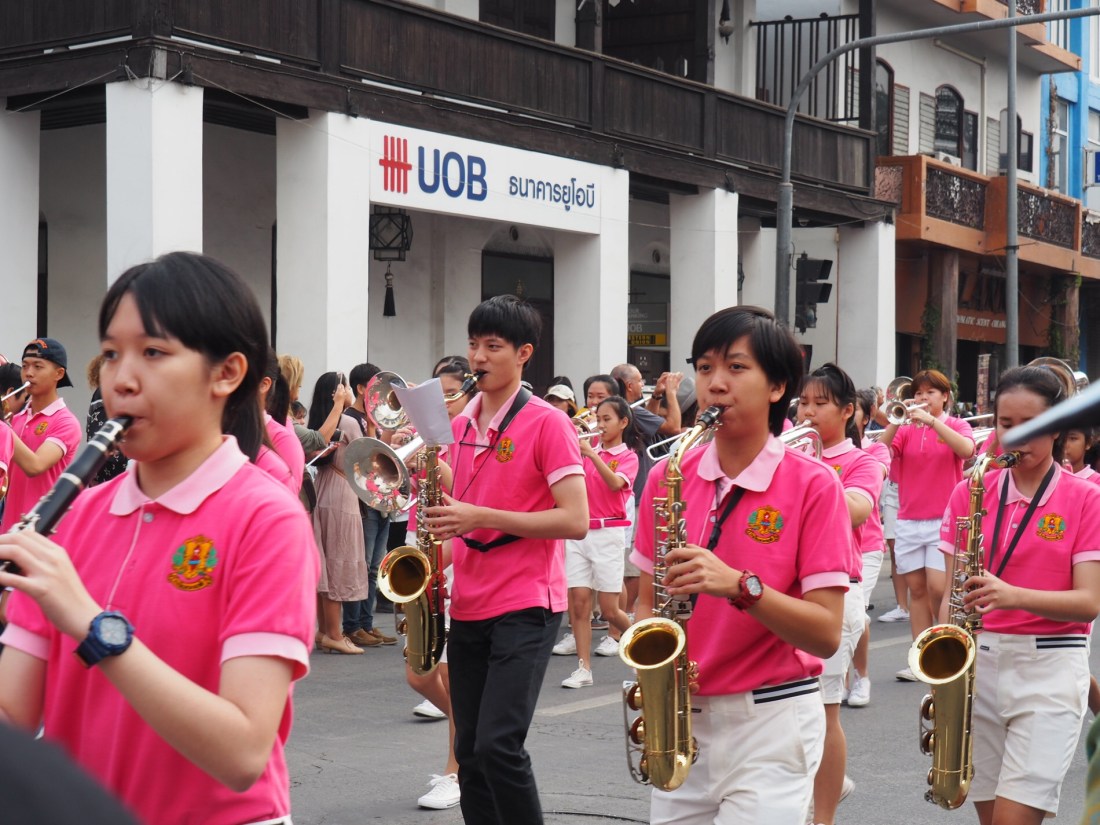
And then, because a parade is not a parade without one, a marching band appeared:

Rose Parade, eat your heart out!

Posted from Chiang Mai 2/3/18

Wat Xiengthong

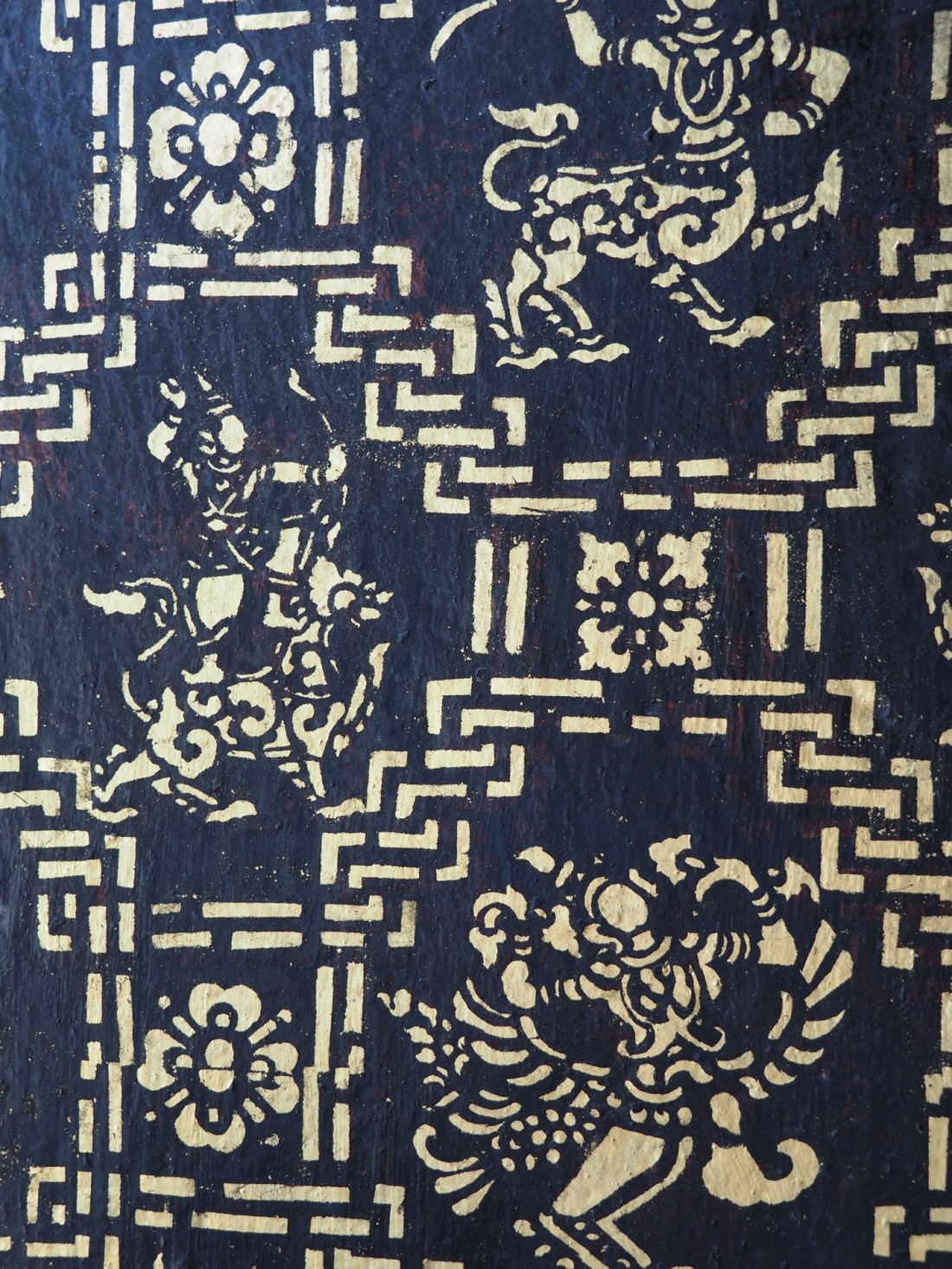
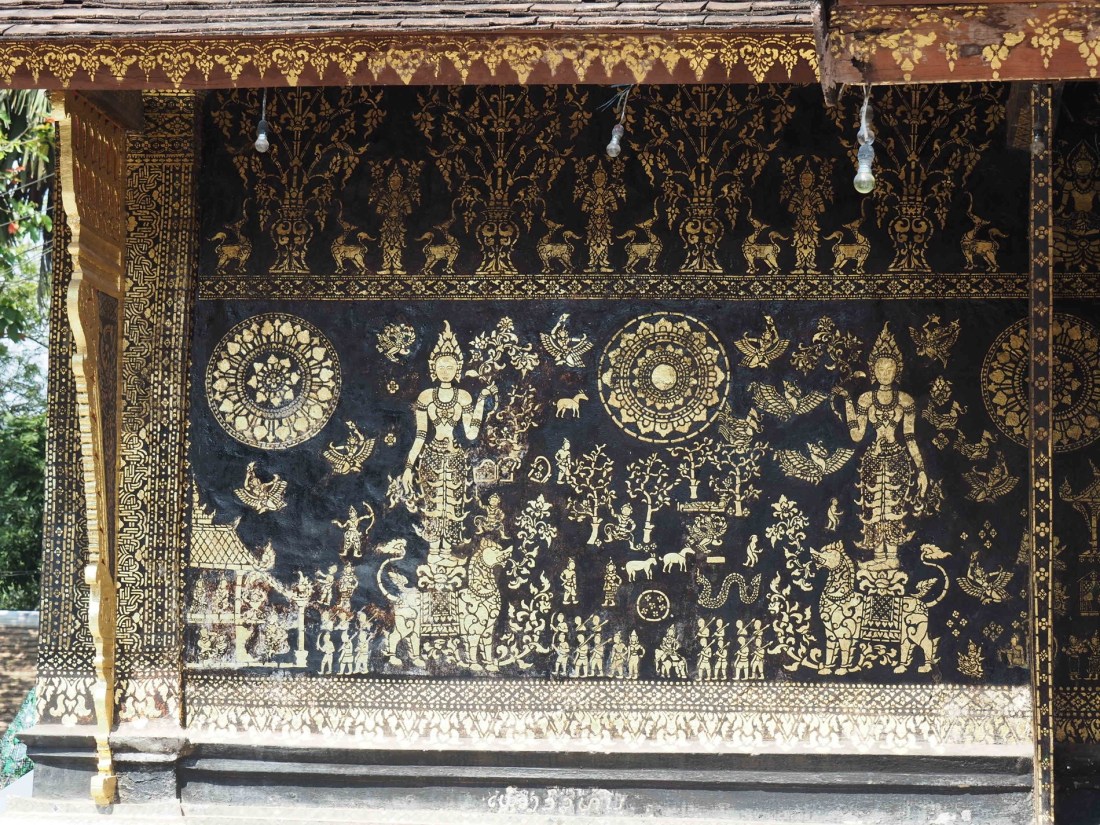
We visited Wat Xiengthong, an exquisite 16th century temple complex, two days ago, and I was struck by its beauty. The history of religion in Laos shows shifts back and forth – sometimes the court religion was Hindu, other times, Buddhist, and overlaid with that is the believe in animism – that everything in the world has a spirit (including our body, which has 32). The decorations of the main temple (the sim) show this interplay, and make for an almost overwhelming design, with patterns and images overlaying each other on every surface.

First and foremost, is the Buddha, whose statue is magnificent.

He sits on a throne above a smaller one, which is lavishly decorated and covered with offerings.

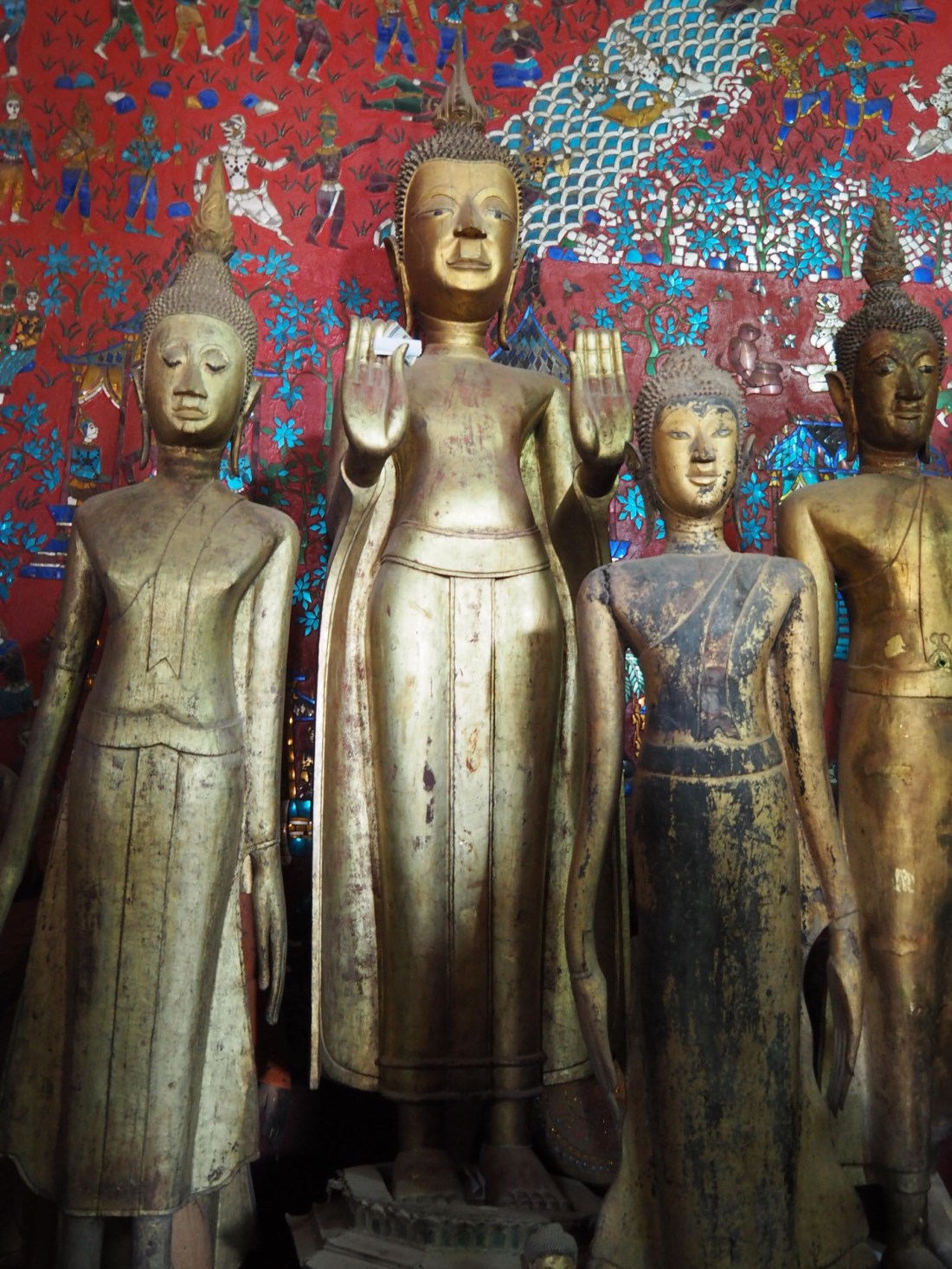
Behind the main statue of the Buddha are many smaller ones, given by people to the temple.

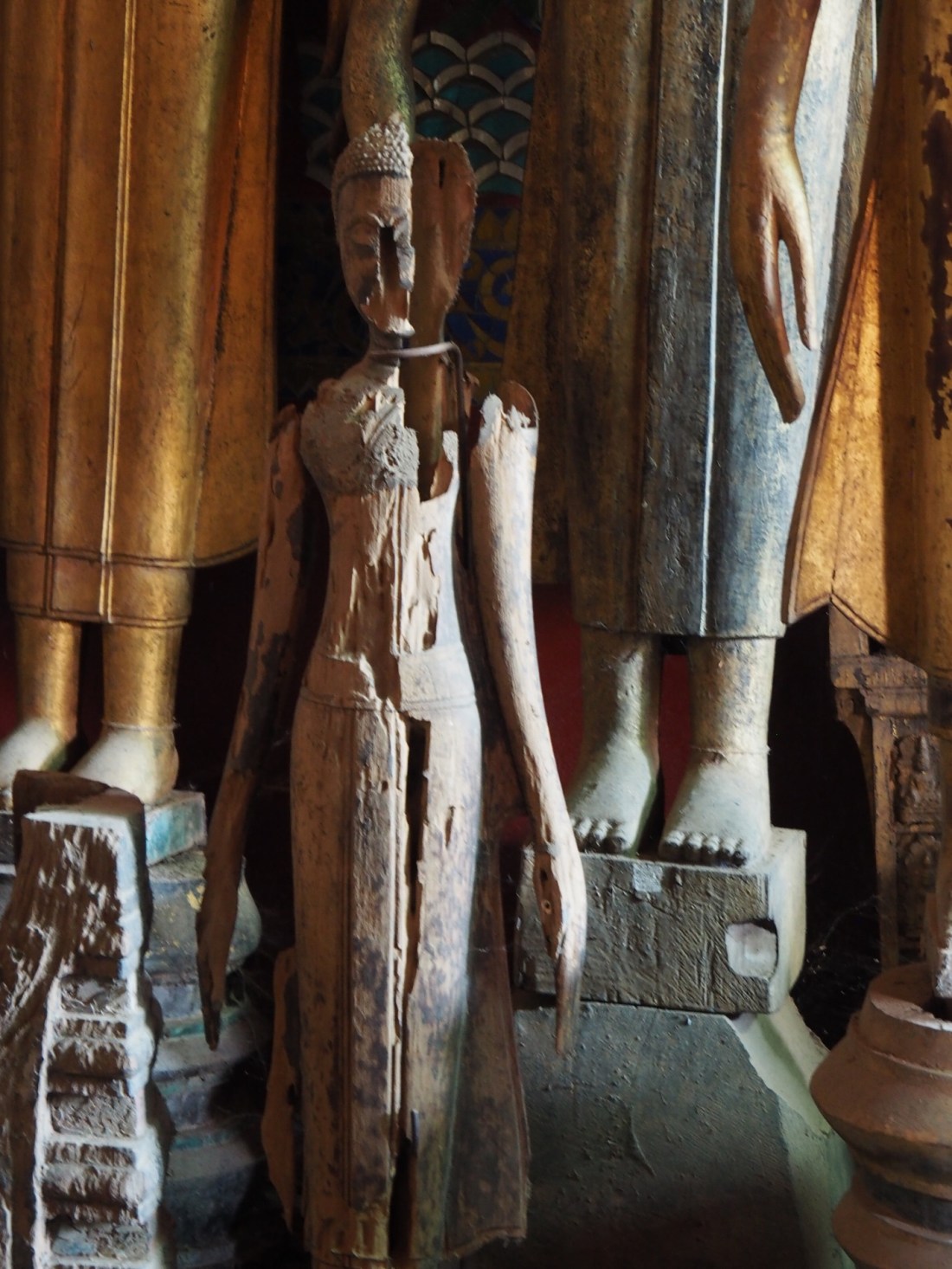
We learned that these are not touched after their donation, and that they are allowed to gradually deteriorate over time.

The entrance to the sim is decorated with gilded carvings. And the one to the right, amazingly enough, bears a marked resemblance to the Virgin Mary.

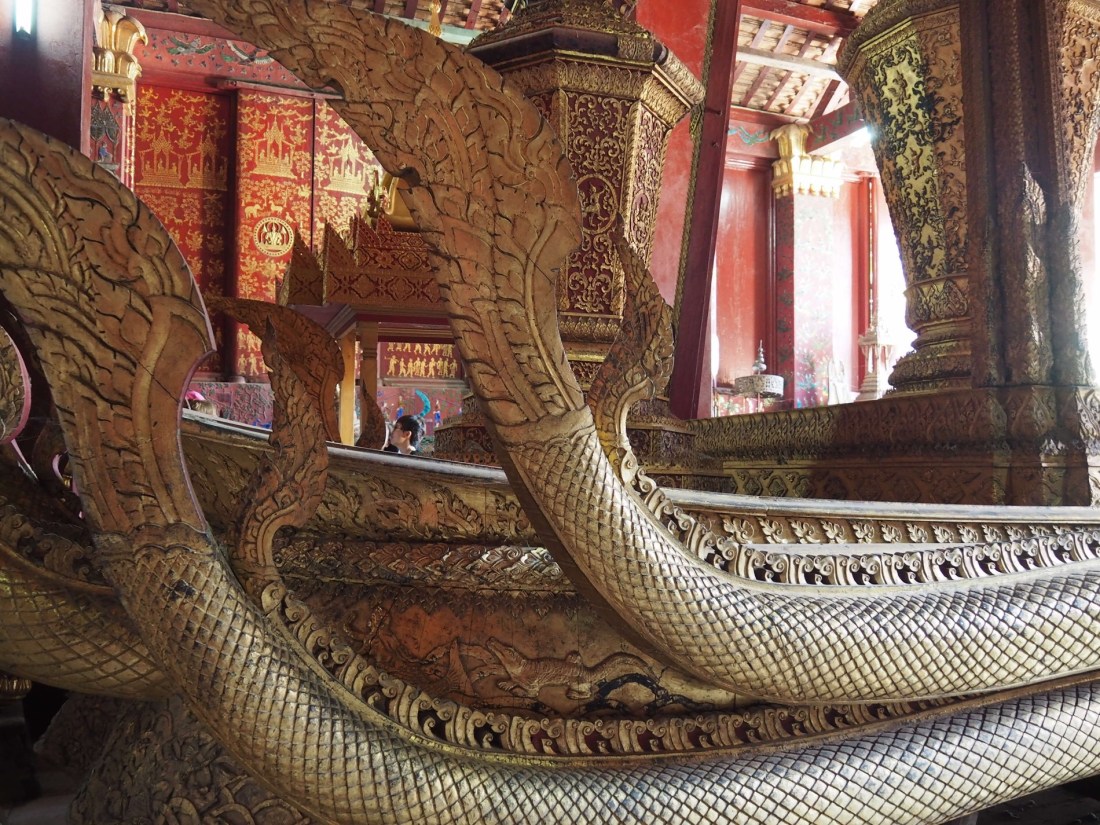
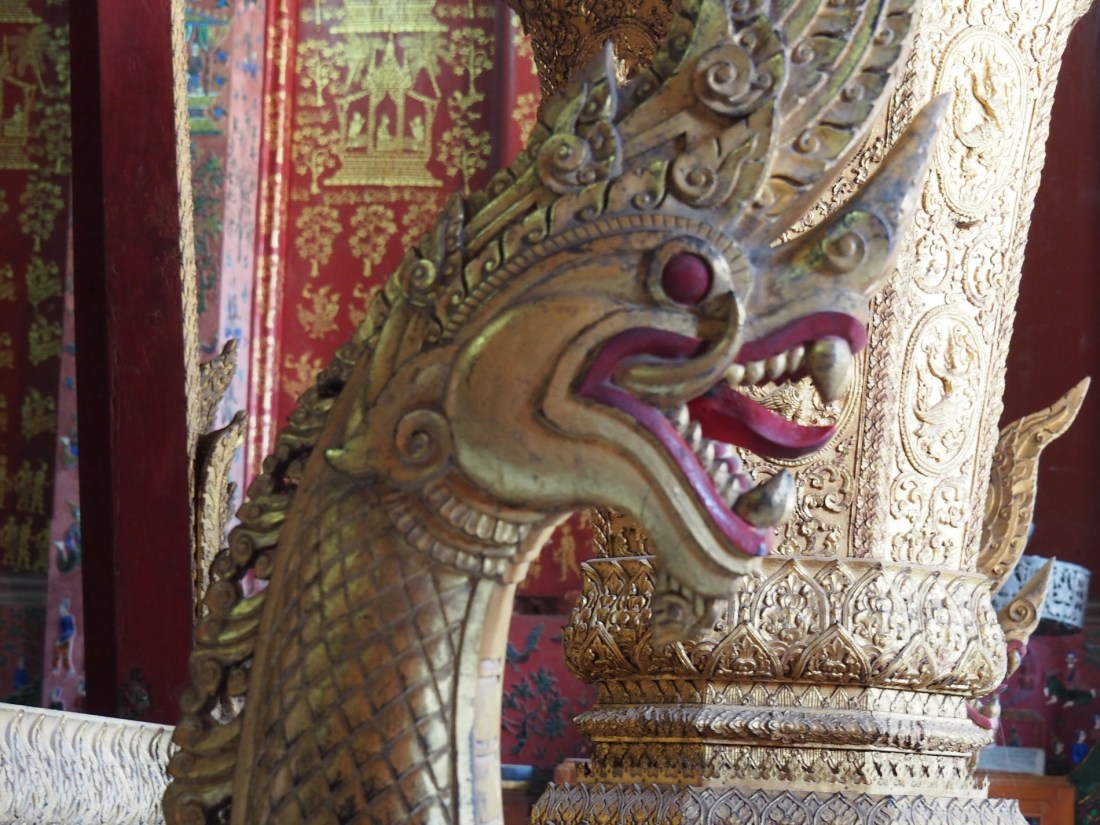
Next to the temple (the sim) is a funeral temple dedicated to the next to the last king. It includes a palanquin that holds the urns of the king and two queens. This is so large that it is impossible to photograph the whole thing. This is detail of the rear of it – showing the tail of the ‘naga’ which is a snake-dragon, and the queen’s urn, with that of the king partially visible to the left.

this is the head of the naga:

In the main temple (sim) is a special wood structure which allowed the king to ‘wash’ the Buddha with water which had been perfumed by gardenia petals. It is constructed like a trough, which carries the water from the sink into which the king poured it, down to be used for washing the figure. The water was collected after being used for this purpose, and then was considered holy water, used much as the Catholic Church uses holy water.,

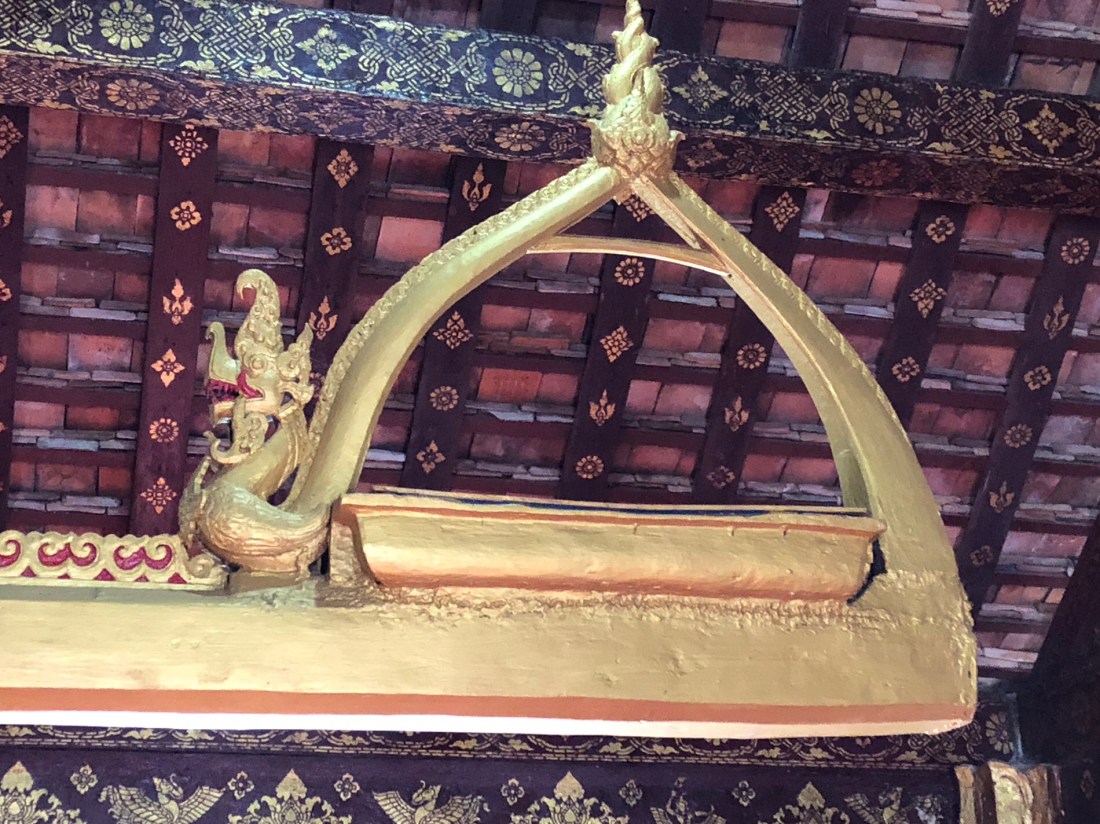
There are also two lavishly decorated items that look as though they might have been attached to the palanquin

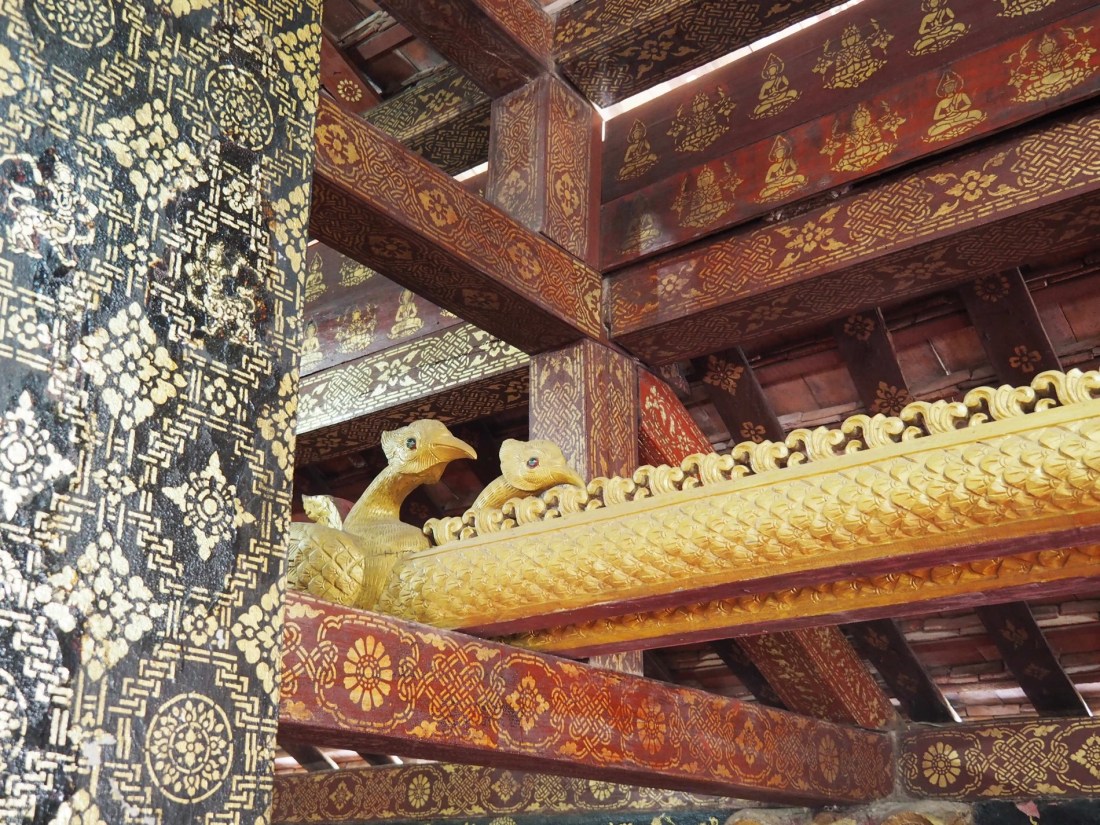
They seem to be decorated with the feathers and heads of the Phoenix, another holy animal.

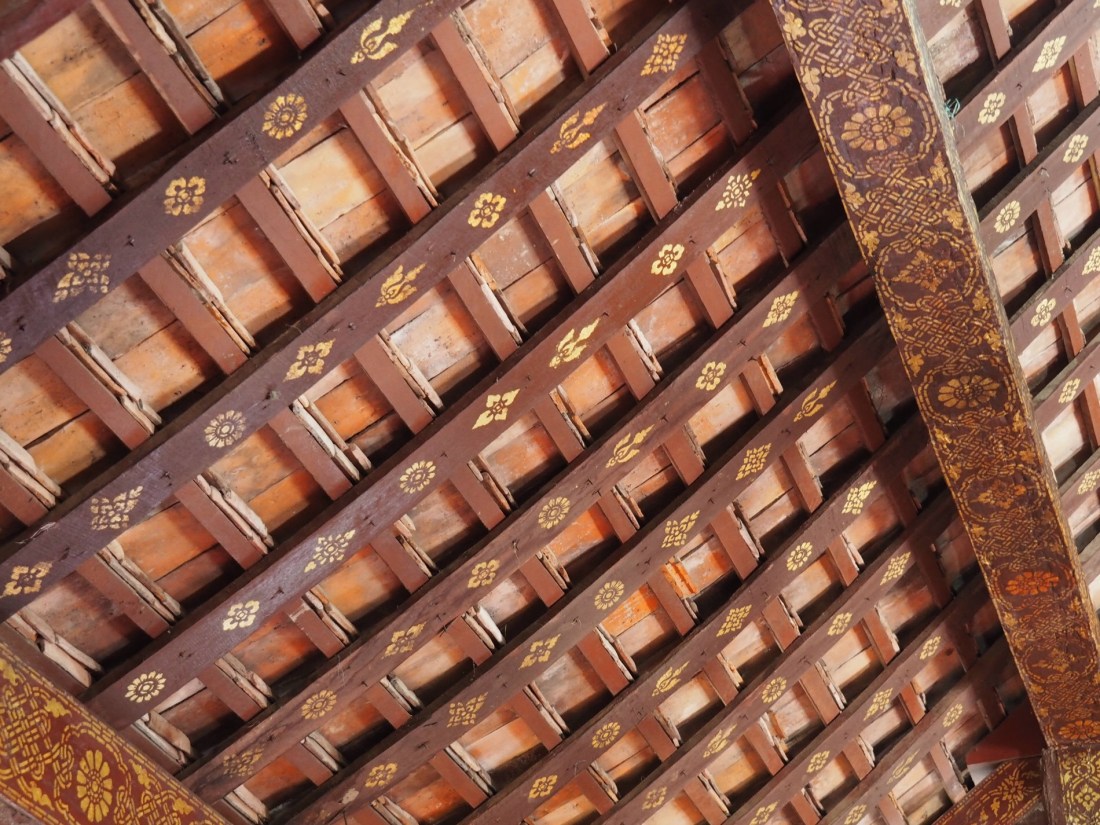
In the funerary temple every surface – even the rafters supporting the roof – is decorated.

And every wall (I think that these figures actually come from a Hindu saga)

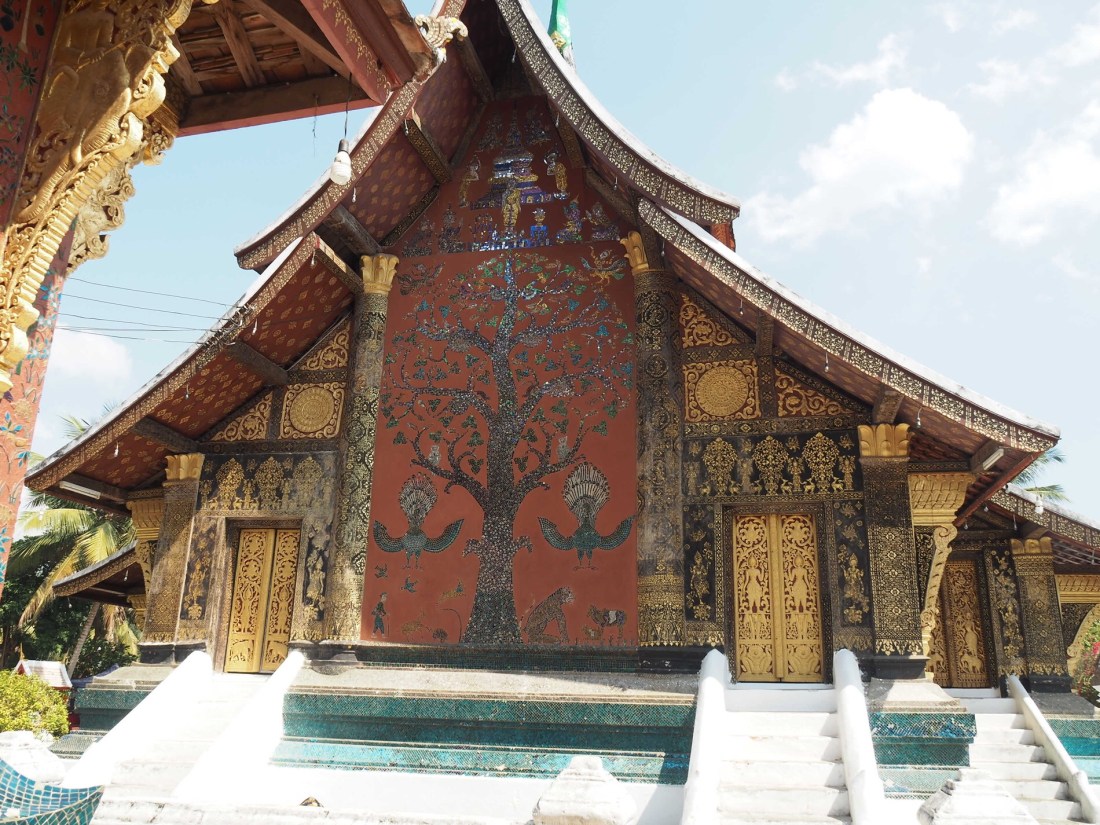
The exterior of the main temple (sim) does not lack for decoration, either.

This is a photo of the rear of the sim building, with not only painted and gilded decorations, but also mosaics made up of colored class imported from Japan, and created by local artists living in Luang Prabang at the time.

Here’s a detail of the mosaic – love the owl sitting in the tree of life, apparently keeping an eye out for the peacock below!

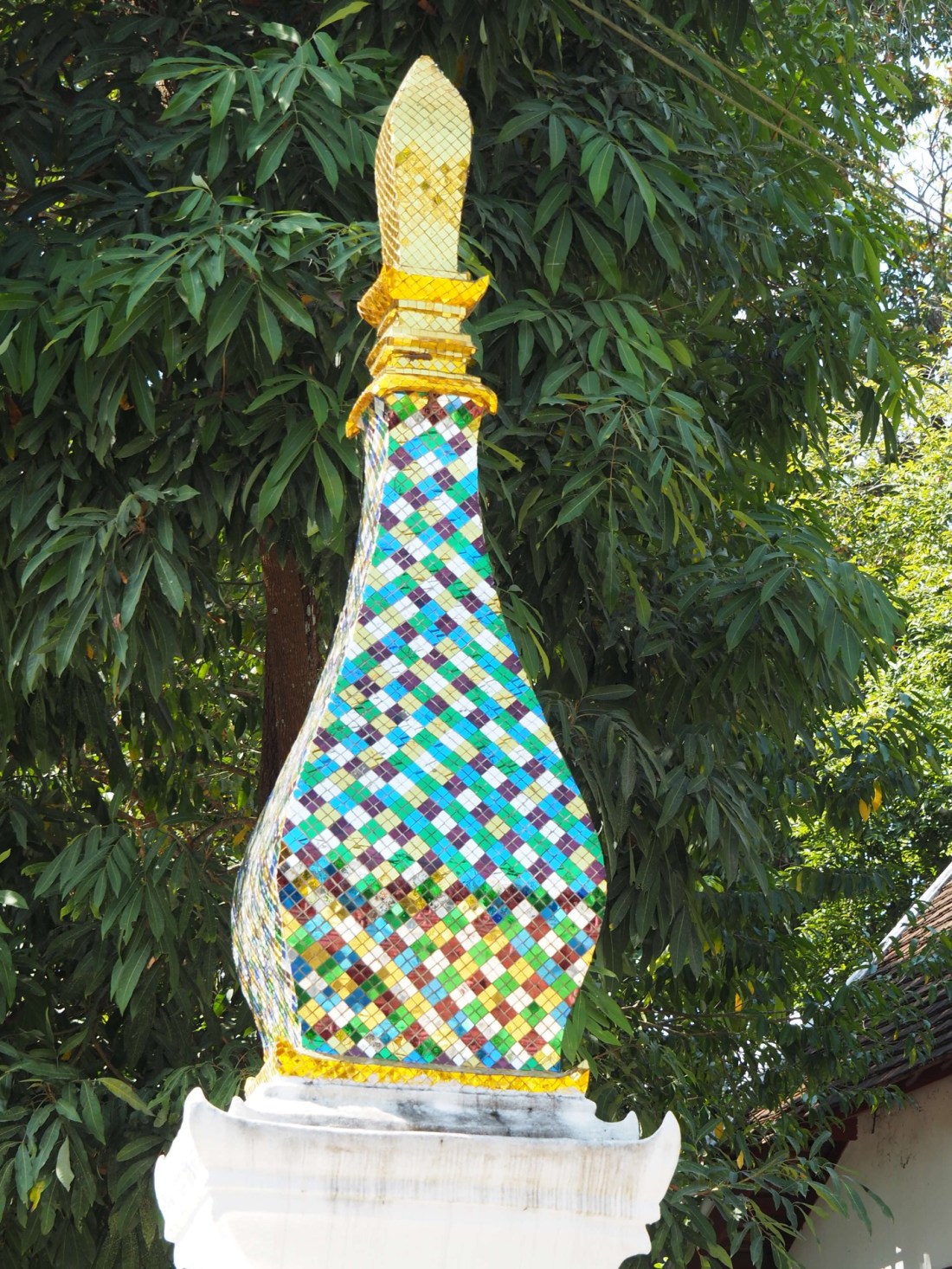
And last but not least, an item which I believe to be a stupa (meant to hold the ashes of a person or several family members). I suspect that it is probably contemporary.

Luang Prabang, Laos 2/1/18

Baci Ceremony, Luang Prabang, Laos

Last night we were honored at a traditional Baci ceremony given to us at a local home by people from a nearby village. We learned that, while people here are primarily Buddhist, they also believe in animism and that spirits inhabit both everything in the world and also our bodies. Interestingly enough, our bodies have 32 spirits. Because we have traveled so far, with a large part of that via airplane, it is thought that one of our spirits might have gotten lost. (Maybe that’s why I had such a bad cough for about 10 days. It started the day after we landed in Hanoi).

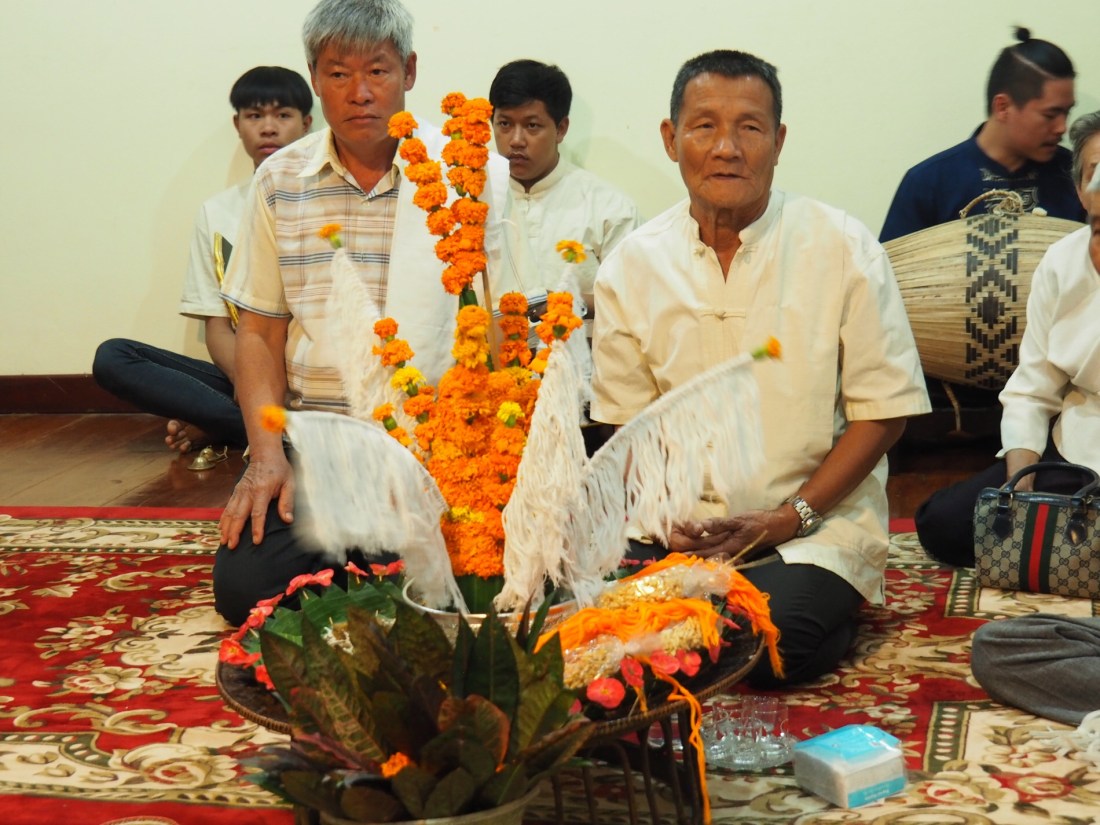
The Baci ceremony, then, strives to bind all of the spirits in our bodies back together. Uncle Ti, (on the right in the photo) who is a local shaman, lead the ceremony.

The centerpiece is made of orange marigolds. Orange is a holy color – the color of the sun and fire and the robes that the monks wear. Around the centerpiece were arranged sticks holding white strings, and around it was a mound of orange braided strings.

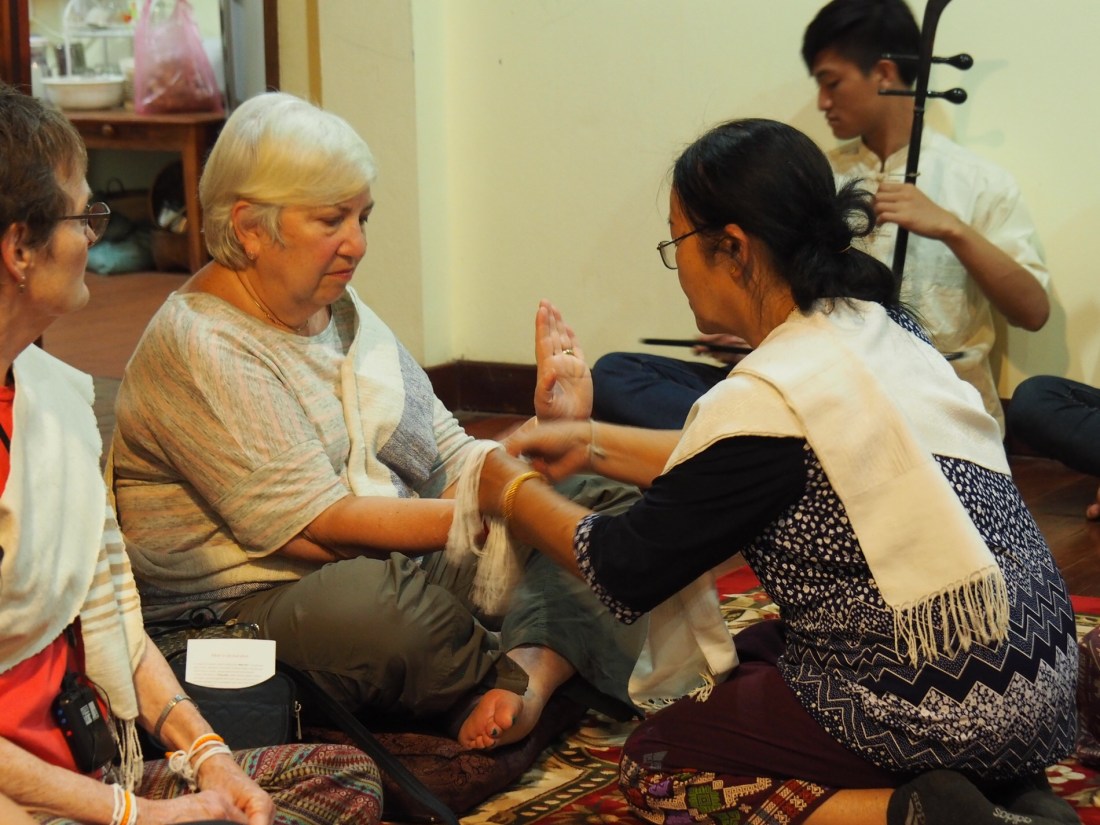
Each of us was wrapped with a scarf. I learned that this denotes respect, and is worn not only for ceremonies like this, but also for giving alms to the monks (subject of another post).

After a blessing chant, the shaman came to each of us in turn, kneeling before us, putting an orange string around our wrist. We were instructed to hold that hand flat and facing upward, while holding the other hand facing upward, perpendicular to the floor. This facilitates receiving the blessing from above.

Then, all of the other people took turns to come, kneel before us, and tie white strings around our wrists. I counted 13 white strings and 2 orange – not quite 32, but nonetheless, I suspect, an auspicious number (auspicious numbers, I learned are always odd numbers, never even numbers).

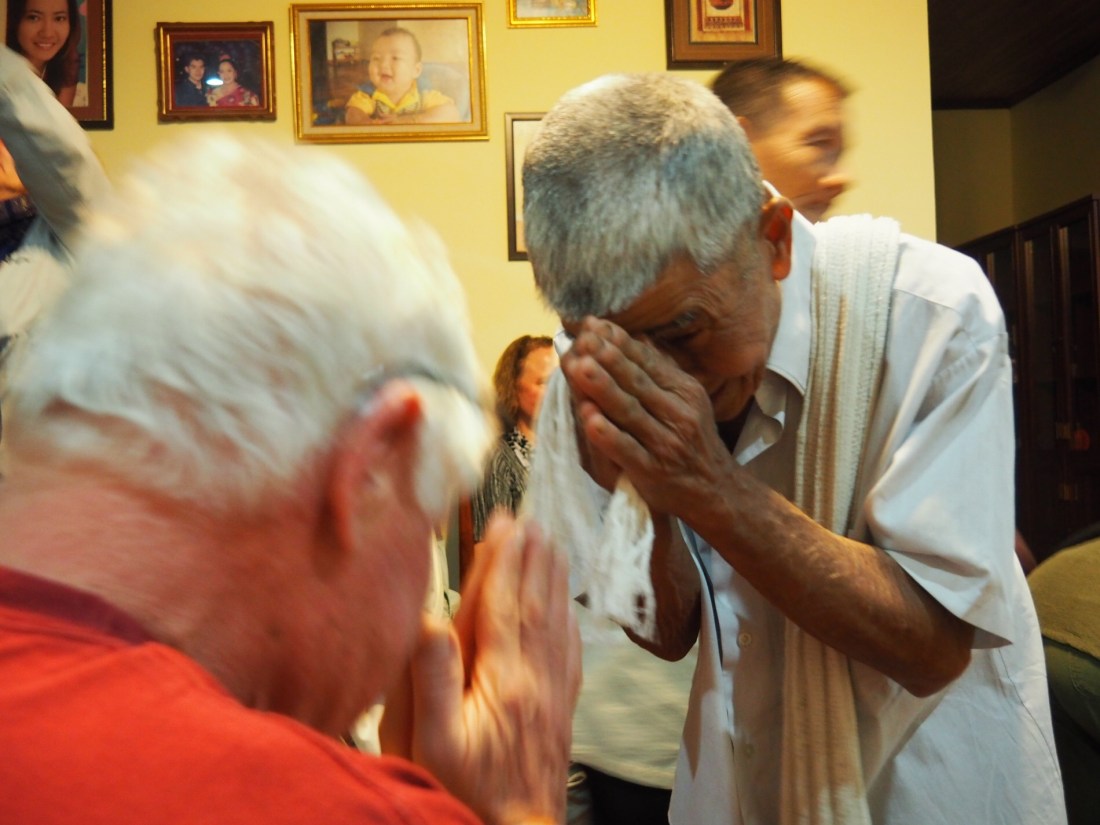
We bowed to show our respect and appreciation for the blessings.

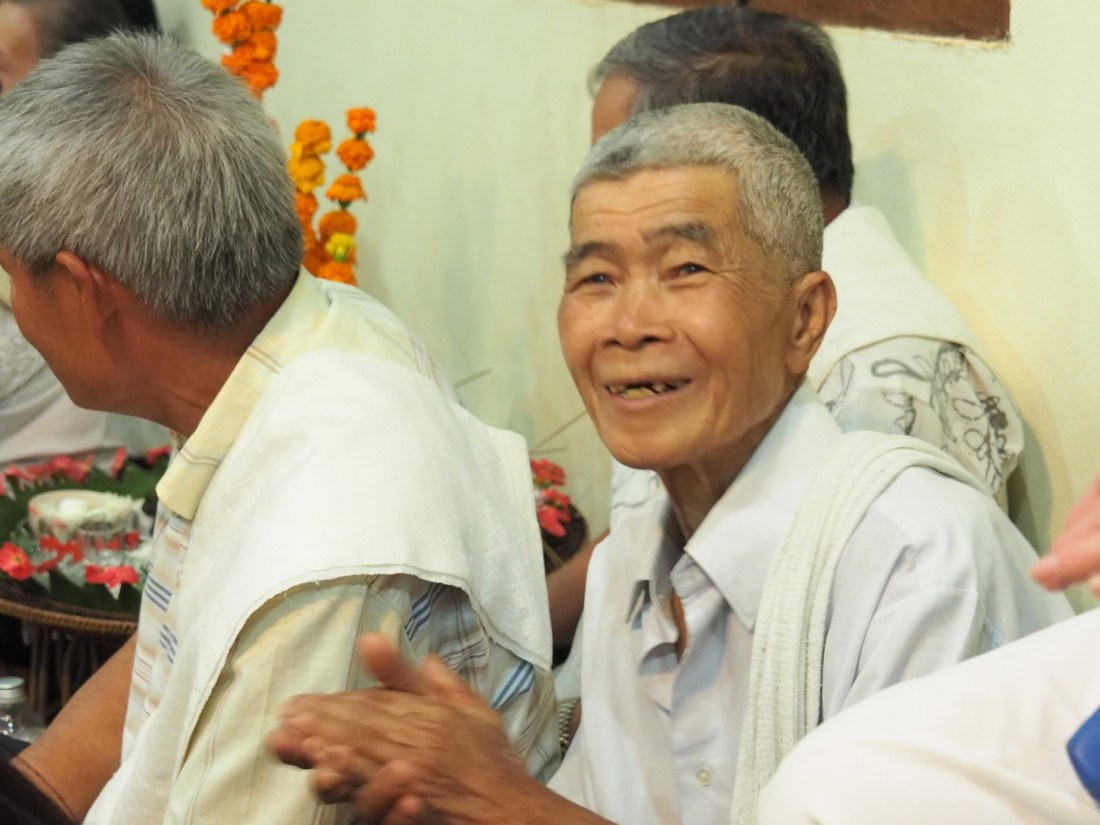
Then there was traditional music and dancing. One of the elderly gentlemen seemed particularly to be enjoying the festivities, and smiled and twinkled at us while urging us to clap along (and then dance) with the music!

We were told to leave the strings on for at least 3 days, and that, when we remove them, they must be untied, not cut. Otherwise the spirits might find a way to depart along with the strings!

Luang Prabang, Laos 2/1/18